

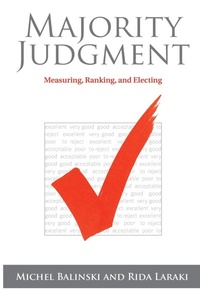
Majority Judgment
Measuring, Ranking, and Electing
Published on 7. June 2022
Book
Paperback/Softback
432 pages
978-0-262-54571-6 (ISBN)
Description
An account of a new theory and method of voting, judging and ranking, majority judgment, shown to be superior to all other known methods.
In Majority Judgment, Michel Balinski and Rida Laraki argue that the traditional theory of social choice offers no acceptable solution to the problems of how to elect, to judge, or to rank. They find that the traditional model—transforming the "preference lists" of individuals into a "preference list" of society—is fundamentally flawed in both theory and practice. Balinski and Laraki propose a more realistic model. It leads to an entirely new theory and method—majority judgment—proven superior to all known methods. It is at once meaningful, resists strategic manipulation, elicits honesty, and is not subject to the classical paradoxes encountered in practice, notably Condorcet's and Arrow's. They offer theoretical, practical, and experimental evidence—from national elections to figure skating competitions—to support their arguments. Drawing on insights from wine, sports, music, and other competitions, Balinski and Laraki argue that the question should not be how to transform many individual rankings into a single collective ranking, but rather, after defining a common language of grades to measure merit, how to transform the many individual evaluations of each competitor into a single collective evaluation of all competitors. The crux of the matter is a new model in which the traditional paradigm—to compare—is replaced by a new paradigm—to evaluate.
In Majority Judgment, Michel Balinski and Rida Laraki argue that the traditional theory of social choice offers no acceptable solution to the problems of how to elect, to judge, or to rank. They find that the traditional model—transforming the "preference lists" of individuals into a "preference list" of society—is fundamentally flawed in both theory and practice. Balinski and Laraki propose a more realistic model. It leads to an entirely new theory and method—majority judgment—proven superior to all known methods. It is at once meaningful, resists strategic manipulation, elicits honesty, and is not subject to the classical paradoxes encountered in practice, notably Condorcet's and Arrow's. They offer theoretical, practical, and experimental evidence—from national elections to figure skating competitions—to support their arguments. Drawing on insights from wine, sports, music, and other competitions, Balinski and Laraki argue that the question should not be how to transform many individual rankings into a single collective ranking, but rather, after defining a common language of grades to measure merit, how to transform the many individual evaluations of each competitor into a single collective evaluation of all competitors. The crux of the matter is a new model in which the traditional paradigm—to compare—is replaced by a new paradigm—to evaluate.
More details
Language
English
Place of publication
Cambridge (Massachusetts)
United States
Publishing group
MIT Press Ltd
Target group
Professional and scholarly
US School Grade: College Graduate Student and over
Product notice
Paperback (trade)
Illustrations
2 FIGURES, 134 TABLES
Dimensions
Height: 229 mm
Width: 152 mm
Thickness: 23 mm
Weight
622 gr
ISBN-13
978-0-262-54571-6 (9780262545716)
Copyright in bibliographic data and cover images is held by Nielsen Book Services Limited or by the publishers or by their respective licensors: all rights reserved.
Schweitzer Classification
Persons
Michel Balinski was Directeur de Recherche de classe exceptionnelle (Emeritus), C.N.R.S. and the Laboratoire d'Econométrie, Département d'Économie, École Polytechnique, Palaiseau, France. Rida Laraki is Chargé de Recherche de première classe, C.N.R.S., Laboratoire d'Econométrie, Professeur, Département d'Économie, École Polytechnique, Palaiseau, France, and Chercheur Associé, Équipe Combinatoire et Optimisation, Université Pierre et Marie Curie, Paris, France.