

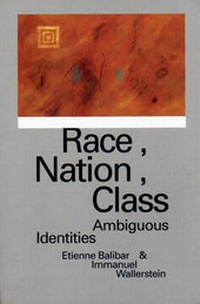
Race, Nation, Class
Ambiguous Identities
Published on 17. December 1991
Book
Paperback/Softback
242 pages
978-0-86091-542-3 (ISBN)
Description
Forty years after the defeat of Nazism, and twenty years after the great wave of decolonization, how is it that racism remains a growing phenomenon? What are the special characteristics of contemporary racism? How can it be related to class divisions and to the contradictions of the nation-state? And how far, in turn, does racism today compel us to rethink the relationship between class struggles and nationalism?
This book attempts to answer these fundamental questions through a remarkable dialogue between the French philosopher Etienne Balibar and the American historian and sociologist Immanuel Wallerstein. Each brings to the debate the fruits of over two decades of analytical work, greatly inspired, respectively, by Louis Althusser and Fernand Braudel.
Both authors challenge the commonly held notion of racism as a continuation of, or throwback to, the xenophobias of past societies and communities. They analyse it instead as a social relation indissolubly tied to present social structures-the nation-state, the division of labour, and the division between core and periphery-which are themselves constantly being reconstructed. Despite their productive disagreements, Balibar and Wallerstein both emphasize the modernity of racism and the need to understand its relation to contemporary capitalism and class struggle. Above all, their dialogue reveals the forms of present and future social conflict, in a world where the crisis of the nation-state is accompanied by an alarming rise of nationalism and chauvinism.
This book attempts to answer these fundamental questions through a remarkable dialogue between the French philosopher Etienne Balibar and the American historian and sociologist Immanuel Wallerstein. Each brings to the debate the fruits of over two decades of analytical work, greatly inspired, respectively, by Louis Althusser and Fernand Braudel.
Both authors challenge the commonly held notion of racism as a continuation of, or throwback to, the xenophobias of past societies and communities. They analyse it instead as a social relation indissolubly tied to present social structures-the nation-state, the division of labour, and the division between core and periphery-which are themselves constantly being reconstructed. Despite their productive disagreements, Balibar and Wallerstein both emphasize the modernity of racism and the need to understand its relation to contemporary capitalism and class struggle. Above all, their dialogue reveals the forms of present and future social conflict, in a world where the crisis of the nation-state is accompanied by an alarming rise of nationalism and chauvinism.
More details
Language
English
Place of publication
London
United Kingdom
Target group
College/higher education
Professional and scholarly
Dimensions
Height: 198 mm
Width: 130 mm
Thickness: 20 mm
Weight
256 gr
ISBN-13
978-0-86091-542-3 (9780860915423)
Copyright in bibliographic data and cover images is held by Nielsen Book Services Limited or by the publishers or by their respective licensors: all rights reserved.
Schweitzer Classification
Other editions
New editions
Book
01/2011
2nd Edition
Verso Books
€15.50
Shipment within 3-4 weeks
Persons
Etienne Balibar is the most celebrated student of Louis Althusser. A leading exponent of French radical philosophy, Balibar is the author of Spinoza and Politics and co-author of Race, Nation and Class and Reading Capital.