

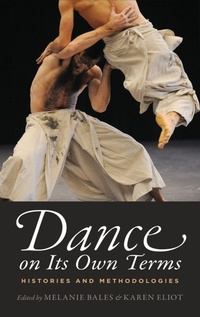
Dance on Its Own Terms
Histories and Methodologies
Published on 13. June 2013
Book
Hardback
456 pages
978-0-19-993998-5 (ISBN)
Description
Dance on its Own Terms: Histories and Methodologies anthologizes a wide range of subjects examined from dance-centered methodologies: modes of research that are emergent, based in relevant systems of movement analysis, use primary sources, and rely on critical, informed observation of movement. The anthology fills a gap in current scholarship by emphasizing dance history and core disciplinary knowledge rather than theories imported from disciplines outside dance. Individual chapters serve as case studies that are further organized into three categories of significant dance activity: performance and reconstruction, pedagogy and choreographic process, and notational and other written forms that analyze and document dance. The breadth of the content reflects the richness and vibrancy of the dance field; each deeply informed examination serves as a window opening onto the larger world of dance. Conceptually, each chapter also raises concerns and questions that point to broadly inclusive methodological applications. Engaging and insightful, Dance on its Own Terms represents a major contribution to research on dance.
Reviews / Votes
Here is an unquestionably lively book of dance essays, made more stimulating by the variety of new voices on the subject. Especially welcome is the central place given to dance itself, bravely situated here within a framework of current theory. * Stephanie Jordan, Research Professor in Dance, University of Roehampton * Putting dance at the heart of dance studies is the object and refreshing contribution of this anthology covering a wide and rich terrain-from dance history to dance writing, music to dance-and-identity, and notation to pedagogy. * Lynn Matluck Brooks, Professor of Dance, Franklin & Marshall College, co-editor of Dance Chronicle: Studies in Dance and the Related Arts * A cause for celebration: Eliot and Bales point the way forward in dance scholarship arguing that theoretical inquiry should grow from a nuanced and rigorous understanding of dance itself and its context, rather than being applied willy-nilly from outside disciplines, whether or not they fit. Clarity of expression is key. * Beth Genne, Professor of Dance and Art History, University of Michigan, Ann Arbor * An invaluable guide to the study of dance today, researchers and students alike will appreciate this volume's focus on the dance itself, though the collection never loses sight of the myriad contexts in which we perform, view, and study dance in the digital age. * Tim Scholl, author, Sleeping Beauty, a Legend in Progress *More details
Language
English
Place of publication
New York
United States
Target group
College/higher education
Professional and scholarly
Illustrations
35 line drawings, 42 halftones
Dimensions
Height: 240 mm
Width: 161 mm
Thickness: 29 mm
Weight
845 gr
ISBN-13
978-0-19-993998-5 (9780199939985)
Copyright in bibliographic data and cover images is held by Nielsen Book Services Limited or by the publishers or by their respective licensors: all rights reserved.
Schweitzer Classification
Other editions
Additional editions
Book
06/2013
Oxford University Press Inc
€75.40
Shipment within 15-20 days
E-Book
05/2013
1st Edition
OUP eBook
€29.49
Available for download
Persons
Melanie Bales is Professor of Dance at The Ohio State University and author of The Body Eclectic: Evolving Practices in Dance Training (Illinois, 2007). Karen Eliot is also Professor of Dance at The Ohio State University and author of Dancing Lives: Five Female Dancers from the Ballet d'Action to Merce Cunningham (Illinois, 2007)
Content
INTRODUCTION ; SECTION ONE: In the moment of re-creation and performance ; Section One Introduction ; Chapter 1: "Dancing the Canon in Wartime: Sergeyev, de Valois, and Inglesby and the Classics of British Ballet," Karen Eliot ; Chapter 2: "Reimagining Le Boeuf sur le Toit," Ann Dils ; Chapter 3: "Reframing the Recent Past: Issues of Reconstruction in Israeli Contemporary Dance," Deborah Friedes Galili ; Chapter 4: "The Body Censored: Dance, Morality and the Production Code during the Golden Age of the Film Musical," Betsy Cooper ; Chapter 5: "'Single Ladies' is Gay: Queer Performances and Mediated Masculinities on YouTube," Harmony Bench ; SECTION TWO: Within the body and mind of the dancer and choreographer ; Section Two Introduction ; Chapter 6: "La Cosmografia del minor mondo: Recovering Dance Theory to Create Today's Baroque Practice," Catherine Turocy ; Chapter 7: "Touchstones of Tradition and Innovation: Pas de Deux by Petipa, Balanchine and Forsythe," Melanie Bales ; Chapter 8: "Pavlova and her Daughters: Genealogies of Contingent Autonomy," Carrie Gaiser Casey ; Chapter 9: "Joined-up Fragments in A Wedding Bouquet: Ashton, Berners and Stein," Geraldine Morris ; Chapter 10: "Kaddish at the Wall: The Long Life of Anna Sokolow's 'Prayer for the Dead,'" Hannah Kosstrin ; Chapter 11: "Developing the American Ballet Dancer: The Pedagogical Lineage of Rochelle Zide-Booth," Jessica Zeller ; SECTION THREE: In the shape of written records ; Section Three Introduction ; Chapter 12: "Recording the Imperial Ballet: Anatomy and Ballet in Stepanov's Notation," Sheila Marion ; Chapter 13: "Musical Expression in the Bournonville-Lovenskjold La Sylphide Variation," Rebecca Schwartz-Bishir ; Chapter 14: "Archives of Embodiment: Visual Culture and the Practice of Score Reading," Victoria Watts ; Chapter 15: "Reading Music, Gesture, and Dualism in Mark Morris' Dido and Aeneas," Rachael Riggs-Leyva ; Chapter 16: "What's in a Dance? The Complexity of Information in Writings about Dance," Candace Feck ; CONTRIBUTOR BIOGRAPHIES ; INDEX