

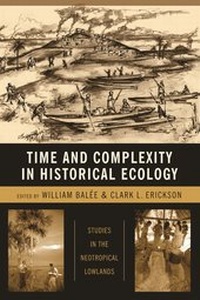
Time and Complexity in Historical Ecology
Studies in the Neotropical Lowlands
Will be published approx. on 22. June 2006
Book
Hardback
432 pages
978-0-231-13562-7 (ISBN)
Description
This collection of studies by anthropologists, botanists, ecologists, and biologists is an important contribution to the emerging field of historical ecology. The book combines cutting-edge research with new perspectives to emphasize the close relationship between humans and their natural environment. Contributors examine how alterations in the natural world mirror human cultures, societies, and languages. Treating the landscape like a text, these researchers decipher patterns and meaning in the Ecuadorian Andes, Amazonia, the desert coast of Peru, and other regions in the neotropics. They show how local peoples have changed the landscape over time to fit their needs by managing and modifying species diversity, enhancing landscape heterogeneity, and controlling ecological disturbance. In turn, the environment itself becomes a form of architecture rich with historical and archaeological significance. Time and Complexity in Historical Ecology explores thousands of years of ecological history while also addressing important contemporary issues, such as biodiversity and genetic variation and change.
Engagingly written and expertly researched, this book introduces and exemplifies a unique method for better understanding the link between humans and the biosphere.
Engagingly written and expertly researched, this book introduces and exemplifies a unique method for better understanding the link between humans and the biosphere.
Reviews / Votes
A welcome addition. -- Emilio F. Moran Quarterly Review of Biology This book succeeds admirably in advancing the theoretical status and ethnographic scope of the historical ecological research position. -- Stanford Zent Journal of Anthropological Research A well-crafted and well-rounded selection of case studies and will unquestionably make a splendid addition to the shelves. -- Carlos E. A. Coimbra Jr. Human Ecology The disciplinary diversity among the chapters yields a well-rounded perspective on the topic. Landscape EcologyMore details
Series
Language
English
Place of publication
New York
United States
Target group
Professional and scholarly
Product notice
Trade binding
Illustrations
27 illus.
Dimensions
Height: 229 mm
Width: 152 mm
Weight
709 gr
ISBN-13
978-0-231-13562-7 (9780231135627)
Copyright in bibliographic data and cover images is held by Nielsen Book Services Limited or by the publishers or by their respective licensors: all rights reserved.
Schweitzer Classification
Other editions
Additional editions
William Balée | Clark Erickson
Time and Complexity in Historical Ecology
Studies in the Neotropical Lowlands
E-Book
09/2015
1st Edition
De Gruyter
from
€86.95
Available for download
Persons
William L. Balee is professor of anthropology at Tulane University. He is the author of Footprints of the Forest: Ka'apor Ethnobotany-The Historical Ecology of Plant Utilization by an Amazonian People and the editor of Advances in Historical Ecology. Clark L. Erickson is associate professor of anthropology at the University of Pennsylvania and associate curator of the American Section at the University of Pennsylvania Museum of Archaeology and Anthropology. William L. Balee, is Professor of Anthropology at Tulane University. He is the editor of Advances in Historical Ecology (1998) and the author of Footprints of the Forest: Ka'apor Ethnobotany - The Historical Ecology of Plant Utilization by an Amazonian People (1994). Clark L. Erickson is an Associate Professor of Anthropology and Associate Curator of the University Museum at the University of Pennsylvania. He is writing a book for Cambridge University Press titled Waru, Waru: Ancient Andean Agriculture.
Content
Preface Contributors Time, Complexity, and Historical Ecology, by William Balee and Clark L. Erickson Part 1 1. The Feral Forests of the Eastern Peten, by David G. Campbell, Anabel Ford, Karen S. Lowell, Jay Walker, Jeffrey K. Lake, Constanza Ocampo-Raeder, Andrew Townesmith, and Michael Balick 2. A Neotropical Framework for Terra Preta, by Elizabeth Graham 3. Domesticated Food and Society in Early Coastal Peru, by Christine A. Hastorf 4. Microvertebrate Synecology and Anthropogenic Footprints in the Forested Neotropics, by Peter W. Stahl Part 2 5. Pre-European Forest Cultivation in Amazonia, by William M. Denevan 6. Fruit Trees and the Transition to Food Production in Amazonia, by Charles R. Clement 7. The Historical Ecology of a Complex Landscape in Bolivia, Clark L. Erickson and William Balee 8. The Domesticated Landscapes of the Bolivian Amazon, by Clark L. Erickson 9. Political Economy and Pre-Columbian Landscape Transformations in Central Amazonia, by Eduardo G. Neves and James B. Petersen 10. History, Ecology, and Alterity: Visualizing Polity in Ancient Amazonia, by Michael Heckenberger 11. Between the Ship and the Bulldozer: Historical Ecology of Guaja Subsistence, Sociality, and Symbolism After 1500, by Loretta A. Cormier 12. Landscapes of the Past, Footprints of the Future: Historical Ecology and the Study of Contemporary Land-Use Change in the Amazon, by Eduardo S. Brondizio Index