

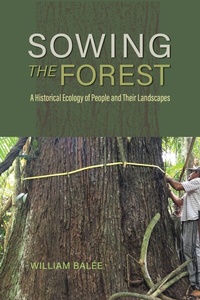
Sowing the Forest
A Historical Ecology of People and Their Landscapes
Published on 23. May 2023
Book
Hardback
246 pages
978-0-8173-2157-4 (ISBN)
Description
Explores how, over centuries, Amazonian people and their cultures have interacted with rainforests
William BalEe is a world-renowned expert on the cultural and historical ecology of the Amazon basin. His new collection, Sowing the Forest, is a companion volume to the award-winning Cultural Forests of the Amazon, published in 2013. Sowing the Forest engages in depth with how, over centuries, Amazonian people and their cultures have interacted with rainforests, making the landscapes of palm forests and other kinds of forests, and how these and related forests have fed back into the vocabulary and behavior of current indigenous occupants of the remotest parts of the vast hinterlands.
The book is divided into two parts. Part 1, "Substrate of Intentionality," comprises chapters on historical ecology, indigenous palm forests, plant names in Amazonia, the origins of the Amazonian plantain, and the unknown "Dark Earth people" of thousands of years ago and their landscaping. Together these chapters illustrate the phenomenon of feedback between culture and environment.
In part 2, "Scope of Transformation," BalEe lays out his theory of landscape transformation, which he divides into two rubrics-primary landscape transformation and secondary landscape transformation-and for which he provides examples and various specific effects. One chapter compares environmental and social interrelationships in an Orang Asli group in Malaysia and the Ka'apor people of eastern Amazonian Brazil, and another chapter covers loss of language and culture in the Bolivian Amazon. A final chapter addresses the controversial topic of monumentality in the rainforest. BalEe concludes by emphasizing the common thread in Amazonian historical ecology: the long-term phenomenon of encouraging diversity for its own sake, not just for economic reasons.
William BalEe is a world-renowned expert on the cultural and historical ecology of the Amazon basin. His new collection, Sowing the Forest, is a companion volume to the award-winning Cultural Forests of the Amazon, published in 2013. Sowing the Forest engages in depth with how, over centuries, Amazonian people and their cultures have interacted with rainforests, making the landscapes of palm forests and other kinds of forests, and how these and related forests have fed back into the vocabulary and behavior of current indigenous occupants of the remotest parts of the vast hinterlands.
The book is divided into two parts. Part 1, "Substrate of Intentionality," comprises chapters on historical ecology, indigenous palm forests, plant names in Amazonia, the origins of the Amazonian plantain, and the unknown "Dark Earth people" of thousands of years ago and their landscaping. Together these chapters illustrate the phenomenon of feedback between culture and environment.
In part 2, "Scope of Transformation," BalEe lays out his theory of landscape transformation, which he divides into two rubrics-primary landscape transformation and secondary landscape transformation-and for which he provides examples and various specific effects. One chapter compares environmental and social interrelationships in an Orang Asli group in Malaysia and the Ka'apor people of eastern Amazonian Brazil, and another chapter covers loss of language and culture in the Bolivian Amazon. A final chapter addresses the controversial topic of monumentality in the rainforest. BalEe concludes by emphasizing the common thread in Amazonian historical ecology: the long-term phenomenon of encouraging diversity for its own sake, not just for economic reasons.
Reviews / Votes
"Sowing the Forest is impressive in its interdisciplinarity, bringing together extensive original work involving ethnography, botany, and linguistics, as well as engaging with other disciplines. It makes interesting and important contributions on multiple levels. Few other monographs of this nature are as wide-ranging."-Patience Epps, coeditor of Upper Rio Negro: Cultural and Linguistic Interaction in Northwestern AmazoniaMore details
Language
English
Place of publication
Alabama
United States
Target group
Professional and scholarly
Product notice
Cloth over boards
Illustrations
19 b&w figures, 2 maps, 24 tables
Dimensions
Height: 231 mm
Width: 156 mm
Thickness: 26 mm
Weight
514 gr
ISBN-13
978-0-8173-2157-4 (9780817321574)
Copyright in bibliographic data and cover images is held by Nielsen Book Services Limited or by the publishers or by their respective licensors: all rights reserved.
Schweitzer Classification
Other editions
Additional editions
E-Book
05/2023
1st Edition
University of Alabama Press
€127.99
Available for download
Person
William Balée is professor of anthropology at Tulane University and author of the textbook Inside Cultures: An Introduction to Cultural Anthropology, 3rd edition, as well as Cultural Forests of the Amazon: A Historical Ecology of People and Their Landscapes and Footprints of the Forest: Ka'apor Ethnobotany--the Historical Ecology of Plant Utilization by an Amazonian People.