

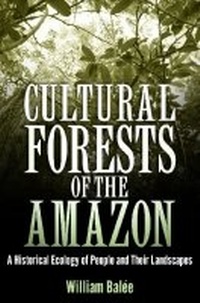
Cultural Forests of the Amazon
A Historical Ecology of People and Their Landscapes
Published on 20. August 2013
Book
Hardback
288 pages
978-0-8173-1786-7 (ISBN)
Description
Cultural Forests of the Amazon is a comprehensive and diverse account of how indigenous people transformed landscapes and managed resources in the most extensive region of tropical forests in the world.
Until recently, most scholars and scientists, as well as the general public, thought indigenous people had a minimum impact on Amazon forests, once considered to be total wildernesses. William Balee's research, conducted over a span of three decades, shows a more complicated truth. In Cultural Forests of the Amazon, he argues that indigenous people, past and present, have time and time again profoundly transformed nature into culture. Moreover, they have done so using their traditional knowledge and technology developed over thousands of years. Balee demonstrates the inestimable value of indigenous knowledge in providing guideposts for a potentially less destructive future of environments and biota in the Amazon. He shows that we can no longer think about species and landscape diversity in any tropical forest without taking into account the intricacies of human history and the impact of all forms of knowledge and technology.
Balee describes the development of his historical ecology approach in Amazonia, along with important material on little-known forest dwellers and their habitats, current thinking in Amazonian historical ecology, and a narrative of his own dialogue with the Amazon and its people.
Until recently, most scholars and scientists, as well as the general public, thought indigenous people had a minimum impact on Amazon forests, once considered to be total wildernesses. William Balee's research, conducted over a span of three decades, shows a more complicated truth. In Cultural Forests of the Amazon, he argues that indigenous people, past and present, have time and time again profoundly transformed nature into culture. Moreover, they have done so using their traditional knowledge and technology developed over thousands of years. Balee demonstrates the inestimable value of indigenous knowledge in providing guideposts for a potentially less destructive future of environments and biota in the Amazon. He shows that we can no longer think about species and landscape diversity in any tropical forest without taking into account the intricacies of human history and the impact of all forms of knowledge and technology.
Balee describes the development of his historical ecology approach in Amazonia, along with important material on little-known forest dwellers and their habitats, current thinking in Amazonian historical ecology, and a narrative of his own dialogue with the Amazon and its people.
More details
Language
English
Place of publication
Alabama
United States
Target group
Professional and scholarly
Illustrations
13 black & white illustrations, 1 map, 21 tables
Weight
608 gr
ISBN-13
978-0-8173-1786-7 (9780817317867)
Copyright in bibliographic data and cover images is held by Nielsen Book Services Limited or by the publishers or by their respective licensors: all rights reserved.
Schweitzer Classification
Other editions
Additional editions
E-Book
08/2013
1st Edition
University of Alabama Press
€89.99
Available for download
Person
William Balee, a world-renowned expert on the cultural and historical ecology of the Amazon basin, is the author of Footprints of the Forest: Ka'apor Ethnobotany--The Historical Ecology of Plant Utilization by an Amazonian People. He is a professor in the Department of Anthropology at Tulane University, USA.