

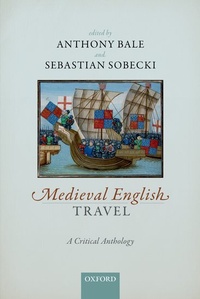
Medieval English Travel
A Critical Anthology
Published on 1. September 2021
Book
Paperback/Softback
528 pages
978-0-19-284860-4 (ISBN)
Description
Medieval English Travel: A Critical Anthology is a comprehensive volume that consists of three sections: concise introductory essays written by leading specialists; an anthology of important and less well-known texts, grouped by destination; and a selection of supporting bibliographies organized by type of voyage. This anthology presents some texts for the first time in a modern edition. The first section consists of six companion essays on 'Places, Real and Imagined', 'Maps and the Organization of Space', 'Encounters', 'Codes and Languages', 'Trade and Exchange', and 'Politics and Diplomacy'.
The organizing principle for the anthology is one of expansive geography. Starting with local English narratives, the section moves to France, en-route destinations, the Holy Land, and the Far East. In total, the anthology contains twenty-six texts or extracts, including new editions of Floris & Blancheflour, The Stacions of Rome, The Libelle of Englyshe Polycye, and Chaucers 'Squire's Tale', in addition to less familiar texts, such as Osbern Bokenham's Mappula Angliae, John Kay's Siege of Rhodes, 1480, and Richard Torkington's Diaries of Englysshe Travell.
The supporting bibliographies, in turn, take a functional approach to travel, and support the texts by elucidating contexts for travel and travellers in five areas: 'commercial voyages', 'diplomatic and military travel', 'maps, rutters, and charts', 'practical needs, languages, and currencies', and 'religious voyages'.
The organizing principle for the anthology is one of expansive geography. Starting with local English narratives, the section moves to France, en-route destinations, the Holy Land, and the Far East. In total, the anthology contains twenty-six texts or extracts, including new editions of Floris & Blancheflour, The Stacions of Rome, The Libelle of Englyshe Polycye, and Chaucers 'Squire's Tale', in addition to less familiar texts, such as Osbern Bokenham's Mappula Angliae, John Kay's Siege of Rhodes, 1480, and Richard Torkington's Diaries of Englysshe Travell.
The supporting bibliographies, in turn, take a functional approach to travel, and support the texts by elucidating contexts for travel and travellers in five areas: 'commercial voyages', 'diplomatic and military travel', 'maps, rutters, and charts', 'practical needs, languages, and currencies', and 'religious voyages'.
Reviews / Votes
Anthony Bale and Sebastian Sobecki's Medieval English Travel is a wonderful anthology, in the full meaning of that word. * Mary Baine Campbell, Brandeis University, Journal of British Studies 61 * Antony Bale and Sebastian Sobecki's edited volume Medieval English Travel: A Critical Anthology is an invaluable resource for those studying and teaching Middle English travel writing. * Kate Ash-Irisarri et al., The Year's Work in English Studies * The volume is well crafted, its texts carefully edited and readily accessible for undergraduates. An incredible resource for teachers . . . [It] will be a foundational starting-point for those interested in the field. * Kara L. McShane, Studies in the Age of Chaucer, Volume 42, 2020 * the volume will surely shape the scholarship of medieval travel, especially insofar as it invites consideration of understudied texts and documents. As a whole, this timely collection offers a treasure trove of primary sources that will help us better understand what medieval English people knew about the rest of the world, what they thought about it, and how they gained this knowledge or belief. * Shannon Gayk, Journal of Medieval Religious Cultures * This is a welcome anthology as the field turns to a deeper understanding of and interest in the global Middle Ages. Medieval English Travel provides a thoughtful guide for studying the literature of travel in medieval England. Moreover, it entices readers to explore the topic further and gives them the tools to do so. I recommend this book for those teaching a class on medieval travel literature and those wishing to learn about it on their own. * Molly Martin, University of Indianapolis, Modern Language Review * This anthology is cogently divided into three sections as a means of guiding both the specialist academic reader and those who may not be familiar with the central purposes of medieval travel writing ... Each of the twenty-six items included in the second section of the anthology is introduced by a helpful account of its literary and historical significance ... this anthology also contains some fascinating material relating to recently discovered writings. * Michael G. Brennan, Notes and Queries * Highly recommended. * D.W. Hayes, CHOICE *More details
Language
English
Place of publication
Oxford
United Kingdom
Target group
Professional and scholarly
College/higher education
Illustrations
4 halftones
Dimensions
Height: 235 mm
Width: 156 mm
Thickness: 30 mm
Weight
778 gr
ISBN-13
978-0-19-284860-4 (9780192848604)
Copyright in bibliographic data and cover images is held by Nielsen Book Services Limited or by the publishers or by their respective licensors: all rights reserved.
Schweitzer Classification
Other editions
Additional editions
Book
01/2019
Oxford University Press
€197.10
Shipment within 15-20 days
E-Book
01/2019
1st Edition
OUP eBook
€20.99
Available for download
Persons
Anthony Bale is Professor of Medieval Studies and Deputy Dean of Arts at Birkbeck, University of London. He has published widely on medieval literature, culture, and religion. In particular, his work has explored relations between Christians and Jews in medieval England and, more recently, the culture of medieval pilgrimage. He has also edited and translated several medieval texts, and published a new translation and edition of The Book of Margery Kempe (Oxford University Press, 2015). His current work explores travel, books, and pilgrimage between England and the Holy Land in the later Middle Ages.
Sebastian Sobecki is Professor of Medieval English Literature and Culture at the University of Groningen. His research concentrates on medieval English and early Tudor literature, especially Chaucer and Gower. He is author of Unwritten Verities: The Making of England's Vernacular Legal Culture, 1463-1549 (University of Notre Dame Press, 2015).
Sebastian Sobecki is Professor of Medieval English Literature and Culture at the University of Groningen. His research concentrates on medieval English and early Tudor literature, especially Chaucer and Gower. He is author of Unwritten Verities: The Making of England's Vernacular Legal Culture, 1463-1549 (University of Notre Dame Press, 2015).
Content
Anthony Bale and Sebastian Sobecki: Introduction
Part 1: Essays
1: Anthony Bale: Places, Real and Imagined
2: Alfred Hiatt: Maps and the Organisation of Space
3: A. Matthew Boyd Goldie: Encounters
4: Jonathan Hsy: Languages and Codes
5: Sebastian Sobecki: Trade and Exchange
6: Joanna Bellis: Politics and Diplomacy
Part 2: Anthology
7: Saewulf
8: The Description of the World
9: Robert of Gloucester, Metrical Chronicle, on the Third Crusade
10: Sir John Mandeville's Prologue
11: Sir John Mandeville in India and Caldilhe
12: The Division of the World
13: St Bridget of Sweden in the Holy Land
14: Geoffrey Chaucer, 'The Squire's Tale'
15: Floris & Blancheflour
16: Jean Froissart, Chronicles, trans. Lord Berners
17: The Stacions of Rome
18: Richard Coer de Lyon
19: Channel crossings in the Alliterative Morte Arthure
20: The Book of Margery Kempe (extracts)
21: John Page, The Siege of Rouen
22: The Libelle of Englyshe Polycye
23: Osbern Bokenham, Mappula Angliae
24: Gilbert Hay, The Buik of Alexander
25: The Pilgrims' Sea Voyage
26: William Wey's will
27: Documents of the English pilgrims at Rome
28: Two travellers' itineraries
29: John Kay, The Siege of Rhodes 1480
30: The Capitulation of Granada 1492
31: The Walsingham Ballad
32: Richard Torkington, Diaries of Englysshe Travell
Part 3: Contexts
33: Commercial voyages
34: Diplomatic and military travel
35: Maps, rutters, and charts
36: Practical needs
37: Religious voyages
Part 1: Essays
1: Anthony Bale: Places, Real and Imagined
2: Alfred Hiatt: Maps and the Organisation of Space
3: A. Matthew Boyd Goldie: Encounters
4: Jonathan Hsy: Languages and Codes
5: Sebastian Sobecki: Trade and Exchange
6: Joanna Bellis: Politics and Diplomacy
Part 2: Anthology
7: Saewulf
8: The Description of the World
9: Robert of Gloucester, Metrical Chronicle, on the Third Crusade
10: Sir John Mandeville's Prologue
11: Sir John Mandeville in India and Caldilhe
12: The Division of the World
13: St Bridget of Sweden in the Holy Land
14: Geoffrey Chaucer, 'The Squire's Tale'
15: Floris & Blancheflour
16: Jean Froissart, Chronicles, trans. Lord Berners
17: The Stacions of Rome
18: Richard Coer de Lyon
19: Channel crossings in the Alliterative Morte Arthure
20: The Book of Margery Kempe (extracts)
21: John Page, The Siege of Rouen
22: The Libelle of Englyshe Polycye
23: Osbern Bokenham, Mappula Angliae
24: Gilbert Hay, The Buik of Alexander
25: The Pilgrims' Sea Voyage
26: William Wey's will
27: Documents of the English pilgrims at Rome
28: Two travellers' itineraries
29: John Kay, The Siege of Rhodes 1480
30: The Capitulation of Granada 1492
31: The Walsingham Ballad
32: Richard Torkington, Diaries of Englysshe Travell
Part 3: Contexts
33: Commercial voyages
34: Diplomatic and military travel
35: Maps, rutters, and charts
36: Practical needs
37: Religious voyages