


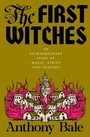
The First Witches
The Extraordinary Story of Magic, Strife and Tragedy
Will be published approx. on 25. February 2027
Book
Hardback
432 pages
978-0-241-75275-3 (ISBN)
Description
FROM THE CRITICALLY ACCLAIMED AUTHOR OF A TRAVEL GUIDE TO THE MIDDLE AGES
In the year 1324, in the burgeoning town of Kilkenny, Ireland's second biggest town, there lived a wealthy, powerful woman named Dame Alicia Kyteler.
After three of her husbands died suspiciously, and with the fourth gravely ill, Alicia and eleven accomplices came under the suspicion of the local bishop, Richard Ledrede. A witch-hunt began. As with every tragedy, we start with the complication - the web of ideas that spread as malicious gossip - and then, the unravelling.
Through rich, creative prose, bestselling historian Anthony Bale reveals how this prosperous yet fractious town stumbled into these allegations, leading to the tragedy that befell Dame Alicia and her accomplices, resulting in one of the accused being burnt at the stake for her crimes against the church.
In time, Europe would be overcome by the "witch craze". The hysteria that followed was by no means inevitable at the time of Bishop Ledrede and Dame Alicia, but their story bears many of the hallmarks of later witch-hunting. Here, in this small Irish town, was where the case against the witch was crystallised and its impact was felt across Europe.
With vivid and enthralling storytelling, this is a story that starts in a quiet Irish town and transports us across medieval Europe, from the countryside to the papal court, to discover the making of the witch.
In the year 1324, in the burgeoning town of Kilkenny, Ireland's second biggest town, there lived a wealthy, powerful woman named Dame Alicia Kyteler.
After three of her husbands died suspiciously, and with the fourth gravely ill, Alicia and eleven accomplices came under the suspicion of the local bishop, Richard Ledrede. A witch-hunt began. As with every tragedy, we start with the complication - the web of ideas that spread as malicious gossip - and then, the unravelling.
Through rich, creative prose, bestselling historian Anthony Bale reveals how this prosperous yet fractious town stumbled into these allegations, leading to the tragedy that befell Dame Alicia and her accomplices, resulting in one of the accused being burnt at the stake for her crimes against the church.
In time, Europe would be overcome by the "witch craze". The hysteria that followed was by no means inevitable at the time of Bishop Ledrede and Dame Alicia, but their story bears many of the hallmarks of later witch-hunting. Here, in this small Irish town, was where the case against the witch was crystallised and its impact was felt across Europe.
With vivid and enthralling storytelling, this is a story that starts in a quiet Irish town and transports us across medieval Europe, from the countryside to the papal court, to discover the making of the witch.
More details
Language
English
Place of publication
London
United Kingdom
Publishing group
Penguin Books Ltd
Target group
College/higher education
Professional and scholarly
Product notice
Laminated cover
Dimensions
Height: 240 mm
Width: 156 mm
Thickness: 22 mm
Weight
690 gr
ISBN-13
978-0-241-75275-3 (9780241752753)
Copyright in bibliographic data is held by Nielsen Book Services Limited or its licensors: all rights reserved.
Schweitzer Classification
Other editions
Additional editions
E-Book
approx. 02/2027
Penguin Books Ltd
€14.99
Not yet available
Person
Anthony Bale is Professor of Medieval & Renaissance Literature at the University of Cambridge and Professorial Fellow at Girton College, Cambridge. He is a former President of the New Chaucer Society. His previous books include Margery Kempe: A Mixed Life (Reaktion Books) and A Travel Guide to the Middle Ages: the World through Medieval Eyes (Penguin). He was awarded the Philip Leverhulme Prize (2011) and holds a Leverhulme Major Research Fellowship (2023-26). He has held fellowships at institutions including Harvard University, The Huntington Library and the University of Melbourne.