

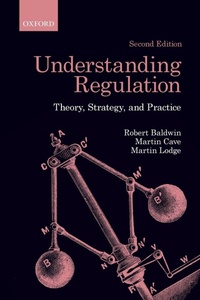
Understanding Regulation
Theory, Strategy, and Practice
2nd Edition
Published on 27. October 2011
Book
Paperback/Softback
568 pages
978-0-19-957609-8 (ISBN)
Description
Regulation is a key concern of industries, consumers, citizens, and governments alike. Building on the success of the first edition, Understanding Regulation, Second Edition provides the reader with an introduction to key debates and discussions in the field of regulation from a number of disciplinary perspectives, looking towards law, economics, business, political science, sociology, and social administration.
The book has been extensively revised and updated to take into account the significant developments and events of the past decade. Containing several new chapters, it has been completely restructured into seven parts, covering: the fundamental issues regarding regulation; different types of regulatory strategies; rules and enforcement; quality and evaluation; regulation at different levels of government; network issues; and concluding thoughts.
Drawing on cross-sectoral and cross-national examples, this book reviews the central questions of regulation, and reflects upon those contentious issues that affect the design and operation of regulatory institutions. Amongst other topics, it discusses 'better regulation', enforcement, self-regulation, risk regulation, cost-benefit analysis, and more utility regulation-oriented topics, such as price-setting. It will be an essential resource for academics, researchers, and graduates across the social sciences studying regulation.
The book has been extensively revised and updated to take into account the significant developments and events of the past decade. Containing several new chapters, it has been completely restructured into seven parts, covering: the fundamental issues regarding regulation; different types of regulatory strategies; rules and enforcement; quality and evaluation; regulation at different levels of government; network issues; and concluding thoughts.
Drawing on cross-sectoral and cross-national examples, this book reviews the central questions of regulation, and reflects upon those contentious issues that affect the design and operation of regulatory institutions. Amongst other topics, it discusses 'better regulation', enforcement, self-regulation, risk regulation, cost-benefit analysis, and more utility regulation-oriented topics, such as price-setting. It will be an essential resource for academics, researchers, and graduates across the social sciences studying regulation.
Reviews / Votes
Review from previous edition It is an excellently constructed work, and provides much food for thought for the times in which we live. * New Law Journal * The book is well researched and written with enough conviction to make a valuable contribution in developing our understanding of the choices regulation presents us with and the potential of new regulatory arrangements going forward. * Matthew Berry, Financial Adviser Careers Extra * Some of the material is very useful and not easily available in textbook form elsewhere ... a good way of catching up on the reforms in a variety of policy sectors and thinking in different disciplines. * Public Administration *More details
Edition
2nd Revised edition
Language
English
Place of publication
Oxford
United Kingdom
Target group
College/higher education
Academics and advanced students across the social sciences in law, economics, business, and politics who study regulatory issues; regulators, consultants, and regulated-industries staff; and those interested in this area of public policy
Edition type
Revised edition
Dimensions
Height: 234 mm
Width: 156 mm
Thickness: 31 mm
Weight
846 gr
ISBN-13
978-0-19-957609-8 (9780199576098)
Copyright in bibliographic data and cover images is held by Nielsen Book Services Limited or by the publishers or by their respective licensors: all rights reserved.
Schweitzer Classification
Other editions
Additional editions
Book
10/2011
2nd Edition
Oxford University Press
€129.60
Shipment within 15-20 days
Previous edition
Book
05/1999
Oxford University Press
€36.77
Article exhausted; check for reprint
Persons
Robert Baldwin is a Professor of Law at the LSE where he teaches Regulation and Criminal Law at undergraduate and graduate levels. He has published widely on regulation and has broad consultancy experience in regulation. His previous books include The Government of Risk (Oxford University Press, 2001 with Christopher Hood and Henry Rothstein). He is the Director of the LSE Short Course on Regulation.
Martin Cave is a Visiting Professor at the Imperial College Business School. He was a member of the U.K. Competition Commission from 1996-2002. He has authored numerous works on economic regulation, and has very extensive experience of advising regulatory agencies such as Ofcom, OFWAT, the Office of Fair Trading, international institutions such as the European Commission and the OECD, and governments in several countries.
Martin Lodge is Reader in Political Science and Public Policy at the LSE. His research and teaching interests are in the comparative study of Executive Government and Regulation.
Martin Cave is a Visiting Professor at the Imperial College Business School. He was a member of the U.K. Competition Commission from 1996-2002. He has authored numerous works on economic regulation, and has very extensive experience of advising regulatory agencies such as Ofcom, OFWAT, the Office of Fair Trading, international institutions such as the European Commission and the OECD, and governments in several countries.
Martin Lodge is Reader in Political Science and Public Policy at the LSE. His research and teaching interests are in the comparative study of Executive Government and Regulation.
Content
PART I: FUNDAMENTALS ; PART II: STRATEGIES ; PART III: RULES AND ENFORCEMENT ; PART IV: QUALITY AND EVALUATION ; PART V: REGULATION AT DIFFERENT LEVELS OF GOVERNMENT ; PART VI: NETWORK ISSUES ; PART VII: CONCLUSIONS