

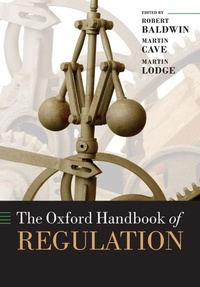
The Oxford Handbook of Regulation
Published on 19. July 2012
Book
Paperback/Softback
680 pages
978-0-19-965588-5 (ISBN)
Description
Regulation is often thought of as an activity that restricts behaviour and prevents the occurrence of certain undesirable activities, but the influence of regulation can also be enabling or facilitative, as when a market could potentially be chaotic if uncontrolled. This Handbook provides a clear and authoritative discussion of the major trends and issues in regulation over the last thirty years, together with an outline of prospective developments. It brings
together contributions from leading scholars from a range of disciplines and countries.
Each chapter offers a broad overview of key current issues and provides an analysis of different perspectives on those issues. Experiences in different jurisdictions and insights from various disciplines are drawn upon, and particular attention is paid to the challenges that are encountered when specific approaches are applied in practice. Contributors develop their own distinctive arguments relating to the central issues in regulation and apply scholarly rigour and clear writing to matters of
high policy-relevance. The essays are original, accessible, and agenda-setting, and the Handbook will be essential reading both to students and researchers and to with regulatory and regulated professionals.
Regulation is often thought of as an activity that restricts behaviour and prevents the occurrence of certain undesirable activities, but the influence of regulation can also be enabling or facilitative, as when a market could potentially be chaotic if uncontrolled. This Handbook provides a clear and authoritative discussion of the major trends and issues in regulation over the last thirty years, together with an outline of prospective developments. It brings
together contributions from leading scholars from a range of disciplines and countries.
Each chapter offers a broad overview of key current issues and provides an analysis of different perspectives on those issues. Experiences in different jurisdictions and insights from various disciplines are drawn upon, and particular attention is paid to the challenges that are encountered when specific approaches are applied in practice. Contributors develop their own distinctive arguments relating to the central issues in regulation and apply scholarly rigour and clear writing to matters of
high policy-relevance. The essays are original, accessible, and agenda-setting, and the Handbook will be essential reading both to students and researchers and to with regulatory and regulated professionals.
together contributions from leading scholars from a range of disciplines and countries.
Each chapter offers a broad overview of key current issues and provides an analysis of different perspectives on those issues. Experiences in different jurisdictions and insights from various disciplines are drawn upon, and particular attention is paid to the challenges that are encountered when specific approaches are applied in practice. Contributors develop their own distinctive arguments relating to the central issues in regulation and apply scholarly rigour and clear writing to matters of
high policy-relevance. The essays are original, accessible, and agenda-setting, and the Handbook will be essential reading both to students and researchers and to with regulatory and regulated professionals.
Regulation is often thought of as an activity that restricts behaviour and prevents the occurrence of certain undesirable activities, but the influence of regulation can also be enabling or facilitative, as when a market could potentially be chaotic if uncontrolled. This Handbook provides a clear and authoritative discussion of the major trends and issues in regulation over the last thirty years, together with an outline of prospective developments. It brings
together contributions from leading scholars from a range of disciplines and countries.
Each chapter offers a broad overview of key current issues and provides an analysis of different perspectives on those issues. Experiences in different jurisdictions and insights from various disciplines are drawn upon, and particular attention is paid to the challenges that are encountered when specific approaches are applied in practice. Contributors develop their own distinctive arguments relating to the central issues in regulation and apply scholarly rigour and clear writing to matters of
high policy-relevance. The essays are original, accessible, and agenda-setting, and the Handbook will be essential reading both to students and researchers and to with regulatory and regulated professionals.
Reviews / Votes
...this Handbook is exactly what it says on the tin: provides high quality state of the art reviews of the main areas of work on regulation. * Michael Moran, University of Manchester Business School *...this Handbook is exactly what it says on the tin: provides high quality state of the art reviews of the main areas of work on regulation. * Michael Moran, University of Manchester Business School *
More details
Product info
Paperback
Series
Language
English
Place of publication
Oxford
United Kingdom
Target group
College/higher education
Academics, scholars, and advanced students of Economics, Politics, Law, and Business and Management; Practitioners in regulatory bodies, regulated sectors, law firms, and consultancies.
Illustrations
Tables and figures
Dimensions
Height: 244 mm
Width: 170 mm
Thickness: 37 mm
Weight
1153 gr
ISBN-13
978-0-19-965588-5 (9780199655885)
Copyright in bibliographic data and cover images is held by Nielsen Book Services Limited or by the publishers or by their respective licensors: all rights reserved.
Schweitzer Classification
Other editions
Additional editions
Robert Baldwin | Martin Cave | Martin Lodge
The Oxford Handbook of Regulation
Book
09/2010
Oxford University Press
€218.30
Shipment within 15-20 days
Persons
Robert Baldwin is a Professor of Law at the London School of Economics and Political Science. He has published extensively on regulation, has wide consultative experience in regulation and is the Director of the LSE Short Course on Regulation.
Martin Cave is Visiting Professor at Imperial College Business School. He was a member of the U.K. Competition Commission from 1996-2002. He has authored numerous works on economic regulation, and has very extensive experience of advising regulatory agencies, international institutions, and governments.
Martin Lodge is Reader in Political Science and Public Policy at the London School of Economics and Political Science. His research and teaching interests are in the comparative study of Executive Government and Regulation.
Robert Baldwin is a Professor of Law at the London School of Economics and Political Science. He has published extensively on regulation, has wide consultative experience in regulation and is the Director of the LSE Short Course on Regulation.
Martin Cave is Visiting Professor at Imperial College Business School. He was a member of the U.K. Competition Commission from 1996-2002. He has authored numerous works on economic regulation, and has very extensive experience of advising regulatory agencies, international institutions, and governments.
Martin Lodge is Reader in Political Science and Public Policy at the London School of Economics and Political Science. His research and teaching interests are in the comparative study of Executive Government and Regulation.
Martin Cave is Visiting Professor at Imperial College Business School. He was a member of the U.K. Competition Commission from 1996-2002. He has authored numerous works on economic regulation, and has very extensive experience of advising regulatory agencies, international institutions, and governments.
Martin Lodge is Reader in Political Science and Public Policy at the London School of Economics and Political Science. His research and teaching interests are in the comparative study of Executive Government and Regulation.
Robert Baldwin is a Professor of Law at the London School of Economics and Political Science. He has published extensively on regulation, has wide consultative experience in regulation and is the Director of the LSE Short Course on Regulation.
Martin Cave is Visiting Professor at Imperial College Business School. He was a member of the U.K. Competition Commission from 1996-2002. He has authored numerous works on economic regulation, and has very extensive experience of advising regulatory agencies, international institutions, and governments.
Martin Lodge is Reader in Political Science and Public Policy at the London School of Economics and Political Science. His research and teaching interests are in the comparative study of Executive Government and Regulation.
Content
PART I: GENERAL ISSUES; PART II : PROCESSES AND STRATEGIES; PART III: CONTESTED ISSUES; PART IV: REGULATORY DOMAINS; PART V: CONCLUSION