

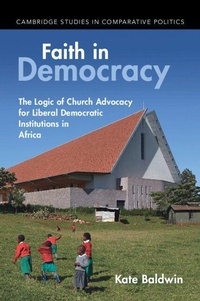
Faith in Democracy
The Logic of Church Advocacy for Liberal Democratic Institutions in Africa
Published on 6. November 2025
Book
Paperback/Softback
316 pages
978-1-009-39162-7 (ISBN)
Description
Why have some churches in Africa engaged in advocacy for stronger liberal democratic institutions while others have not? Faith in Democracy explores this question, emphasizing the benefits of liberal democratic protections for some churches. The book explains how churches' historic investments create different autocratic risk exposure, as states can more easily regulate certain activities - including social service provision - than others. In situations where churches have invested in schools as part of their evangelization activities, which create high autocratic risk, churches have incentives to defend liberal democratic institutions to protect their control over them. This theory also explains how church fiscal dependence on the state interacts with education provision to change incentives for advocacy. Empirically, the book demonstrates when churches engage in democratic activism, drawing on church-level data from across the continent, and the effects of church activism, drawing on micro-level evidence from Zambia, Tanzania and Ghana.
Reviews / Votes
'Baldwin's fascinating book explores the dilemma of African churches that face risks of autocratic expropriation. Liberal democracy promises the conditions for survival, but there are risks and potential rewards for Church leaders to advocate democratic reforms, depending on whether they provide education and are free from state funding. Baldwin relies on newly compiled data, statistical tests, experiments, case studies, and compelling strategic analysis to identify the conditions for Church leader challenges to democratic decline.' David D. Laitin, James T. Watkins IV and Elise V. Watkins Professor of Political Science, Stanford University 'Why do some African Church leaders publicly oppose threats to liberal democratic institutions while others remain silent? Baldwin argues that it depends on whether such advocacy protects the Church's ability to achieve its ecclesiastical goal of spreading the gospel - especially through Church-run schools. This is a deeply researched and compelling book. It should be required reading for those interested in understanding the complex links between religion and democracy, in Africa and beyond.' Daniel N. Posner, James S. Coleman Professor of International Development, University of California, Los Angeles 'Why do churches sometimes take great risks to defend liberal democracy? Religious institutions are often viewed as conservative actors, but Baldwin shows that this is not always true. Through a brilliant combination of cross-national and within-country evidence, Baldwin convincingly argues that churches with activities at risk of suppression and with independent sources of financing are more likely to resist autocrats. The book makes novel contributions to the study of democratic resilience, non-state provision, and religion in political life.' Melani Cammett, Clarence Dillon Professor of International Affairs, Harvard UniversityMore details
Series
Language
English
Place of publication
Cambridge
United Kingdom
Illustrations
Worked examples or Exercises
Dimensions
Height: 229 mm
Width: 152 mm
Thickness: 18 mm
Weight
463 gr
ISBN-13
978-1-009-39162-7 (9781009391627)
Copyright in bibliographic data and cover images is held by Nielsen Book Services Limited or by the publishers or by their respective licensors: all rights reserved.
Schweitzer Classification
Other editions
Additional editions
Kate Baldwin
Faith in Democracy
The Logic of Church Advocacy for Liberal Democratic Institutions in Africa
Book
11/2025
Cambridge University Press
€112.90
Shipment within 15-20 days
Person
Kate Baldwin is Associate Professor of Political Science and Global Affairs at Yale University. She is the author of The Paradox of Traditional Chiefs in Democratic Africa (2016), which was awarded the Gaddis Smith International Book Prize.
Content
Part I. Theory: 1. Church interests in liberal democracy; 2. Liberal democracy as an institutional guarantee of church interests; 3. The politics of church education in Sub-Saharan Africa; Part II. Testing the Main Hypotheses: 4. Evidence on church democratic activism in Africa: the effect of church schools and autocratic risk exposure; 5. Evidence on Catholic democratic activism in Africa: the effect of church school dependence on state subsidies; Part III. Testing Underlying Assumptions; 6. Church activism and support for liberal democratic institutions: evidence from Zambia and Tanzania; 7. Tracing liberal democracy's influence on educational policy: evidence from Zambia, Ghana, and beyond; Part IV. Extensions and Implications: 8. Church school legacies for citizenship: evidence from Zambia and Tanzania; 9. Reconsidering churches, education, and democracy in the contemporary world; Appendices; Appendix A. List of interviews; Appendix B. Data sets; Appendix C. Additional table Chapter 7; Appendix D. Additional tables Chapter 8.