

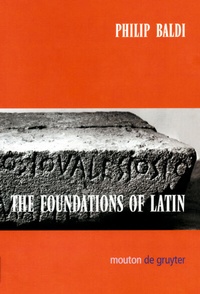
The Foundations of Latin
1st Edition
Published on 25. July 2002
Book
Hardback
XXVII, 534 pages
978-3-11-017208-9 (ISBN)
Description
This volume provides an up-to-date account of the linguistic evolution of Latin, from its origins in the Proto-Indo-European ancestral language until the end of the second century CE. As the first English-language treatment of the history of Latin and its speakers in four decades, this study fills a critical need in classical and linguistic scholarship.
Reviews / Votes
"... a reliable compendium of all there is to know about Latin and Indo-European." Edgar C. Polomé in: 'The Journal of Indo-European Studies'More details
Edition
Reprint 2018
Language
English
Place of publication
Berlin/Boston
Germany
Publishing group
de Gruyter Mouton
Target group
Professional and scholarly
US School Grade: College Graduate Student
Illustrations
78 s/w Tabellen, 39 Abbildungen
39 ill., 78 tbl.
Dimensions
Height: 236 mm
Width: 160 mm
Thickness: 36 mm
Weight
983 gr
ISBN-13
978-3-11-017208-9 (9783110172089)
Schweitzer Classification
Other editions
Additional editions
E-Book
07/2018
1st Edition
De Gruyter Mouton
€169.95
Available for download
Content
Chapter 1 Indo-European and the Indo-European languages
1.1 Introduction
1.2 The comparative method and and the regularity principle
1.3 The method of internal reconstruction
1.4 Genetic classification and family trees
1.5 The Indo-European language family
1.6 Aspects of Proto-Indo-European culture and civilization
1.7 Summary
Chapter 2 An outline of Proto-Indo-European
2.1 Phonology
2.2 Morphology
2.3 Syntax
2.4 Summary
Chapter 3 Ancient Italy and its Indo-Europeanization
3.1 The European Stone Age and its reflection in Italy
3.2 The Metal Ages
3.3 Rome
3.4 The Etruscans
3.5. The people of ancient Italy
3.6 Summary
Chapter 4 The languages of ancient Italy
4.1 Sources of information
4.2 Samples of the Italic languages
4.3 Samples of non-Italic languages
4.4 Interrelations with Italic
4.5 Relationships between the Italic and other Indo-European languages
4.6 Summary
Chapter 5 Materials for the study of Latin
5.1 Samples of Latin inscriptions, with commentary
5.2 Continuous texts
5.3 Literary texts
5.4 Spoken Latin
5.5 Graffiti
5.6 Letters
Chapter 6 The development of the Latin phonological system from PIE
6.1 The vowels and laryngeals
6.2 The consonants
6.3 Summary
Chapter 7 The development of the Latin morphological system from PIE
7.1 The parts of speech
7.2 Nouns and adjectives
7.3 Pronouns
7.4 Comparison of adjectives
7.5 Adverbs
7.6 Numerals
7.7 Undeclined forms
7.8 The verb
7.9 Summary
1.1 Introduction
1.2 The comparative method and and the regularity principle
1.3 The method of internal reconstruction
1.4 Genetic classification and family trees
1.5 The Indo-European language family
1.6 Aspects of Proto-Indo-European culture and civilization
1.7 Summary
Chapter 2 An outline of Proto-Indo-European
2.1 Phonology
2.2 Morphology
2.3 Syntax
2.4 Summary
Chapter 3 Ancient Italy and its Indo-Europeanization
3.1 The European Stone Age and its reflection in Italy
3.2 The Metal Ages
3.3 Rome
3.4 The Etruscans
3.5. The people of ancient Italy
3.6 Summary
Chapter 4 The languages of ancient Italy
4.1 Sources of information
4.2 Samples of the Italic languages
4.3 Samples of non-Italic languages
4.4 Interrelations with Italic
4.5 Relationships between the Italic and other Indo-European languages
4.6 Summary
Chapter 5 Materials for the study of Latin
5.1 Samples of Latin inscriptions, with commentary
5.2 Continuous texts
5.3 Literary texts
5.4 Spoken Latin
5.5 Graffiti
5.6 Letters
Chapter 6 The development of the Latin phonological system from PIE
6.1 The vowels and laryngeals
6.2 The consonants
6.3 Summary
Chapter 7 The development of the Latin morphological system from PIE
7.1 The parts of speech
7.2 Nouns and adjectives
7.3 Pronouns
7.4 Comparison of adjectives
7.5 Adverbs
7.6 Numerals
7.7 Undeclined forms
7.8 The verb
7.9 Summary