

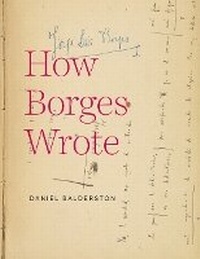
How Borges Wrote
Will be published approx. on 30. May 2018
Book
Hardback
416 pages
978-0-8139-3964-3 (ISBN)
Description
A distinguished poet and essayist and one of the finest writers of short stories in world letters, Jorge Luis Borges deliberately and regularly altered his work by extensive revision. In this volume, renowned Borges scholar Daniel Balderston undertakes to piece together Borges's creative process through the marks he left on paper.
Balderston has consulted over 170 manuscripts and primary documents to reconstruct the creative process by which Borges arrived at his final published texts. How Borges Wrote is organized around the stages of the his writing process, from notes on his reading and brainstorming sessions to his compositional notebooks, revisions to various drafts, and even corrections in already-published works. The book includes hundreds of reproductions of Borges's manuscripts, allowing the reader to see clearly how he revised and ""thought"" on paper. The manuscripts studied include many of Borges's most celebrated stories and essays-""The Aleph,"" ""Kafka and His Precursors,"" ""The Cult of the Phoenix,"" ""The Garden of Forking Paths,"" ""Emma Zunz,"" and many others-as well as lesser known but important works such as his 1930 biography of the poet Evaristo Carriego.
As the first and only attempt at a systematic and comprehensive study of the trajectory of Borges's creative process, this will become a definitive work for all scholars who wish to trace how Borges wrote.
Balderston has consulted over 170 manuscripts and primary documents to reconstruct the creative process by which Borges arrived at his final published texts. How Borges Wrote is organized around the stages of the his writing process, from notes on his reading and brainstorming sessions to his compositional notebooks, revisions to various drafts, and even corrections in already-published works. The book includes hundreds of reproductions of Borges's manuscripts, allowing the reader to see clearly how he revised and ""thought"" on paper. The manuscripts studied include many of Borges's most celebrated stories and essays-""The Aleph,"" ""Kafka and His Precursors,"" ""The Cult of the Phoenix,"" ""The Garden of Forking Paths,"" ""Emma Zunz,"" and many others-as well as lesser known but important works such as his 1930 biography of the poet Evaristo Carriego.
As the first and only attempt at a systematic and comprehensive study of the trajectory of Borges's creative process, this will become a definitive work for all scholars who wish to trace how Borges wrote.
Reviews / Votes
"[F]ull of fresh insights into the relationship between Borges's reading material and the multiple versions of the texts he created. [...] This book is not always easy, but it constitutes essential reading for anyone seriously interested in how Borges wrote. You will never read the Argentine Master in the same way again." - Modern Language ReviewMore details
Language
English
Place of publication
Charlottesville
United States
Target group
Professional and scholarly
Illustrations
271 black & white illustrations
Dimensions
Height: 229 mm
Width: 178 mm
Thickness: 28 mm
Weight
793 gr
ISBN-13
978-0-8139-3964-3 (9780813939643)
Copyright in bibliographic data and cover images is held by Nielsen Book Services Limited or by the publishers or by their respective licensors: all rights reserved.
Schweitzer Classification
Other editions
Additional editions
Daniel Balderston
How Borges Wrote
E-Book
05/2018
1st Edition
Naval Institute Press
from
€121.99
Available for download
Person
Daniel Balderston is Andrew W. Mellon Professor of Modern Languages at the University of Pittsburgh and the author of Out of Context: Historical Reference and the Representation of Reality in Borges.