

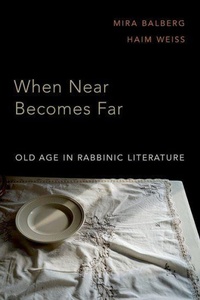
When Near Becomes Far
Old Age in Rabbinic Literature
Published on 4. August 2021
Book
Hardback
232 pages
978-0-19-750148-1 (ISBN)
Description
When Near Becomes Far explores the representations and depictions of old age in the rabbinic Jewish literature of late antiquity (150-600 CE). Through close literary readings and cultural analysis, the book reveals the gaps and tensions between idealized images of old age on the one hand, and the psychologically, physiologically, and socially complicated realities of aging on the other hand. The authors argue that while rabbinic literature presents a number of prescriptions related to qualities and activities that make for good old age, the respect and reverence that the elderly should be awarded, and harmonious intergenerational relationship, it also includes multiple anecdotes and narratives that portray aging in much more nuanced and poignant ways.
These anecdotes and narratives relate, alongside fantasies about blissful or unnoticeable aging, a host of fears associated with old age: from the loss of physical capability and beauty to the loss of memory and mental acuity, and from marginalization in the community to being experienced as a burden by one's children. Each chapter of the book focuses on a different aspect of aging in the rabbinic world: bodily appearance and sexuality, family relations, intellectual and cognitive prowess, honor and shame, and social roles and identity. As the book shows, in their powerful and sensitive treatments of aging, rabbinic texts offer some of the richest and most audacious observations on aging in ancient world literature, many of which still resonate today.
These anecdotes and narratives relate, alongside fantasies about blissful or unnoticeable aging, a host of fears associated with old age: from the loss of physical capability and beauty to the loss of memory and mental acuity, and from marginalization in the community to being experienced as a burden by one's children. Each chapter of the book focuses on a different aspect of aging in the rabbinic world: bodily appearance and sexuality, family relations, intellectual and cognitive prowess, honor and shame, and social roles and identity. As the book shows, in their powerful and sensitive treatments of aging, rabbinic texts offer some of the richest and most audacious observations on aging in ancient world literature, many of which still resonate today.
Reviews / Votes
Nuanced and detailed ... the volume will be primarily useful to those familiar with the critical study of rabbinic texts. * J. S. Kaminsky, CHOICE * While this most engagingly written book would be a natural for an academic library, members of a synagogue library would certainly significantly expand their intellectual horizons through an encounter with this volume ... Reading When Near Becomes Far will challenge the reader of whatever age to question their assumptions as to the meaning of old age, societal expectations of the aged, and what the Talmudic writings have to truly teach. * Mindy C. Reiser, Association of Jewish Libraries News and Reviews * In this insightful study on old age in rabbinic literature, Balberg and Weiss give the rabbis' kaleidoscopic and multi-layered look... When Near Becomes Far contributes substantially to rabbinic studies in terms of its topic and the analysis of rabbinic texts. * Michail Kitsos, Religious Studies Review *More details
Language
English
Place of publication
New York
United States
Target group
Professional and scholarly
Dimensions
Height: 163 mm
Width: 243 mm
Thickness: 23 mm
Weight
490 gr
ISBN-13
978-0-19-750148-1 (9780197501481)
Copyright in bibliographic data and cover images is held by Nielsen Book Services Limited or by the publishers or by their respective licensors: all rights reserved.
Schweitzer Classification
Other editions
Additional editions
E-Book
03/2021
OUP eBook
€58.99
Available for download
E-Book
03/2021
OUP eBook
€58.99
Available for download
Persons
Mira Balberg is Professor of History and Endowed Chair in Ancient Jewish Civilization at the University of California, San Diego. She specializes in ancient Mediterranean Religions, with a focus on the emergence and development of Judaism in antiquity (200 BCE-500 CE).
Haim Weiss is Associate Professor of Hebrew Literature at Ben Gurion University in Israel. He specializes in rabbinic literature, Midrash, and folklore, as well as in the relations between classical Jewish literature and modern Hebrew literature.
Haim Weiss is Associate Professor of Hebrew Literature at Ben Gurion University in Israel. He specializes in rabbinic literature, Midrash, and folklore, as well as in the relations between classical Jewish literature and modern Hebrew literature.
Content
Acknowledgments
Introduction
1. Like Two Fountains: Fluidity, Sexuality, and the Aging Body
2. Squawk to Them Like Roosters: Aging Parents and their Children
3. I Am Not Old: Age and Agelessness in the Study House
4. Raise My Eyes for Me: Gazing at Old Age
5. Running at Dusk: Anonymity and Identity in Old Age
Epilogue
Bibliography
Source Index
Subject Index
Introduction
1. Like Two Fountains: Fluidity, Sexuality, and the Aging Body
2. Squawk to Them Like Roosters: Aging Parents and their Children
3. I Am Not Old: Age and Agelessness in the Study House
4. Raise My Eyes for Me: Gazing at Old Age
5. Running at Dusk: Anonymity and Identity in Old Age
Epilogue
Bibliography
Source Index
Subject Index