

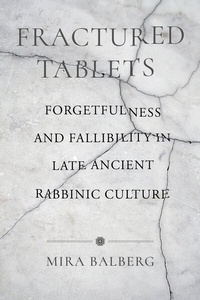
Fractured Tablets
Forgetfulness and Fallibility in Late Ancient Rabbinic Culture
1st Edition
Published on 25. April 2023
Book
Paperback/Softback
300 pages
978-0-520-39186-4 (ISBN)
Description
A free ebook version of this title is available through Luminos, University of California Press's Open Access publishing program. Visit www.luminosoa.org to learn more.
This book examines the significant role that memory failures play in early rabbinic literature. The rabbis who shaped Judaism in late antiquity envisioned the commitment to the Torah and its commandments as governing every aspect of a person's life. Their vision of a Jewish subject who must keep constant mental track of multiple obligations and teachings led them to be preoccupied with forgetting: forgetting tasks, forgetting facts, forgetting texts, and-most broadly-forgetting the Torah altogether. In Fractured Tablets, Mira Balberg examines the ways in which the early rabbis approached and delineated the possibility of forgetfulness in practice and study and the solutions and responses they conjured for forgetfulness, along with the ways in which they used human fallibility to bolster their vision of Jewish observance and their own roles as religious experts. In the process, Balberg shows that the rabbis' intense preoccupation with the prospect of forgetfulness was a meaningful ideological choice, with profound implications for our understanding of Judaism in late antiquity.
This book examines the significant role that memory failures play in early rabbinic literature. The rabbis who shaped Judaism in late antiquity envisioned the commitment to the Torah and its commandments as governing every aspect of a person's life. Their vision of a Jewish subject who must keep constant mental track of multiple obligations and teachings led them to be preoccupied with forgetting: forgetting tasks, forgetting facts, forgetting texts, and-most broadly-forgetting the Torah altogether. In Fractured Tablets, Mira Balberg examines the ways in which the early rabbis approached and delineated the possibility of forgetfulness in practice and study and the solutions and responses they conjured for forgetfulness, along with the ways in which they used human fallibility to bolster their vision of Jewish observance and their own roles as religious experts. In the process, Balberg shows that the rabbis' intense preoccupation with the prospect of forgetfulness was a meaningful ideological choice, with profound implications for our understanding of Judaism in late antiquity.
Reviews / Votes
"Balberg's book is clear-ly writ-ten and large-ly avoids bury-ing the read-er in lengthy foot-notes and recur-sive argu-ments. . .It is impor-tant mate-r-i-al for rab-bini-cal stu-dents and will appeal to those wish-ing to study the debates, argu-ments, and prac-tices of the Tan-naim at a deep-er lev-el." * Jewish Book Council *More details
Edition
First Edition
Language
English
Place of publication
Berkerley
United States
Target group
Professional and scholarly
Product notice
Paperback (trade)
Dimensions
Height: 229 mm
Width: 152 mm
Thickness: 20 mm
Weight
408 gr
ISBN-13
978-0-520-39186-4 (9780520391864)
Copyright in bibliographic data and cover images is held by Nielsen Book Services Limited or by the publishers or by their respective licensors: all rights reserved.
Schweitzer Classification
Other editions
Additional editions
E-Book
04/2023
1st Edition
Naval Institute Press
€12.49
Available for download
Person
Mira Balberg is Professor of History and Endowed Chair in Ancient Jewish Civilization at the University of California, San Diego. She is author of Purity, Body, and Self in Early Rabbinic Literature and Blood for Thought: The Reinvention of Sacrifice in Early Rabbinic Literature and coauthor of When Near Becomes Far: Old Age in Rabbinic Literature.