

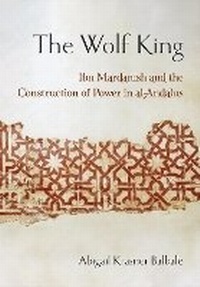
The Wolf King
Ibn Mardanish and the Construction of Power in Al-Andalus
Published on 15. March 2025
Book
Paperback/Softback
360 pages
978-1-5017-8138-4 (ISBN)
Description
Winner of the Wallace K. Ferguson Prize
Winner of the Dionisius A. Agius Book Prize
The Wolf King explores how political power was conceptualized, constructed, and wielded in twelfth-century al-Andalus, focusing on the eventful reign of Muhammad ibn Sad ibn Ahmad ibn Mardanish (r. 1147-1172). Celebrated in Castilian and Latin sources as el rey lobo/rex lupus and denigrated by Almohad and later Arabic sources as irreligious and disloyal to fellow Muslims because he fought the Almohads and served as vassal to the Castilians, Ibn Mardanish ruled a kingdom that at its peak constituted nearly half of al-Andalus and served as an important buffer between the Almohads and the Christian kingdoms of Castile and Aragon.
Through a close examination of contemporary sources across the region, Abigail Krasner Balbale shows that Ibn Mardanish's short-lived dynasty was actually an attempt to integrate al-Andalus more closely with the Islamic East-particularly the Abbasid caliphate. At stake in his battles against the Almohads was the very idea of the caliphate in this period, as well as who could define righteous religious authority. The Wolf King makes effective use of chronicles, chancery documents, poetry, architecture, coinage, and artifacts to uncover how Ibn Mardanish adapted language and cultural forms from around the Islamic world to assert and consolidate power-and then tracks how these strategies, and the memory of Ibn Mardanish more generally, influenced expressions of kingship in subsequent periods.
Open access edition funded by the National Endowment for the Humanities.
Winner of the Dionisius A. Agius Book Prize
The Wolf King explores how political power was conceptualized, constructed, and wielded in twelfth-century al-Andalus, focusing on the eventful reign of Muhammad ibn Sad ibn Ahmad ibn Mardanish (r. 1147-1172). Celebrated in Castilian and Latin sources as el rey lobo/rex lupus and denigrated by Almohad and later Arabic sources as irreligious and disloyal to fellow Muslims because he fought the Almohads and served as vassal to the Castilians, Ibn Mardanish ruled a kingdom that at its peak constituted nearly half of al-Andalus and served as an important buffer between the Almohads and the Christian kingdoms of Castile and Aragon.
Through a close examination of contemporary sources across the region, Abigail Krasner Balbale shows that Ibn Mardanish's short-lived dynasty was actually an attempt to integrate al-Andalus more closely with the Islamic East-particularly the Abbasid caliphate. At stake in his battles against the Almohads was the very idea of the caliphate in this period, as well as who could define righteous religious authority. The Wolf King makes effective use of chronicles, chancery documents, poetry, architecture, coinage, and artifacts to uncover how Ibn Mardanish adapted language and cultural forms from around the Islamic world to assert and consolidate power-and then tracks how these strategies, and the memory of Ibn Mardanish more generally, influenced expressions of kingship in subsequent periods.
Open access edition funded by the National Endowment for the Humanities.
Reviews / Votes
The Wolf King is an important work of interdisciplinary and comparative history that employs an array of textual, visual, and material evidence to reincorporate al-Andalus into the broader world of the medieval Mediterranean.(Mediterranean Historical Review) This meticulous exploration of the figure of Ibn Mardanish allows us to reformulate the understanding we have of the history of Islam in the West in one of the last phases of Muslim supremacy in the Iberian Peninsula, showing the plurality of strategies adopted by the political authorities of the time to respond to the changing times.
(Studi Magrebini) In this richly sourced, nuanced, and insightful study of the twelfth-century Wolf King Ibn Mardanish, Abigail Balbale has given us the gift of a rigorous and methodologically innovative historical study that deepens our understanding not just of the subject of her study but the subfield to which he belongs as well.
(Speculum: A Journal of Medieval Studies)
More details
Series
Language
English
Place of publication
Ithaca
United States
Product notice
Paperback (trade)
Illustrations
64 b&w halftones, 4 maps, 1 chart - 4 Maps - 1 Charts - 64 Halftones, black and white
Dimensions
Height: 229 mm
Width: 152 mm
Thickness: 24 mm
Weight
907 gr
ISBN-13
978-1-5017-8138-4 (9781501781384)
Copyright in bibliographic data and cover images is held by Nielsen Book Services Limited or by the publishers or by their respective licensors: all rights reserved.
Schweitzer Classification
Other editions
Additional editions
E-Book
12/2022
Cornell University Press
€0.00
Available for download
Person
Abigail Krasner Balbale is Associate Professor in the Department of Middle Eastern and Islamic Studies at New York University and the coauthor of The Arts of Intimacy.
Content
Introduction: Ibn Mardanish as Historical Figure and Historiographic Subject
1. Caliph and Madhi: The Battle over Power in the Islamic Middle Period
2. Rebel against the Truth: Almohad Visions of Ibn Mardanish
3. Filiative Networks: Lineage and Legitimacy in Sharq al-Andalus
4. Material Genealogies and the Construction of Power
5. Vassals, Traders, and Kings: Economic and Political Networks in the Western Mediterranean
6. Renaissance and Assimilation after the Almohad Conquest
7. The Reconquista, a Lost Paradise, and Other Teleologies
1. Caliph and Madhi: The Battle over Power in the Islamic Middle Period
2. Rebel against the Truth: Almohad Visions of Ibn Mardanish
3. Filiative Networks: Lineage and Legitimacy in Sharq al-Andalus
4. Material Genealogies and the Construction of Power
5. Vassals, Traders, and Kings: Economic and Political Networks in the Western Mediterranean
6. Renaissance and Assimilation after the Almohad Conquest
7. The Reconquista, a Lost Paradise, and Other Teleologies