

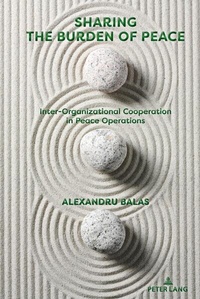
Sharing the Burden of Peace
Inter-Organizational Cooperation in Peace Operations
Published on 28. April 2022
Book
Hardback
156 pages
978-1-4331-9577-8 (ISBN)
Description
Most peace operations (60%) were deployed in conflicts in which other international organizations' peace operations were active at the same time. Multiple simultaneous peace operations increased from around 10% of all peace operations in 1992 to almost 60% of all peace operations. The author defines two or more peace operations deployed by international organizations at the same time, in the same conflicts as multiple simultaneous peace operations (MSPOs). We have little understanding of why we observe international organizations (IOs) deployed at the same time, in the same conflicts, and increasingly cooperating with each other to address these conflicts. This book asks the question: What factors determine cooperation between international organizations in peace operations? The author tests several rational and social constructivist explanations introducing an innovative collective principals-multiple agents framework. There are three rational-interest explanations for inter-organizational cooperation tested (resources, complementarity, and conflict complexity) and three social-constructivist explanations (social learning, security cultures similarity, and personnel nationality similarity). The research design is a multi-method approach, using statistical analysis from the author's new datasets on multiple simultaneous peace operations, data from interviews with EU officials, and case studies. There are two stages for the initiation of inter-organizational cooperation: the member-states' acquiescence and the international organizations' cooperation. At the first stage of cooperation, member-states are acquiescent to inter-organizational cooperation. At the second stage, the findings show that international organizations cooperate because they want to share the financial and human resources costs, and second, because they want to complement each other's work.
Reviews / Votes
"At the time when both the European Union and NATO are reviewing their strategic priorities, this book is a timely contribution. By illustrating the challenges of inter-organizational cooperation, the book suggests concrete ways to improve the effectiveness of inter-organizational cooperation when they deploy multiple simultaneous peace operations. More broadly, this book is a must-read for those students, academics and policy-makers interested in understanding and improving inter-organizational cooperation."-Giulia Tercovich, PhD, Assistant Director of the Centre for Security, Diplomacy and Strategy (CSDS) of the Brussels School of Governance (BSoG- VUB) and Assistant Professor in International Affairs at the Brussels School of Governance "This work shatters the myopic myth that peacekeeping operations should be studied separately and independent of one another. The reality is that operations of the United Nations and regional organizations regularly intersect and cooperate in the same conflicts, and now we have a framework to understand those interconnections."
-Paul F. Diehl, University of Illinois "Sharing the Burden of Peace is an essential contribution to the academic study of peace operations and cooperation among inter-governmental organizations in peacekeeping missions which seemed to have lost importance in recent years despite the growing need for them. It is not only a must read for those studying peace operations but might be of interest to those in organizational management studies, global conflict and cooperation, and social constructivism from theoretical, empirical, and policy perspectives. It also serves as a reference book for analyzing peaceful interventions carried out by African international organizations, the United Nations, and European international organizations since it provides rich data driven from interviews with the officials from these organizations. Using a multi-method approach, Balas shows that while multiple simultaneous peace operations are difficult, they are essential to improve the use of financial and human resources."
-Ayse Betuel Celik, Professor of Political Science, Program in Conflict Analysis and Resolution, Sabanci University
More details
Edition
New edition
Language
English
Place of publication
New York
United States
Target group
Professional and scholarly
Edition type
New edition
Illustrations
20 Illustrations
Dimensions
Height: 231 mm
Width: 155 mm
Thickness: 14 mm
Weight
399 gr
ISBN-13
978-1-4331-9577-8 (9781433195778)
Schweitzer Classification
Other editions
Additional editions
E-Book
04/2022
1st Edition
Peter Lang Verlag
€100.99
Available for download
E-Book
04/2022
1st Edition
Peter Lang Verlag
€100.99
Available for download
Person
Alexandru Balas is Associate Professor and Coordinator of the International Studies Program and the Director of the Clark Center for Global Engagement at SUNY Cortland. He received his PhD in Political Science from the University of Illinois, Urbana-Champaign (2011) and his MA in Conflict Analysis and Resolution from Sabanci University (2006). His books include The Puzzle of Peace: The Evolution of Peace in the International System (2016), Peace Operations (2014) and Muslims in Europe: The European Union Solving Social Conflicts (2008).
Content
List of Tables - List of Figures - Introduction - Prior Research on Inter-Organizational Cooperation - Why Cooperate? Explaining Rationales for Cooperation - Definitions, Measurements, and Datasets - Findings: Resources and Complementarity - Peacekeepers' Thoughts on Inter-Organizational Cooperation - Case Studies - Afghanistan, Darfur (Sudan), and Kosovo - Concluding Remarks and Policy Recommendations.