

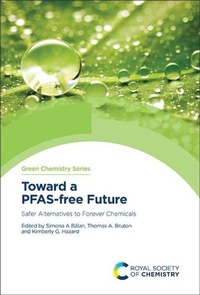
Toward a PFAS-free Future
Safer Alternatives to Forever Chemicals
Published on 17. November 2023
Book
Hardback
242 pages
978-1-83767-054-3 (ISBN)
Description
Perfluoroalkyl and polyfluoroalkyl substances (PFASs) are extensively used in consumer products, despite their high persistence and other hazards. The risks posed by this chemical class to human health and the environment, which are increasingly becoming understood, have triggered regulation and policy changes. However, safer alternatives to these technically effective materials and methods to discover and use those alternatives are still under development. Remediation of PFAS contaminated sites will not solve the growing worldwide pollution, but substitution with safer substances at the formulation and manufacturing phases will at least abate the flow of PFASs into our bodies and environment.
Introducing safer alternatives to some of the PFASs of concern used in select industry sectors, this book informs the reader about the processes of chemical hazard and alternatives assessment that can foster innovation. It is a valuable resource for both green chemists and industrial chemists interested in how they can make their products safer without compromising on function.
Introducing safer alternatives to some of the PFASs of concern used in select industry sectors, this book informs the reader about the processes of chemical hazard and alternatives assessment that can foster innovation. It is a valuable resource for both green chemists and industrial chemists interested in how they can make their products safer without compromising on function.
More details
Series
Language
English
Place of publication
Cambridge
United Kingdom
Target group
Professional and scholarly
Product notice
Unsewn / adhesive bound
Dimensions
Height: 242 mm
Width: 160 mm
Thickness: 26 mm
Weight
680 gr
ISBN-13
978-1-83767-054-3 (9781837670543)
DOI
10.1039/9781837671410
Copyright in bibliographic data and cover images is held by Nielsen Book Services Limited or by the publishers or by their respective licensors: all rights reserved.
Schweitzer Classification
Other editions
Additional editions
Simona A. Balan | Thomas A. Bruton | Kimberly G. Hazard
Toward a PFAS-free Future
Safer Alternatives to Forever Chemicals
E-Book
11/2023
1st Edition
Royal Society of Chemistry
€216.99
Available for download
Simona A. Balan | Thomas A. Bruton | Kimberly G. Hazard
Toward a PFAS-free Future
Safer Alternatives to Forever Chemicals
E-Book
11/2023
1st Edition
Royal Society of Chemistry
€216.99
Available for download
Persons
This book is the collaborative work of the Berkeley Center for Green Chemistry (BCGC) at the University of California, Berkeley and the Safer Consumer Products Program at the California Department of Toxic Substances Control (DTSC). Authors from DTSC include: Simona A. Balan (Chief, External Communications and Environmental Justice Unit), Thomas A. Bruton (Senior Hazardous Substances Engineer), Kelly A. Grant (Senior Environmental Scientist) and Christopher Leonetti (Senior Environmental Scientist). Authors affiliated with BCGC's Greener Solutions course and were students at the time of their course involvement include: Elizabeth Boxer, Grace Campbell, Edythe S. Glazer, Kimberly G. Hazard, Aaron Maruzzo, McKenna Thompson, Sophia Thompson, Tessa A. Wardle, and Yuning Xu (School of Public Health, Environmental Health Sciences); Amanda Guan (Materials Science and Engineering); Erin B. Creel, Sumana L. Raj, Brittany Stinger, and Jenna Tan (Chemistry); and Emily K. Cook and Minerva Teli (Civil and Environmental Engineering). Thomas A. Bruton (DTSC) and Hannah L. Ray (International Living Future Institute) conducted research for the building products chapter while at Green Science Policy Institute.
Content
Why Aim Toward a PFAS-free Future?;Why PFASs Are Chemicals of Concern;Alternatives to PFASs in Molded Fiber Fast Food Packaging;PFAS-free Moisture Barriers in Household Product Packaging;Alternatives to PFASs for the Surfactant Role in Floor Polish;Strategies for PFAS Removal During Carpet Recycling;PFASs in Building Products: Survey of Uses and Potential Alternatives;Greener Solutions to Achieve Durable Water Repellency Without Using PFASs;PFAS-free Moisture Barriers in Structural Firefighting Gear;Is a PFAS-free Future Possible?