

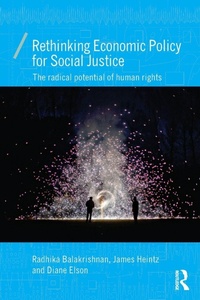
Rethinking Economic Policy for Social Justice
The radical potential of human rights
1st Edition
Published on 24. March 2016
Book
Paperback/Softback
152 pages
978-1-138-82915-2 (ISBN)
Description
The dominant approach to economic policy has so far failed to adequately address the pressing challenges the world faces today: extreme poverty, widespread joblessness and precarious employment, burgeoning inequality, and large-scale environmental threats. This message was brought home forcibly by the 2008 global economic crisis.
Rethinking Economic Policy for Social Justice shows how human rights have the potential to transform economic thinking and policy-making with far-reaching consequences for social justice. The authors make the case for a new normative and analytical framework, based on a broader range of objectives which have the potential to increase the substantive freedoms and choices people enjoy in the course of their lives and not on not upon narrow goals such as the growth of gross domestic product. The book covers a range of issues including inequality, fiscal and monetary policy, international development assistance, financial markets, globalization, and economic instability. This new approach allows for a complex interaction between individual rights, collective rights and collective action, as well as encompassing a legal framework which offers formal mechanisms through which unjust policy can be protested.
This highly original and accessible book will be essential reading for human rights advocates, economists, policy-makers and those working on questions of social justice.
Rethinking Economic Policy for Social Justice shows how human rights have the potential to transform economic thinking and policy-making with far-reaching consequences for social justice. The authors make the case for a new normative and analytical framework, based on a broader range of objectives which have the potential to increase the substantive freedoms and choices people enjoy in the course of their lives and not on not upon narrow goals such as the growth of gross domestic product. The book covers a range of issues including inequality, fiscal and monetary policy, international development assistance, financial markets, globalization, and economic instability. This new approach allows for a complex interaction between individual rights, collective rights and collective action, as well as encompassing a legal framework which offers formal mechanisms through which unjust policy can be protested.
This highly original and accessible book will be essential reading for human rights advocates, economists, policy-makers and those working on questions of social justice.
Reviews / Votes
'In this important new book, Balakrishnan, Heintz and Elson have set out to challenge the dominant economic paradigm in the name of social justice and human rights. Applying a rigorous human rights lens, they expose the fundamental weaknesses of neoliberal economic policy both nationally and in its globalized manifestations, prescribing a new approach built not on deference to markets but on empowerment of people; not on GDP but on progress; not on aggregate wealth but on dignity and equality; and not on austerity but on the advancement of economic and social rights. What they have constructed is an economics of human rights-an economics for the 99%.' - Craig Mokhiber, Chief of Development and Economic and Social Issues, United Nations Human Rights Office'Radhika Balakrishnan, Diane Elson and James Heinz's book could not be more timely. Decades of neoliberalism and the global financial crisis have wrecked the economy, compromised the life chances of the vulnerable around the world, destroyed the environment, and privileged the wealthy and powerful. The book provides an urgently needed ethical antidote to neoliberalism, one that develops a fresh and radically powerful rights-based approach that places ethics, social justice, and the right to a good and just life at the heart of economic policy design and evaluation.' - Professor Ilene Grabel, Josef Korbel School of International Studies, University of Denver, USA, and co-author (with Ha-Joon Chang) of Reclaiming Development: An Alternative Economic Policy Manual (2004, 2014, Zed Books)
'Amidst tired rehearsals of the argument that security has now trumped human rights, and normalisation of the neo-liberal economy we live with, this book comes like a breath of fresh air into a stale environment. By reconnecting political economy with human rights, the authors do a great service of desecuritising human-rights based approaches to economic and social change and to macro-level policy making. It is going to be useful for our students in understanding connections too rarely explored - especially between challenges to globalised impoverishment and assertions of people's fundamental human rights' - Helen Hintjens, Assistant Professor in Development and Social Justice, ISS (International Institute of Social Justice of Erasmus University Rotterdam) The Hague, Netherlands.
'Rethinking Economic Policy for Social Justice has value as a clearly presented text that provides a barometer of present thinking in human rights circles on the practical application of international human rights law'. - Dorothea Anthony, University of New South Wales, Sydney, Australia
More details
Series
Language
English
Place of publication
London
United Kingdom
Publishing group
Taylor & Francis Ltd
Target group
College/higher education
Illustrations
5 s/w Abbildungen, 5 s/w Zeichnungen
5 Line drawings, black and white; 5 Illustrations, black and white
Dimensions
Height: 234 mm
Width: 156 mm
Thickness: 9 mm
Weight
266 gr
ISBN-13
978-1-138-82915-2 (9781138829152)
Copyright in bibliographic data and cover images is held by Nielsen Book Services Limited or by the publishers or by their respective licensors: all rights reserved.
Schweitzer Classification
Other editions
Additional editions
Radhika Balakrishnan | James Heintz | Diane Elson
Rethinking Economic Policy for Social Justice
The radical potential of human rights
Book
04/2016
1st Edition
Routledge
€241.30
Shipment within 10-20 days
Radhika Balakrishnan | James Heintz | Diane Elson
Rethinking Economic Policy for Social Justice
The radical potential of human rights
E-Book
03/2016
Routledge
€80.49
Available for download
Radhika Balakrishnan | James Heintz | Diane Elson
Rethinking Economic Policy for Social Justice
The radical potential of human rights
E-Book
03/2016
Routledge
€80.49
Available for download
Persons
Radhika Balakrishnan is the Faculty Director at the Center for Women's Global Leadership, and Professor of Women's and Gender Studies at Rutgers University, USA.
James Heintz is the Andrew Glyn Professor of Economics and Associate Director of the Political Economy Research Institute at the University of Massachusetts Amherst, USA.
Diane Elson is Emeritus Professor of Sociology at the University of Essex, Visiting Professor at the Centre for Research on Women in Scotland's Economy at Glasgow Caledonian University, and Research Associate of the Center for Women's Global Leadership at Rutgers University, USA.
James Heintz is the Andrew Glyn Professor of Economics and Associate Director of the Political Economy Research Institute at the University of Massachusetts Amherst, USA.
Diane Elson is Emeritus Professor of Sociology at the University of Essex, Visiting Professor at the Centre for Research on Women in Scotland's Economy at Glasgow Caledonian University, and Research Associate of the Center for Women's Global Leadership at Rutgers University, USA.
Content
1. The Radical Potential of Human Rights 2. The Human Rights Framework and Economic Policy 3. What Does Inequality Have to Do With Human Rights? 4. A Human Rights Approach to Government Spending and Taxation 5. Mobilizing Resources to Realize Rights: Debt, Aid, and Monetary Policy 6. Financialization, Credit Markets, and Human Rights 7. Extraterritorial Obligations, Human Rights and Economic Governance 8. Economic Crises and Human Rights 9. Conclusion