

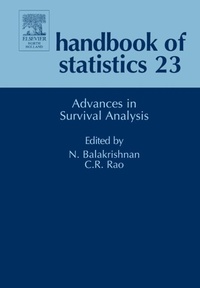
Advances in Survival Analysis: Volume 23
Advances in Survival Analysis
Published on 30. January 2004
Book
Hardback
822 pages
978-0-444-50079-3 (ISBN)
Description
Handbook of Statistics: Advances in Survival Analysis covers all important topics in the area of Survival Analysis. Each topic has been covered by one or more chapters written by internationally renowned experts. Each chapter provides a comprehensive and up-to-date review of the topic. Several new illustrative examples have been used to demonstrate the methodologies developed. The book also includes an exhaustive list of important references in the area of Survival Analysis.
Reviews / Votes
"Forty papers provide an overview of survival analysis and describe the state of the art (...) in this field of statistics." --Journal of Economic Literature, 2004-1222"The book successfully provides the reader with an overiew of which topics are the subject of current research in survival analysis. Areas covered include (to name a few): complex patterns of information loss, bivariate survival, multi-state models, gene expression analysis, and quality of life analysis." --Jan Beyersmann, in STATISTICS IN MEDICINE, Vol. 24, 2005
More details
Series
Language
English
Place of publication
United States
Publishing group
Elsevier Science & Technology
Target group
Professional and scholarly
Biostatisticians, Mathematical Statisticians and
Reliability Engineers.
Product notice
Laminated cover
Dimensions
Height: 244 mm
Width: 167 mm
Thickness: 55 mm
Weight
1330 gr
ISBN-13
978-0-444-50079-3 (9780444500793)
Copyright in bibliographic data and cover images is held by Nielsen Book Services Limited or by the publishers or by their respective licensors: all rights reserved.
Schweitzer Classification
Other editions
Additional editions
Narayanaswamy Balakrishnan | C. R. Rao
Advances in Survival Analysis
E-Book
01/2004
Elsevier
€220.00
Available for download
Persons
Narayanaswamy Balakrishnan is a distinguished university professor in the Department of Mathematics and Statistics at McMaster University Hamilton, Ontario, Canada. He is an internationally recognized expert on statistical distribution theory, and a book-powerhouse with over 24 authored books, four authored handbooks, and 30 edited books under his name. He is currently the Editor-in-Chief of Communications in Statistics published by Taylor & Francis. He was also the Editor-in-Chief for the revised version of Encyclopedia of Statistical Sciences published by John Wiley & Sons. He is a Fellow of the American Statistical Association and a Fellow of the Institute of Mathematical Statistics. In 2016, he was awarded an Honorary Doctorate from The National and Kapodistrian University of Athens, Athens, Greece. In 2021, he was elected as a Fellow of the Royal Society of Canada. book "Ancient Inhabitants of Jebel Moya? published by the Cambridge Press under the joint authorship of Rao and two anthropologists. On the basis of work done at CU during the two year period, 1946-1948, Rao earned a Ph.D. degree and a few years later Sc.D. degree of CU and the rare honor of life fellowship of Kings College, Cambridge.
He retired from ISI in 1980 at the mandatory age of 60 after working for 40 years during which period he developed ISI as an international center for statistical education and research. He also took an active part in establishing state statistical bureaus to collect local statistics and transmitting them to Central Statistical Organization in New Delhi. Rao played a pivitol role in launching undergraduate and postgraduate courses at ISI. He is the author of 475 research publications and several breakthrough papers contributing to statistical theory and methodology for applications to problems in all areas of human endeavor. There are a number of classical statistical terms named after him, the most popular of which are Cramer-Rao inequality, Rao-Blackwellization, Rao's Orthogonal arrays used in quality control, Rao's score test, Rao's Quadratic Entropy used in ecological work, Rao's metric and distance which are incorporated in most statistical books.
He is the author of 10 books, of which two important books are, Linear Statistical Inference which is translated into German, Russian, Czec, Polish and Japanese languages,and Statistics and Truth which is translated into, French, German, Japanese, Mainland Chinese, Taiwan Chinese, Turkish and Korean languages.
He directed the research work of 50 students for the Ph.D. degrees who in turn produced 500 Ph.D.'s. Rao received 38 hon. Doctorate degree from universities in 19 countries spanning 6 continents. He received the highest awards in statistics in USA,UK and India: National Medal of Science awarded by the president of USA, Indian National Medal of Science awarded by the Prime Minister of India and the Guy Medal in Gold awarded by the Royal Statistical Society, UK. Rao was a recipient of the first batch of Bhatnagar awards in 1959 for mathematical sciences and and numerous medals in India and abroad from Science Academies. He is a Fellow of Royal Society (FRS),UK, and member of National Academy of Sciences, USA, Lithuania and Europe. In his honor a research Institute named as CRRAO ADVANCED INSTITUTE OF MATHEMATICS, STATISTICS AND COMPUTER SCIENCE was established in the campus of Hyderabad University.
He retired from ISI in 1980 at the mandatory age of 60 after working for 40 years during which period he developed ISI as an international center for statistical education and research. He also took an active part in establishing state statistical bureaus to collect local statistics and transmitting them to Central Statistical Organization in New Delhi. Rao played a pivitol role in launching undergraduate and postgraduate courses at ISI. He is the author of 475 research publications and several breakthrough papers contributing to statistical theory and methodology for applications to problems in all areas of human endeavor. There are a number of classical statistical terms named after him, the most popular of which are Cramer-Rao inequality, Rao-Blackwellization, Rao's Orthogonal arrays used in quality control, Rao's score test, Rao's Quadratic Entropy used in ecological work, Rao's metric and distance which are incorporated in most statistical books.
He is the author of 10 books, of which two important books are, Linear Statistical Inference which is translated into German, Russian, Czec, Polish and Japanese languages,and Statistics and Truth which is translated into, French, German, Japanese, Mainland Chinese, Taiwan Chinese, Turkish and Korean languages.
He directed the research work of 50 students for the Ph.D. degrees who in turn produced 500 Ph.D.'s. Rao received 38 hon. Doctorate degree from universities in 19 countries spanning 6 continents. He received the highest awards in statistics in USA,UK and India: National Medal of Science awarded by the president of USA, Indian National Medal of Science awarded by the Prime Minister of India and the Guy Medal in Gold awarded by the Royal Statistical Society, UK. Rao was a recipient of the first batch of Bhatnagar awards in 1959 for mathematical sciences and and numerous medals in India and abroad from Science Academies. He is a Fellow of Royal Society (FRS),UK, and member of National Academy of Sciences, USA, Lithuania and Europe. In his honor a research Institute named as CRRAO ADVANCED INSTITUTE OF MATHEMATICS, STATISTICS AND COMPUTER SCIENCE was established in the campus of Hyderabad University.
Content
Part I. General Methodology.Evaluation of the Performance of Survival Analysis Models: Discrimination and Calibration Measures (R.B. D'Agostino, B.-H. Nam).Discretizing a Continuous Covariate in Survival Studies (J.P. Klein, J.-T. Wu).On Comparison of Two Classification Methods with Survival Endpoints (Y. Lu, H. Jin, J. Mi).Time-Varying Effects in Survival Analysis (T.H. Scheike).Kaplan-Meier Integrals (W. Stute).
Part II. Concensored Data and Inference.Statistical Analysis of Doubly Interval-Censored Failure Time Data (J. Sun).The Missing Consoring-Indicator Model of Random Censorship (S. Subramanian).Estimation of the Bivariate Survival Function with Generalized Bivariate Right Censored Data Structures (S. Keles, M.J. van der Laan, J.M. Robins).Estimation of Semi-Markov Models with Right-Censored Data (O. Pons). Part III. Truncated Data and Inference.Nonparametric Bivariate Estimation with Randomly Truncated Observations (UE. Guerler). Part IV. Hazard Rate Estimation.Lower Bounds for Estimating a Hazard (C. Huber, b. MacGibbon).Non-Parametric Hazard Rate Estimation under Proressive Type-II Consoring (N. Balakrishnan, L. Bordes) Part V. Comparison of Survival Curves.Statistical Tests of the Equality of Survival Curves: Reconsidering the Options (G.P. Suciu, S. Lemeshow, M. Moeschberger).Testing Equality of Survival Functions with Bivariate Censored Data: A Review (P.V. Rao).Statistical Methods for the Comparison of Crossing Survival Curves (C.T. Le).
Part VI. Competing Risks and Analysis.Inference for Competing Risks (J.P. Klein, R. Bajorunaite).Analysis of Cause-Specific Events in Competing Risks Survival Data (J. Dignam, J. Bryant, H.S. Wieand).Analysis of Progressively Censored Competing Risks Data (D. Kundu, N. Kannan, N. Balakrishnan).Marginal Analysis of Point Processes with Competing Risks (R.J. Cook, B. Chen, P. Major).
Part VII. Propoertional Hazards Model and Analysis.Categorical Auxiliary Data in the Discrete Time Proportional Hazards Model (P. Slasor, N. Laird).Hosmer and Lemeshow type Goodness-of-Fit Statistics for the Cox Proportional Hazards Model (S. May, D.W. Hosmer).The Effects of Misspecifying Cox's Regression Model on Randomized Treatment Group Comparisons (A.G. DiRienzo, S.W. Lagakos).Statistical Modeling in Survival Analysis and Its Influence on the Duration Analysis (V. Bagdonavicius, M. Nikulin.
Part VIII. Accelerated Models and Analysis.Accelerated Hazards Model: Method, Theory and Applications (Y.Q. Chen, N.P. Jewell, J. Yang).Diagnostics for the Accelerated Life Time Model of Survival Data (D. Zelterman, H. Lin).Cumulative Damage Approaches Leading to Inverse Gaussian Accelerated Test Models (A. Onar, W.J. Padgett).On Estimating the Gamma Accelerated Failure-Time Models (K.M. Koti).
Part IX. Frailty Models and Applications.Frailty Model and its Application to Seizure Data (N. Ebrahimi, X. Zhang, A. Berg, S. Shinnar).
Part X. Models and Applications.State Space Models for Survival Analysis (W.Y. Tan, W. Ke).First Hitting Time Models for Lifetime Date (M.-L.T. Lee, G.A. Whitmore).An Increasing Hazard Cure Model (Y. Peng, K.B.G. Dear).
Part XI. Multivariate Survival Data Analysis.Marginal Analyses of Multistage Data (G.A. Satten, S. Datta).The Matrix-Valued Counting Process Model with Proportional Hazards for Sequential Survival Data (K.L. Kesler, P.K. Sen).
Part XII. Recurrent Event Data Analysis.Analysis of Recurrent Event Data (J. Cai, D.E. Schaubel).
Part XIII. Current Status Data Analysis.Current Status Data: Review, Recent Developments and Open Problems (N.P. Jewell, M. van der Laan).
Part XIV. Disease Progression Analysis.Appraisal of Models for the Study of Disease Progression in Psoriatic Arthritis (R. Aguirre-Hernandez, V.T. Farewell).
Part XV. Gene Expressions and Analysis.Survival Analysis with Gene Expression Arrays (D.K. Pauler, J. Hardin, J.R. Faulkner, M. LeBlanc, J.J. Crowley).
Part XVI. Quality of Life Analysis.Joint Analysis of Longitudinal Quailty of Life and Survival Processes (M. Mesbah, J.-F. Dupuy, N. Heutte, L. Awad).
Part XVII. Flowgraph Models and Applications.Modelling Survival Data using Flowgraph Models (A.V. Huzurbazar).
Part XVIII. Repair Models and Analysis.Nonparametric Methods for Repair Models (M. Hollander, J. Sethuraman).
Part II. Concensored Data and Inference.Statistical Analysis of Doubly Interval-Censored Failure Time Data (J. Sun).The Missing Consoring-Indicator Model of Random Censorship (S. Subramanian).Estimation of the Bivariate Survival Function with Generalized Bivariate Right Censored Data Structures (S. Keles, M.J. van der Laan, J.M. Robins).Estimation of Semi-Markov Models with Right-Censored Data (O. Pons). Part III. Truncated Data and Inference.Nonparametric Bivariate Estimation with Randomly Truncated Observations (UE. Guerler). Part IV. Hazard Rate Estimation.Lower Bounds for Estimating a Hazard (C. Huber, b. MacGibbon).Non-Parametric Hazard Rate Estimation under Proressive Type-II Consoring (N. Balakrishnan, L. Bordes) Part V. Comparison of Survival Curves.Statistical Tests of the Equality of Survival Curves: Reconsidering the Options (G.P. Suciu, S. Lemeshow, M. Moeschberger).Testing Equality of Survival Functions with Bivariate Censored Data: A Review (P.V. Rao).Statistical Methods for the Comparison of Crossing Survival Curves (C.T. Le).
Part VI. Competing Risks and Analysis.Inference for Competing Risks (J.P. Klein, R. Bajorunaite).Analysis of Cause-Specific Events in Competing Risks Survival Data (J. Dignam, J. Bryant, H.S. Wieand).Analysis of Progressively Censored Competing Risks Data (D. Kundu, N. Kannan, N. Balakrishnan).Marginal Analysis of Point Processes with Competing Risks (R.J. Cook, B. Chen, P. Major).
Part VII. Propoertional Hazards Model and Analysis.Categorical Auxiliary Data in the Discrete Time Proportional Hazards Model (P. Slasor, N. Laird).Hosmer and Lemeshow type Goodness-of-Fit Statistics for the Cox Proportional Hazards Model (S. May, D.W. Hosmer).The Effects of Misspecifying Cox's Regression Model on Randomized Treatment Group Comparisons (A.G. DiRienzo, S.W. Lagakos).Statistical Modeling in Survival Analysis and Its Influence on the Duration Analysis (V. Bagdonavicius, M. Nikulin.
Part VIII. Accelerated Models and Analysis.Accelerated Hazards Model: Method, Theory and Applications (Y.Q. Chen, N.P. Jewell, J. Yang).Diagnostics for the Accelerated Life Time Model of Survival Data (D. Zelterman, H. Lin).Cumulative Damage Approaches Leading to Inverse Gaussian Accelerated Test Models (A. Onar, W.J. Padgett).On Estimating the Gamma Accelerated Failure-Time Models (K.M. Koti).
Part IX. Frailty Models and Applications.Frailty Model and its Application to Seizure Data (N. Ebrahimi, X. Zhang, A. Berg, S. Shinnar).
Part X. Models and Applications.State Space Models for Survival Analysis (W.Y. Tan, W. Ke).First Hitting Time Models for Lifetime Date (M.-L.T. Lee, G.A. Whitmore).An Increasing Hazard Cure Model (Y. Peng, K.B.G. Dear).
Part XI. Multivariate Survival Data Analysis.Marginal Analyses of Multistage Data (G.A. Satten, S. Datta).The Matrix-Valued Counting Process Model with Proportional Hazards for Sequential Survival Data (K.L. Kesler, P.K. Sen).
Part XII. Recurrent Event Data Analysis.Analysis of Recurrent Event Data (J. Cai, D.E. Schaubel).
Part XIII. Current Status Data Analysis.Current Status Data: Review, Recent Developments and Open Problems (N.P. Jewell, M. van der Laan).
Part XIV. Disease Progression Analysis.Appraisal of Models for the Study of Disease Progression in Psoriatic Arthritis (R. Aguirre-Hernandez, V.T. Farewell).
Part XV. Gene Expressions and Analysis.Survival Analysis with Gene Expression Arrays (D.K. Pauler, J. Hardin, J.R. Faulkner, M. LeBlanc, J.J. Crowley).
Part XVI. Quality of Life Analysis.Joint Analysis of Longitudinal Quailty of Life and Survival Processes (M. Mesbah, J.-F. Dupuy, N. Heutte, L. Awad).
Part XVII. Flowgraph Models and Applications.Modelling Survival Data using Flowgraph Models (A.V. Huzurbazar).
Part XVIII. Repair Models and Analysis.Nonparametric Methods for Repair Models (M. Hollander, J. Sethuraman).