

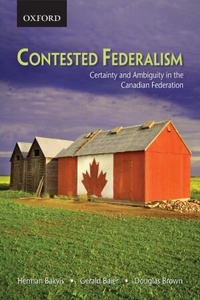
Contested Federalism
Certainty and Ambiguity in the Canadian Federation
Published on 29. January 2009
Book
Paperback/Softback
320 pages
978-0-19-542529-1 (ISBN)
Description
Contested Federalism: Certainty and Ambiguity in the Canadian Federation examines the relations between and within the two main orders of government in Canada-the federal government and the provincial and territorial governments, the two central players in the intergovernmental system. The text also examines other orders of government, or would-be governments, which can be considered part of the broader federal and intergovernmental framework, even if these
governments or proto-governments lack explicit constitutional recognition-that is, municipalities and First Nations, and other Aboriginal peoples' governments. In doing so, the book focuses on three areas: basic federal and intergovernmental structure, the constitutional and institutional framework, and what
can be termed 'federal governance'.
Federalism, and particularly the Canadian variant, involves an ongoing contestation of interests, ideas, and identities. It is a contestation that sometimes clarifies but often obscures the nature of conflicts and the manner in which they are resolved. Because of the great degree of ambivalence associated with federalism, the authors provide students with the conceptual tools and basic knowledge of various governmental processes that will allow them to analyze and, if necessary, critique
intergovernmental relations.
governments or proto-governments lack explicit constitutional recognition-that is, municipalities and First Nations, and other Aboriginal peoples' governments. In doing so, the book focuses on three areas: basic federal and intergovernmental structure, the constitutional and institutional framework, and what
can be termed 'federal governance'.
Federalism, and particularly the Canadian variant, involves an ongoing contestation of interests, ideas, and identities. It is a contestation that sometimes clarifies but often obscures the nature of conflicts and the manner in which they are resolved. Because of the great degree of ambivalence associated with federalism, the authors provide students with the conceptual tools and basic knowledge of various governmental processes that will allow them to analyze and, if necessary, critique
intergovernmental relations.
Reviews / Votes
"This is a book I've waited for 35 years for: it is comprehensive, superbly readable, uniform in style and language, and consistent in its comprehensibility. It has immediate coherence, relevance, and accessibility. Its voice is clear, timely, thoughtful, and provocative. It illuminates without preaching. It will become the superior primer on Canadian federalism for students first encountering this versatile governing system."--Anthony Careless, University of Toronto
More details
Language
English
Place of publication
Toronto
Canada
Target group
College/higher education
Professional and scholarly
Illustrations
5 tables, 5 figures
Dimensions
Height: 230 mm
Width: 153 mm
Thickness: 11 mm
Weight
425 gr
ISBN-13
978-0-19-542529-1 (9780195425291)
Copyright in bibliographic data and cover images is held by Nielsen Book Services Limited or by the publishers or by their respective licensors: all rights reserved.
Schweitzer Classification
Persons
Herman Bakvis is Professor of Public Administration at the University of Victoria. His research interests include federalism, the policy process, and government structure and organization.
Gerald Baier is Assistant Professor of Political Science at the University of British Columbia. His research interests focus on Canadian federalism and the constitution. Of particular interest is the role of courts and the law in the development of Canadian federalism and the constitutional division of powers.
Douglas Brown is a Fellow and former Director of the Institute of Intergovernmental Relations at Queen's University in Kingston, Ontario. He is also Assistant Professor of Political Science at St Francis Xavier University. His main area of interest is Canadian federalism and intergovernmental relations, where he has over 25 years' experience as both a practitioner and an academic observer.
Gerald Baier is Assistant Professor of Political Science at the University of British Columbia. His research interests focus on Canadian federalism and the constitution. Of particular interest is the role of courts and the law in the development of Canadian federalism and the constitutional division of powers.
Douglas Brown is a Fellow and former Director of the Institute of Intergovernmental Relations at Queen's University in Kingston, Ontario. He is also Assistant Professor of Political Science at St Francis Xavier University. His main area of interest is Canadian federalism and intergovernmental relations, where he has over 25 years' experience as both a practitioner and an academic observer.
Content
Introduction ; 1. Approaches to Federalism and Intergovernmental Relations ; 2. The Economic, Social, and Institutional Basis of Canadian Federalism ; 3. Intergovernmental Relations and the Policy Process: A Framework ; 4. The Constitution and Constitutional Change ; 5. Judicial Review and Dispute Resolution ; 6. The Settings of Executive Federalism ; 7. The Management and Reform of Executive Federalism ; 8. Fiscal Relations: Basic Principles and Overview ; 9. Fiscal Relations: Key Issues into the Harper Era ; 10. The Social Union, SUFA, and the Health Care Gorilla ; 11. Economic Union and Economic Policy ; 12. The Environmental Union ; 13. Local Government and Federalism ; 14. Aboriginal Governments and Federalism ; Conclusion: The Ambivalent Federation