

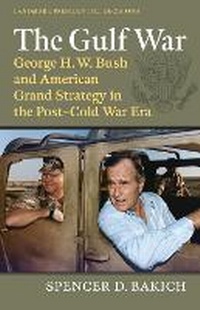
The Gulf War
George H. W. Bush and American Grand Strategy in the Post-Cold War Era
Published on 31. July 2024
Book
Hardback
160 pages
978-0-7006-3687-7 (ISBN)
Description
President George H. W. Bush assumed office at a critical juncture, as the Cold War came to an end and the world shifted to a new era of international relations. In The Gulf War, Spencer Bakich argues that Bush fashioned a grand strategy to bring about a New World Order designed to transform international politics by focusing on great power cooperation through the United Nations. The Persian Gulf War became the chance for Bush to put his strategy into action. This latest volume in the Landmark Presidential Decision series offers a fresh and concise look at President Bush's strategic decision making and his choice to wage war against Iraq.Bakich, an expert in wartime strategy, traces the ideas and actions of Bush's new world order strategy between 1989 and 1991, which had a profound impact on the diplomacy of Desert Shield and the warfighting of Desert Storm. Bush's strategic beliefs contained core elements of Wilsonian internationalism-specifically its goals of promoting democracy, conducting multilateral diplomacy through international institutions, and transforming the United Nations into the collective security institution that its founders envisioned. His "New World Order" was not mere political sloganeering intended to bolster support for the Persian Gulf War among a skeptical American public. Rather, Bush intended the Gulf War to exercise and firmly establish the UN's collective security function in the post-Cold War era.
In this bold new interpretation of George H. W. Bush's foreign policy, Bakich challenges conventional wisdom, arguing that Bush's New World Order was carefully defined and had a comprehensive logic. He shows how Bush's strategic beliefs oriented American statecraft in peace and war. Bush's grand strategy was remarkably coherent, powerfully affecting how his administration decided to go to war to evict Iraq from Kuwait, how it waged war in the Persian Gulf, and ultimately the reasons why the fighting was terminated before the coalition's war aims were completely achieved. In the end, the Gulf War's outcome exposed faulty assumptions about the international system that underpinned the strategy, weakening the president's fidelity to his own approach. Ultimately, the Gulf War did usher in a New World Order, but not the one Bush had envisioned.
In this bold new interpretation of George H. W. Bush's foreign policy, Bakich challenges conventional wisdom, arguing that Bush's New World Order was carefully defined and had a comprehensive logic. He shows how Bush's strategic beliefs oriented American statecraft in peace and war. Bush's grand strategy was remarkably coherent, powerfully affecting how his administration decided to go to war to evict Iraq from Kuwait, how it waged war in the Persian Gulf, and ultimately the reasons why the fighting was terminated before the coalition's war aims were completely achieved. In the end, the Gulf War's outcome exposed faulty assumptions about the international system that underpinned the strategy, weakening the president's fidelity to his own approach. Ultimately, the Gulf War did usher in a New World Order, but not the one Bush had envisioned.
Reviews / Votes
Spencer Bakich brightly illuminates two central realities of one of America's most important foreign engagements of the twentieth century. First, he shows that President Bush not only put together an all-star team of national security experts-Baker, Cheney, Scowcroft, Powell, and Gates-the president personally provided the bold strategic leadership and political backbone indispensable to their success. Second, Bakich elaborately demonstrates how the liberation of Kuwait was central to Bush's conception of a New World Order. Little was done against Baghdad without considering the consequences for Berlin and Moscow-and what Bush hoped would be a prototype of action for the United Nations. An eminently readable and convincing account.""-Russell L. Riley, author of Inside the Clinton White House: An Oral History and coeditor of 43: Inside the George W. Bush Presidency""George H. W. Bush was president at a pivot point in international politics. Most observers say that his extensive experience and prudential disposition made him an effective manager-not a maker-of the post-Cold War world. Spencer Bakich disagrees. He retells the story of Bush era foreign policy with brevity, clarity, and balance. But he does much more. Bakich argues that the elder President Bush actually had a grand strategy for US leadership in the new world that was emerging. This is a controversial claim that challenges conventional wisdom and will generate a healthy reconsideration of the Bush 41 foreign policy legacy.""-Robert A. Strong, author of Character and Consequence: Foreign Policy Decisions of George H. W. Bush""The Gulf War: George H. W. Bush and American Grand Strategy in the Post-Cold War Era offers readers a valuable synthesis of the George H.W. Bush administration's grand strategy. Spencer Bakich reviews how President Bush, National Security Adviser Scowcroft, the NSC staff, and others in the administration conceived and implemented their grand strategy over the months of Desert Shield and weeks of Desert Storm. The book is particularly strong on the diplomatic, military, and political steps taken by the Bush administration to create an international coalition able to evict Iraqi military forces from Kuwait. For a moment, the United States had forged a New World Order, one based on the promotion of stable international relations, the rule of law, respect for human dignity, and the expansion of free markets and democratic government. But as the author shows, this grand strategy foundered on the shoals of Saddam Hussein's truculence in Iraq, events in Yugoslavia and elsewhere around the world, and differences in Washington and among Republicans on the future of US national security policy.""-Bartholomew Sparrow, author of The Strategist: Brent Scowcroft and the Call of National Security
More details
Series
Language
English
Place of publication
Kansas
United States
Target group
Professional and scholarly
Dimensions
Height: 216 mm
Width: 140 mm
ISBN-13
978-0-7006-3687-7 (9780700636877)
Copyright in bibliographic data and cover images is held by Nielsen Book Services Limited or by the publishers or by their respective licensors: all rights reserved.
Schweitzer Classification
Other editions
Additional editions
Spencer D. Bakich
The Gulf War
George H. W. Bush and American Grand Strategy in the Post-Cold War Era
E-Book
08/2024
University Press of Kansas
€24.49
Available for download
Person
Spencer D. Bakich is Professor of International Studies and Director of the National Security Program at the Virginia Military Institute, and is a Senior Fellow at the University of Virginia's Miller Center. He is the author of Success and Failure in Limited War: Information and Strategy in the Korean, Vietnam, Persian Gulf, and Iraq Wars.
Content
Foreword by Meena Bose
Acknowledgments
Introduction
1. George Bush: President and Strategist
2. The New World Order Grand Strategy, 1989-1990
3. Operation Desert Shield and the Decision for War
4. Operation Desert Storm
5. War and Statecraft in the post-Cold War Era
Notes
Bibliographic Essay
Index
Acknowledgments
Introduction
1. George Bush: President and Strategist
2. The New World Order Grand Strategy, 1989-1990
3. Operation Desert Shield and the Decision for War
4. Operation Desert Storm
5. War and Statecraft in the post-Cold War Era
Notes
Bibliographic Essay
Index