

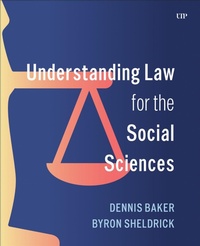
Understanding Law for the Social Sciences
Published on 22. July 2025
Book
Paperback/Softback
276 pages
978-1-4875-9333-9 (ISBN)
Description
Understanding Law for the Social Sciences provides students with essential tools to study Canadian law from various disciplinary perspectives. It introduces key legal principles and concepts, ensuring that social science students build a strong foundation to engage confidently with legal topics.
The book focuses on legal doctrines, helping students understand how these doctrines are applied by lawyers, judges, and legal scholars. To achieve this aim, it begins with chapters that cover the sources of law, legal reasoning, and statutory interpretation. Subsequent chapters introduce substantive areas of law, including constitutional law, criminal law, administrative law, contract law, tort law, property law, labour law, and environmental law. For each of these areas, the text not only outlines core concepts and terminology but also illustrates how legal controversies intersect with public debates, state authority, self-governance, and public policy.
Designed as an introduction to law and legal concepts, Understanding Law for the Social Sciences prepares undergraduate students to engage with legal matters that they might further examine in law school or explore in social science graduate study. While the book is especially beneficial for political science students due to its focus on public policy, its broad scope offers valuable insights for anyone interested in understanding the role of law in society.
The book focuses on legal doctrines, helping students understand how these doctrines are applied by lawyers, judges, and legal scholars. To achieve this aim, it begins with chapters that cover the sources of law, legal reasoning, and statutory interpretation. Subsequent chapters introduce substantive areas of law, including constitutional law, criminal law, administrative law, contract law, tort law, property law, labour law, and environmental law. For each of these areas, the text not only outlines core concepts and terminology but also illustrates how legal controversies intersect with public debates, state authority, self-governance, and public policy.
Designed as an introduction to law and legal concepts, Understanding Law for the Social Sciences prepares undergraduate students to engage with legal matters that they might further examine in law school or explore in social science graduate study. While the book is especially beneficial for political science students due to its focus on public policy, its broad scope offers valuable insights for anyone interested in understanding the role of law in society.
More details
Language
English
Place of publication
Toronto
Canada
Target group
College/higher education
Professional and scholarly
Product notice
Paperback (trade)
Illustrations
2 illustrations
Dimensions
Height: 234 mm
Width: 191 mm
Thickness: 20 mm
Weight
540 gr
ISBN-13
978-1-4875-9333-9 (9781487593339)
Copyright in bibliographic data and cover images is held by Nielsen Book Services Limited or by the publishers or by their respective licensors: all rights reserved.
Schweitzer Classification
Persons
Dennis Baker is an associate professor of political science at the University of Guelph.
Byron Sheldrick is associate vice-president academic and professor of political science at the University of Guelph.
Byron Sheldrick is associate vice-president academic and professor of political science at the University of Guelph.
Content
List of Figures, Tables, and Boxes
Preface
Introduction
Part One: Foundations of Law
1. Sources of Law
2. Legal Reasoning & Statutory Interpretation
3. The Canadian Constitution
Part Two: Fields of Legal Doctrine and Practice
4. The Criminal Law
5. Administrative Law
6. Private Law with Public Dimensions: Contracts
7. Private Law with Public Dimensions: Torts
8. Property Law
9. Labour Law
10. Law and the Environment
Afterword
Glossary
References
Index
Preface
Introduction
Part One: Foundations of Law
1. Sources of Law
2. Legal Reasoning & Statutory Interpretation
3. The Canadian Constitution
Part Two: Fields of Legal Doctrine and Practice
4. The Criminal Law
5. Administrative Law
6. Private Law with Public Dimensions: Contracts
7. Private Law with Public Dimensions: Torts
8. Property Law
9. Labour Law
10. Law and the Environment
Afterword
Glossary
References
Index