

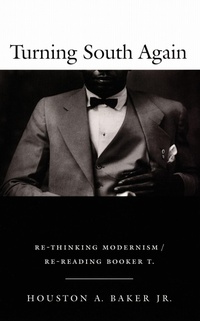
Turning South Again
Re-Thinking Modernism/Re-Reading Booker T.
Will be published approx. on 6. June 2001
Book
Paperback/Softback
128 pages
978-0-8223-2695-3 (ISBN)
Description
In Turning South Again the distinguished and award-winning essayist, poet, and scholar of African American literature Houston A. Baker, Jr. offers a revisionist account of the struggle for black modernism in the United States. With a take on the work of Booker T. Washington and the Tuskegee Institute surprisingly different from that in his earlier book Modernism and the Harlem Renaissance, Baker combines historical considerations with psychoanalysis, personal memoir, and whiteness studies to argue that the American South and its regulating institutions-particularly that of incarceration-have always been at the center of the African American experience.
From the holds of slave ships to the peonage of Reconstruction to the contemporary prison system, incarceration has largely defined black life in the United States. Even Washington's school at Tuskegee, Baker explains, housed and regulated black bodies no longer directly controlled by slave owners. He further implicates Washington by claiming that in enacting his ideas about racial "uplift," Washington engaged in "mulatto modernism," a compromised attempt at full citizenship. Combining autobiographical prose, literary criticism, psychoanalytic writing, and, occasionally, blues lyrics and poetry, Baker meditates on the consequences of mulatto modernism for the project of black modernism, which he defines as the achievement of mobile, life-enhancing participation in the public sphere and economic solvency for the majority of African Americans. By including a section about growing up in the South, as well as his recent return to assume a professorship at Duke, Baker contributes further to one of the book's central concerns: a call to centralize the South in American cultural studies.
From the holds of slave ships to the peonage of Reconstruction to the contemporary prison system, incarceration has largely defined black life in the United States. Even Washington's school at Tuskegee, Baker explains, housed and regulated black bodies no longer directly controlled by slave owners. He further implicates Washington by claiming that in enacting his ideas about racial "uplift," Washington engaged in "mulatto modernism," a compromised attempt at full citizenship. Combining autobiographical prose, literary criticism, psychoanalytic writing, and, occasionally, blues lyrics and poetry, Baker meditates on the consequences of mulatto modernism for the project of black modernism, which he defines as the achievement of mobile, life-enhancing participation in the public sphere and economic solvency for the majority of African Americans. By including a section about growing up in the South, as well as his recent return to assume a professorship at Duke, Baker contributes further to one of the book's central concerns: a call to centralize the South in American cultural studies.
Reviews / Votes
"A book by Baker tends to be something of an event in the field-the field being not only African American literature but also cultural studies impinging on Americana. His books have an impact, cause discussion, and provoke debates. This one, however, seems to me unusually well motivated. Personal matters have moved Baker to outdo himself in the sharpness of his observations, the power of his insights, and the vigor of his language."-Arnold Rampersad, Stanford University "Baker offers an original blend of self-reflection, cultural inquiry, social critique, and close textual analysis of a classic book in African American history and literature. This is the most revealing study of Up From Slavery that I've ever seen and the most personal and self-revealing piece of writing that Baker has ever published."-William L. Andrews, author of To Tell a Free Story: The First Century of Afro-American Autobiography, 1760-1865 "A tiny gem, as condensed and complex as Jean Toomer's Cane or Toni Morrison's Playing in the Dark." - Quinn Eli (Philadelphia Inquirer) "Houston A. Baker Jr., a provocateur on matters of race, is required reading even for critics who find his pessimistic views too extreme. . . . In his new book . . . he elaborates his view that to be a black American-no matter how successful or well off-amounts to a kind of prison sentence." - Emily Eakin (New York Times) "It is not uncommon for scholars to revise views espoused in earlier works. But Houston A. Baker Jr.'s new take on Booker T. Washington is more than a revision-it's an about-face." - Jeff Sharlet and Alex P. Kellogg (Chronicle of Higher Education)More details
Language
English
Place of publication
North Carolina
United States
Target group
Professional and scholarly
Product notice
Paperback (trade)
Dimensions
Height: 234 mm
Width: 148 mm
Thickness: 9 mm
Weight
213 gr
ISBN-13
978-0-8223-2695-3 (9780822326953)
Copyright in bibliographic data and cover images is held by Nielsen Book Services Limited or by the publishers or by their respective licensors: all rights reserved.
Schweitzer Classification
Other editions
Additional editions
E-Book
06/2001
1st Edition
De Gruyter
€169.99
Available for download
Person
Houston A. Baker Jr. is the Susan Fox and George D. Beischer Arts and Sciences Professor of English and Professor of African and African American Studies at Duke University and editor of the journal American Literature. In addition to being the author of numerous books of literary criticism-including Black Studies, Rap, and the Academy and Modernism and Harlem Renaissance-and collections of poetry, Baker is the recipient of many awards and distinctions, including eleven honorary doctorates.
Content
Prologue: Blue Men, Black Writing, and Southern Revisions
Modernism's Performative Masquerade: Mr. Washington, Tuskegee, and Black-South Mobility
A Concluding Meditation on Plantations, Ships, and Black Modernism
Notes
Index
Modernism's Performative Masquerade: Mr. Washington, Tuskegee, and Black-South Mobility
A Concluding Meditation on Plantations, Ships, and Black Modernism
Notes
Index