

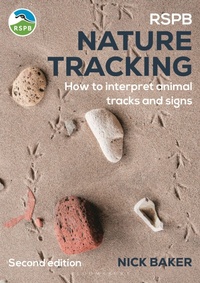
RSPB Nature Tracking
How to interpret animal tracks and signs
2nd Edition
Will be published approx. on 26. February 2026
Book
Paperback/Softback
288 pages
978-1-3994-2172-0 (ISBN)
Description
An updated edition of the popular RSPB guide to interpreting the signs that animals leave behind.
Every animal leaves traces as it passes through its habitat. By learning to interpret signs like paw prints, leftover food and scrapes in the earth, you can build the story of an animal's life and discover intriguing details and hidden meanings.
Updated and refreshed for this new edition, this popular and attractively designed RSPB handbook takes a new approach to the fascinating science of nature tracking.
Detailed diagrams, hundreds of photos and easy-to-read text by nature presenter Nick Baker make this the ideal guide for families and beginner naturalists of all ages. You'll learn how to find and interpret the evidence animals leave behind, from a pile of mangled feathers or a bent blade of grass to a delicately nibbled mushroom or a patch of disturbed soil. And by combining the clues you find with other signs, tracks and trails, you can build a profile of a huge range of species.
Nick reveals how technological advances help conservationists interpret tracks and traces to deepen their understanding of the natural world. He explains how we can use some of that technology to hone our nature detective skills, and demonstrates essential tracker tools and activities, like taking a cast of a paw print and dissecting owl pellets to reveal their last meal.
Every animal leaves traces as it passes through its habitat. By learning to interpret signs like paw prints, leftover food and scrapes in the earth, you can build the story of an animal's life and discover intriguing details and hidden meanings.
Updated and refreshed for this new edition, this popular and attractively designed RSPB handbook takes a new approach to the fascinating science of nature tracking.
Detailed diagrams, hundreds of photos and easy-to-read text by nature presenter Nick Baker make this the ideal guide for families and beginner naturalists of all ages. You'll learn how to find and interpret the evidence animals leave behind, from a pile of mangled feathers or a bent blade of grass to a delicately nibbled mushroom or a patch of disturbed soil. And by combining the clues you find with other signs, tracks and trails, you can build a profile of a huge range of species.
Nick reveals how technological advances help conservationists interpret tracks and traces to deepen their understanding of the natural world. He explains how we can use some of that technology to hone our nature detective skills, and demonstrates essential tracker tools and activities, like taking a cast of a paw print and dissecting owl pellets to reveal their last meal.
More details
Series
Edition
2nd edition
Language
English
Place of publication
London
United Kingdom
Publishing group
Bloomsbury Publishing PLC
Product notice
Paperback (trade)
Unsewn / adhesive bound
Illustrations
B/w track illustrations and 600+ colour photographs
Dimensions
Height: 208 mm
Width: 147 mm
Thickness: 20 mm
Weight
522 gr
ISBN-13
978-1-3994-2172-0 (9781399421720)
Copyright in bibliographic data and cover images is held by Nielsen Book Services Limited or by the publishers or by their respective licensors: all rights reserved.
Schweitzer Classification
Other editions
Additional editions
E-Book
02/2026
2nd Edition
Bloomsbury Wildlife
€18.49
Available for download
E-Book
02/2026
2nd Edition
Bloomsbury Wildlife
€18.49
Available for download
Person
Nick Baker is a naturalist and broadcaster based in the Cairngorms. He has presented a number of wildlife programmes, including The Really Wild Show, Weird Creatures with Nick Baker and more recently Springwatch and Autumnwatch. A regular contributor to BBC Wildlife magazine, he is also the author of more than 10 natural history books, including Nick Baker's Bug Book, The Complete Naturalist and ReWild. Nick is Vice President of Buglife, the RSPB and The Wildlife Trusts.
Content
Introduction
Stuff in the tracker's kitbag
Tracks and trails
Signs of feeding activity
Nests
Whose hole?
The pleasures of poo
Pellets
Dead things
Natural objects and remains
Glossary
Further reading
Acknowledgements and picture credits
Index
Stuff in the tracker's kitbag
Tracks and trails
Signs of feeding activity
Nests
Whose hole?
The pleasures of poo
Pellets
Dead things
Natural objects and remains
Glossary
Further reading
Acknowledgements and picture credits
Index