

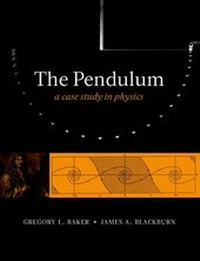
The Pendulum
A Case Study in Physics
Published on 2. June 2005
Book
Hardback
300 pages
978-0-19-856754-7 (ISBN)
Description
The pendulum: a case study in physics is a unique book in several ways. Firstly, it is a comprehensive quantitative study of one physical system, the pendulum, from the viewpoint of elementary and more advanced classical physics, modern chaotic dynamics, and quantum mechanics. In addition, coupled pendulums and pendulum analogs of superconducting devices are also discussed. Secondly, this book treats the physics of the pendulum within a historical and cultural context, showing, for example, that the pendulum has been intimately connected with studies of the earth's density, the earth's motion, and timekeeping. While primarily a physics book, the work provides significant added interest through the use of relevant cultural and historical vignettes. This approach offers an alternative to the usual modern physics courses. The text is amply illustrated and augmented by exercises at the end of each chapter.
Reviews / Votes
Overall, The Pendulm presents insights and unusual approaches that will broaden the experience of undergraduate physics students. * Kenneth S. Krane, Physics Today * In this well-illustrated treatment of the study of pendulum, Baker (Bryn Athyn College of the New Church) and Blackburn (Wilfrid Laurier U.) provide fascinating information about the history of the pendulum and what scientists thought it did, the revolution wrought by Foucault, the special cases of the torsion pendulum, the chaotic pendulum, the quantum pendulum, and coupled pendulums, the effects of superconductivity, and the most familiar to most of us, the pendulum clock. They include information on special interests in the appendices, such as the inverted pedulum and the longnow clock. SciTech Book News, December 2005.More details
Language
English
Place of publication
Oxford
United Kingdom
Target group
College/higher education
Illustrations
numerous line drawings, halftones and mathematical examples
Dimensions
Height: 255 mm
Width: 195 mm
Thickness: 20 mm
Weight
822 gr
ISBN-13
978-0-19-856754-7 (9780198567547)
Copyright in bibliographic data and cover images is held by Nielsen Book Services Limited or by the publishers or by their respective licensors: all rights reserved.
Schweitzer Classification
Other editions
Additional editions
Book
11/2008
Oxford University Press
€73.00
Shipment within 15-20 days
Persons
Gregory L. Baker was born and educated in Toronto receiving his B.Sc. in mathematics and physics from the University of Toronto, and his M.Sc and Ph.D. in physics, also from the University of Toronto. He has taught physics and mathematics at Bryn Athyn College since 1970, retiring from fulltime involvement in 2007. His scholarly interests have included stochastic processes (as a consultant), chaotic dynamics, and the relationship between religion and science. He has authored or co-authored more than sixty publications, many of which have appeared in peer reviewed journals. His books include the best selling Chaotic Dynamics: an Introduction, a technical/cultural book on the pendulum The Pendulum: a case study in physics, and Religion and Science: from Swedenborg to chaotic dynamics. Baker is a member of the American Physical Society and the American Association of Physics Teachers, and is a recipient of the Glencairn award for scholarship at Bryn Athyn College.
James A. Blackburn is Professor of Physics at Wilfrid Laurier University, Ontario, Canada.
James A. Blackburn is Professor of Physics at Wilfrid Laurier University, Ontario, Canada.
Content
1. Introduction ; 2. Pendulums somewhat simple ; 3. Pendulums less simple ; 4. The Foucault pendulum ; 5. The torsion pendulum ; 6. The chaotic pendulum ; 7. Coupled pendulums ; 8. The quantum pendulum ; 9. Superconductivity and the pendulum ; 10. The pendulum clock ; A. Pendulum Q ; B. The inverted pendulum ; C. The double pendulum ; D. The cradle pendulum ; E. The long now clock ; F. The Blackburn pendulum