

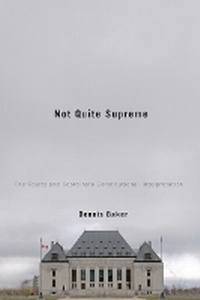
Not Quite Supreme
The Courts and Coordinate Constitutional Interpretation
Will be published approx. on 1. January 2010
Book
Hardback
220 pages
978-0-7735-3650-0 (ISBN)
Description
Baker argues that coordinate interpretation - a model which requires both elected and appointed officials to interpret the Charter - allows for the creation of a more robust democracy, alleviating some of the tension between constitutionalism and democracy while limiting judicial activism. Drawing on literature from Montesquieu to recent court decisions, Not Quite Supreme gives an extensive critique of both Canadian and American judicial models and explores the tensions between the separation of powers in both countries. Not Quite Supreme is a fresh and substantial contribution to the debate, advancing a new argument in support of a more diverse tradition of legal decision making in Canada that makes the constitution, rather than individual decisions of the Court, its cornerstone.
More details
Language
English
Place of publication
Montreal
Canada
Target group
College/higher education
Professional and scholarly
Dimensions
Height: 229 mm
Width: 152 mm
Weight
454 gr
ISBN-13
978-0-7735-3650-0 (9780773536500)
Copyright in bibliographic data and cover images is held by Nielsen Book Services Limited or by the publishers or by their respective licensors: all rights reserved.
Schweitzer Classification
Other editions
Additional editions
E-Book
05/2014
1st Edition
McGill-Queen's University Press
€27.99
Available for download
E-Book
01/2010
McGill-Queen's University Press
€50.99
Available for download
Person
Dennis Baker is an assistant professor of political science at the University of Guelph.
Content
Acknowledgments Introduction: Sharing Interpretive Power; 1 Judicial Supremacy, Dialogue Theory, and Coordinate Interpretation; 2 Explaining the Hostility to Coordinate Interpretation; 3 The Separation of Powers in Canada: "Partial Agency" or Watertight Compartments"?; 4 The Separation of Powers in Canada: "Fusion" or "Ambivalence"?; 5 The Ambivalent Judicial Role in the Separation of Powers; 6 Legal Pluralism after the Supreme Court Decides; 7 Judicial Remedies and the Separation of Power; Conclusion: Some Final Words about the "Final Say" Notes; Bibliography; Index