

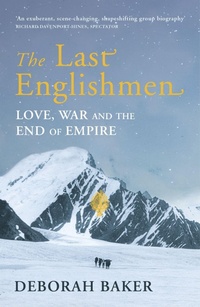
The Last Englishmen
Love, War and the End of Empire
Published on 4. July 2019
Book
Paperback/Softback
384 pages
978-0-09-959315-7 (ISBN)
Description
Winner of the Kekoo Naoroji Award for Mountain Literature 2019
An engrossing story of passion and exploration that traces the end of empire and the stirring of a new world order.
John Auden was a pioneering geologist of the Himalayas. Michael Spender was the first to draw a detailed map of the North Face of Mount Everest. While their younger brothers - W. H. Auden and Stephen Spender - achieved literary fame, they vied for a place on an expedition that would finally conquer Everest. To this rivalry was added another: their shared love for a painter named Nancy Sharp. Her choice would determine each man's wartime loyalties.
From Calcutta to pre-war London to Everest itself, The Last Englishmen tracks a generation obsessed with a romantic ideal. With a cast including writers, artists, political rogues and spies, this is narrative history at its most engaging and illuminating.
'Wholly original... It wouldn't be an exaggeration to say that there is something Tolstoyan to Baker's vast project... Remarkable' Neel Mukherjee
'An exuberant, scene-changing, shapeshifting group biography' Spectator
An engrossing story of passion and exploration that traces the end of empire and the stirring of a new world order.
John Auden was a pioneering geologist of the Himalayas. Michael Spender was the first to draw a detailed map of the North Face of Mount Everest. While their younger brothers - W. H. Auden and Stephen Spender - achieved literary fame, they vied for a place on an expedition that would finally conquer Everest. To this rivalry was added another: their shared love for a painter named Nancy Sharp. Her choice would determine each man's wartime loyalties.
From Calcutta to pre-war London to Everest itself, The Last Englishmen tracks a generation obsessed with a romantic ideal. With a cast including writers, artists, political rogues and spies, this is narrative history at its most engaging and illuminating.
'Wholly original... It wouldn't be an exaggeration to say that there is something Tolstoyan to Baker's vast project... Remarkable' Neel Mukherjee
'An exuberant, scene-changing, shapeshifting group biography' Spectator
Reviews / Votes
Wholly original...a dense, rich, exhilarating piece of work that moves deftly between worlds and peoples...she keeps the big events always in view, dramatizing and humanizing the workings of history, particularly the story of empire and its machinations, in a way a novelist would - by making it a story of individuals... It wouldn't be an exaggeration to say that there is something Tolstoyan to her vast project...remarkable -- Neel Mukherjee * Wall Street Journal * In The Last Englishmen, Deborah Baker has written an exuberant, scene-changing, shapeshifting group biography, with John Auden and Michael Spender as its chief human protagonists. But she makes the Himalayas, and Mount Everest, palpable and vivid characters in her story too -- Richard Davenport-Hines * Spectator * Deborah Baker combines a novelistic alertness to the inner life with an anthropologist's understanding of multiple cultures and a historian's eye for major events. The result, yet again, is a continuously absorbing and stimulating book, which enlarges the cultural and political history of the mid-20th century even as it grippingly relates the adventures of a few men and women -- Pankaj Mishra Love, war, politics, psychoanalysis, poetry, Calcutta and, especially, the Himalayas - Deborah Baker's meticulously researched account of India and Britain in the forties reads like the very best of novels. -- Siddhartha Deb An enlightening and utterly compelling read... what really distinguishes the book is its brilliant characterisation and its structural agility. It reads like fiction. Anyone seeking only information will be disappointed. Non-fiction ought always to be this engaging -- John Keay * Literary Review * A refreshingly novel account... this is skilful work, showing ordinary individuals as they cope-or buckle-while great geopolitical events twist and shape their lives * Economist * A Pulitzer Prize and National Book Award finalist takes readers on a journey through the Indian subcontinent at the closing of the British Empire... Seemingly covering disparate topics, Baker beautifully connects them all with an incisive, clear writing style and sharp descriptions of the terrain. A book for any readers curious about India after 1900 * Kirkus * Seemingly covering disparate topics, Baker beautifully connects them all with an incisive, clear writing style and sharp descriptions of the terrain. A book for any readers curious about India after 1900 * Booklist * Vivid... Baker tells her story as if it were fiction... The result is a book with the narrative sweep of an epic novel -- Peter Parker * The Oldie * Ambitious and entertaining... The history of Empire is seen here through a unique prism -- Jules Stewart * Geographical *More details
Language
English
Place of publication
London
United Kingdom
Publishing group
Vintage Publishing
Target group
Professional and scholarly
College/higher education
Product notice
Paperback (UK-B)
Dimensions
Height: 130 mm
Width: 197 mm
Thickness: 25 mm
Weight
304 gr
ISBN-13
978-0-09-959315-7 (9780099593157)
Copyright in bibliographic data and cover images is held by Nielsen Book Services Limited or by the publishers or by their respective licensors: all rights reserved.
Schweitzer Classification
Other editions
Additional editions
E-Book
08/2018
Vintage Digital
€12.99
Available for download
Person
Deborah Baker is the author of Making a Farm, In Extremis, which was shortlisted for the Pulitzer Prize, A Blue Hand and The Convert, which was a finalist for the National Book Award. She lives in India and New York.