

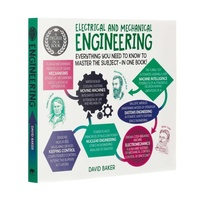
A Degree in a Book: Electrical and Mechanical Engineering
Everything You Need to Know to Master the Subject - In One Book!
Published on 15. June 2021
Book
Paperback/Softback
256 pages
978-1-83940-667-6 (ISBN)
Description
A concise introduction to all the key tenets of electrical and mechanical engineering degree course, written by former NASA engineer Dr David Baker.
A Degree in a Book: Electrical and Mechanical Engineering is presented in an attractive landscape format in full-color. With flow charts, infographics, timelines, feature spreads and information boxes, this highly visual guide will help readers quickly get to grips with the fundamentals of electrical and mechanical engineering and their practical applications.
Covering Newtonian mechanics, nuclear engineering, artificial intelligence, 3D printing and more, this essential guide brings clarity to complex ideas. David Baker delves into the history and development of this far-reaching subject as well as the challenges of the future such as environmental responsibility.
Complete with a useful glossary of key terms, this holistic introduction will equip students and laypeople alike with the knowledge of an engineering graduate.
ABOUT THE SERIES: Get the knowledge of a degree for the price of a book in Arcturus Publishing's A Degree in a Book series. Featuring handy timelines, information boxes, feature spreads and margin annotations, these illustrated books are perfect for anyone wishing to master seemingly complex subject with ease and enjoyment..
A Degree in a Book: Electrical and Mechanical Engineering is presented in an attractive landscape format in full-color. With flow charts, infographics, timelines, feature spreads and information boxes, this highly visual guide will help readers quickly get to grips with the fundamentals of electrical and mechanical engineering and their practical applications.
Covering Newtonian mechanics, nuclear engineering, artificial intelligence, 3D printing and more, this essential guide brings clarity to complex ideas. David Baker delves into the history and development of this far-reaching subject as well as the challenges of the future such as environmental responsibility.
Complete with a useful glossary of key terms, this holistic introduction will equip students and laypeople alike with the knowledge of an engineering graduate.
ABOUT THE SERIES: Get the knowledge of a degree for the price of a book in Arcturus Publishing's A Degree in a Book series. Featuring handy timelines, information boxes, feature spreads and margin annotations, these illustrated books are perfect for anyone wishing to master seemingly complex subject with ease and enjoyment..
More details
Series
Language
English
Place of publication
United Kingdom
Target group
Children/juvenile
Interest Age: From 10 years
Product notice
Paperback (trade)
Unsewn / adhesive bound
Illustrations
Illustrations
Dimensions
Height: 254 mm
Width: 220 mm
Thickness: 25 mm
Weight
1075 gr
ISBN-13
978-1-83940-667-6 (9781839406676)
Copyright in bibliographic data and cover images is held by Nielsen Book Services Limited or by the publishers or by their respective licensors: all rights reserved.
Schweitzer Classification
Person
Content
Introduction
Chapter 1: The Dawn of Ideas - the Empirical Age
Chapter 2: Understanding Forces - the Scientific Age
Chapter 3: Manipulation of Forces
Chapter 4: Mechanisms
Chapter 5: A Choice of Materials
Chapter 6: Keeping the Machines Moving
Chapter 7: Engineering the Systems
Chapter 8: What is Reliability?
Chapter 9: Nuclear Engineering
Chapter 10: Electrical and Electronic Engineering
Chapter 11: Power Production and Generation
Chapter 12: Electromechanics
Chapter 13: Computing Machines and Artificial Intelligence
Glossary
Suggested Reading
Chapter 1: The Dawn of Ideas - the Empirical Age
Chapter 2: Understanding Forces - the Scientific Age
Chapter 3: Manipulation of Forces
Chapter 4: Mechanisms
Chapter 5: A Choice of Materials
Chapter 6: Keeping the Machines Moving
Chapter 7: Engineering the Systems
Chapter 8: What is Reliability?
Chapter 9: Nuclear Engineering
Chapter 10: Electrical and Electronic Engineering
Chapter 11: Power Production and Generation
Chapter 12: Electromechanics
Chapter 13: Computing Machines and Artificial Intelligence
Glossary
Suggested Reading