

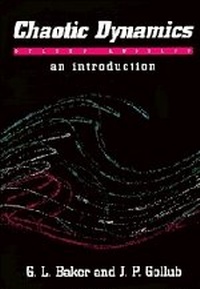
Chaotic Dynamics
An Introduction
2nd Edition
Published on 26. January 1996
Book
Hardback
272 pages
978-0-521-47106-0 (ISBN)
Description
The previous edition of this text was the first to provide a quantitative introduction to chaos and nonlinear dynamics at undergraduate level. It was widely praised for the clarity of the writing and for the unique and effective way in which the authors presented the basic ideas. These same qualities characterise this revised and expanded second edition. Interest in chaotic dynamics has grown explosively in recent years. Applications to practically every scientific field have had far-reaching impact. As in the first edition, the authors present all the main features of chaotic dynamics using the damped, driven pendulum as the primary model. This second edition includes additional material on the analysis and characterisation of chaotic data, and applications of chaos. This new edition of Chaotic Dynamics can be used as a text for courses on chaos for physics and engineering students at the second and third year level.
Reviews / Votes
'Chaotic Dynamics is refreshingly down-to-earth ... I recommend it to anyone who wishes to penetrate beneath the flashy surface of the popular image of chaos to the hardcore science beneath. The book makes an excellent text for physics or mathematics students, and its reliance on concrete examples offers a welcome antidote to the esotericism of many undergraduate science courses.' The Times Higher Education Supplement 'The original text, published 1990, was the first quantitative introduction to chaos for science undergraduates. This has now been revised and skilfully extended ... Suitable as a source text for lecture courses.' Aslib Book List 'This book was a pleasure to review.' Physics Today 'The authors' express purpose was to fill the void in the literature on chaotic dynamics between the readable but technically light books, best exemplified by James Gleick's Chaos (Viking 1987) and the technically difficult books ... Gregory Baker and Jerry Gollub have accomplished this superbly and provided us with a text, or text supplement, suitable for the advanced undergraduate.' Physics Today 'It bridges the gap between the popular books and the technical tomes, by employing computer experiments in place of calculations, and by concentrating on examples ... Written by people for whom chaos is not an end but a means to the understanding of physical phenomena.' The Times Higher Education SupplementMore details
Edition
2nd Revised edition
Language
English
Place of publication
Cambridge
United Kingdom
Target group
College/higher education
Edition type
Revised edition
Illustrations
Worked examples or Exercises; 3 Tables, unspecified; 2 Halftones, unspecified; 112 Line drawings, unspecified
Dimensions
Height: 259 mm
Width: 185 mm
Thickness: 26 mm
Weight
701 gr
ISBN-13
978-0-521-47106-0 (9780521471060)
Copyright in bibliographic data and cover images is held by Nielsen Book Services Limited or by the publishers or by their respective licensors: all rights reserved.
Schweitzer Classification
Other editions
New editions
Book
01/1996
2nd Edition
Cambridge University Press
€75.00
Shipment within 15-20 days
Additional editions
Book
01/1996
2nd Edition
Cambridge University Press
€75.00
Shipment within 15-20 days
Previous edition

Book
07/1990
Cambridge University Press
€43.33
Article exhausted; check for reprint
Persons
Content
1. Introduction; 2. Some helpful tools; 3. Visualization of the pendulum's dynamics; 4. Toward an understanding of chaos; 5. The characterization of chaotic attractors; 6. Experimental characterization, prediction, and modification of chaotic states; 7. Chaos broadly applied; Further reading; Appendix A. Numerical integration - Runge-Kutta method; Appendix B. Computer program listings; References; Index.