

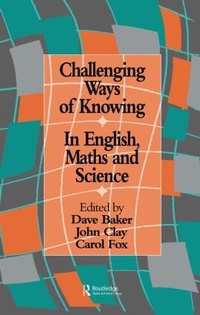
Challenging Ways Of Knowing
In English, Mathematics And Science
Published on 15. March 1996
Book
Hardback
214 pages
978-0-7507-0524-0 (ISBN)
Description
This work provides an analysis of how knowledge is constructed and defined by teachers and lecturers in schools and universities/colleges. It considers how everyday uses of reading, writing, numeracy and science are cast aside in favour of academic language and academic discourse, arguing that such discourses are alien to learners' daily experiences and are, therefore, difficult to acquire and adopt.; Chapters examine literacies of English, mathematics and science as practised in and outside schools and colleges. The book is interdisciplinary and multicultural, adopting perspectives from the UK, USA, South Africa, India, Brazil and Kenya. It should be of interest to a wide market of educationalists, including those involved in educational policy making, teacher education, cultural/multicultural studies, development studies, anthropology, and adult and continuing education.
More details
Language
English
Place of publication
London
United Kingdom
Publishing group
Taylor & Francis Ltd
Target group
College/higher education
Professional and scholarly
Postgraduate and Professional
Dimensions
Height: 234 mm
Width: 156 mm
Weight
560 gr
ISBN-13
978-0-7507-0524-0 (9780750705240)
Copyright in bibliographic data and cover images is held by Nielsen Book Services Limited or by the publishers or by their respective licensors: all rights reserved.
Schweitzer Classification
Other editions
Additional editions
E-Book
10/2012
1st Edition
Routledge
€32.99
Available for download
E-Book
10/2012
1st Edition
Routledge
€32.99
Available for download
Book
03/1996
Routledge Falmer
€38.00
Article not available for order
Persons
Dave Baker, John Clay, Carol Fox
Content
Part 1 Changing the subject boundaries: good science or good art? or both?, Shirley Brice Heath; evolving shared discourse with teachers to promote literacies for learning in South Africa, Alan and Viv Kenyon; mathematics, and its learning, as narrative - a literacy for the 21st century, Leone Burton. Part 2 Literacy practices inside schools, outside schools and in higher education: scientific literacy - a functional construct, Edgar Jenkins; family literacy programmes and home literacy practices, David Barton; enlarging the ways of taking for literary texts, Henrietta Dombey; frames of knowledge, Terezinha Nunes; children's formal and informal school numeracy practices, Dave Baker; how can you discuss alone? - academic literacy in a South African context, Lyn Hewlett; academic literacies, Brian V. Street. Part 3 The role of texts in literacies for learning: an agenda for research on text materials in primary science for second language learners in developing countries, Alan Peacock; focusing on the frames - using comic books to challenge dominant literacies in South Africa, Peter Esterhuysen; book learning - literacy and information, Margaret Meek. Part 4 Questioning dominant canons and practices: dominant and subversive literacy practices - the case for literature, Carol Fox; scientific literacy - whose science? whose literacy?, John Clay; calculating people - origins of numeracy in India and the West, George Gherverrhese Joseph.