

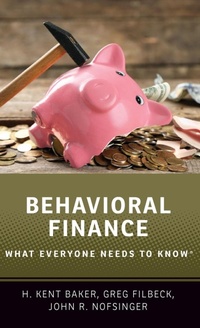
Behavioral Finance
What Everyone Needs to Know (R)
Published on 16. June 2019
Book
Hardback
248 pages
978-0-19-086874-1 (ISBN)
Description
People tend to be penny wise and pound foolish and cry over spilt milk, even though we are taught to do neither. Focusing on the present at the expense of the future and basing decisions on lost value are two mistakes common to decision-making that are particularly costly in the world of finance. People are also tempted to throw good money after bad. Behavioral finance is the field that sheds light on how people make decisions and make predictable mistakes due to mental and emotional characteristics. It also provides insights into how markets operate. Having a better understanding of both can mitigate mistakes.
Behavioral Finance: What Everyone Needs to Know (R) provides an overview of common shortcuts and mistakes people make in managing their finances that can affect their wealth. An extensive discussion sets forth the cognitive biases or errors in thinking that occur when people are collecting, processing, and interpreting information. Emotional biases that can create distortions in cognition and decision-making are also covered, as are the influence of social factors, from culture to the behavior of one's peers. These effects vary during one's life, reflecting differences in cognitive ability due to age, experience, and gender effects. Of great importance is framing, how the presentation of a choice affects people's forecasts about the stock market, claiming social security benefits, savings behavior, mortgage choice, charitable contributions, and more.
Throughout the authors combine discussions of concepts, insights from research, and examples from recent events. Among the questions to be addressed are: How did the financial crisis of 2007-2008 spur understanding human behavior? What are market anomalies and how do they relate to behavioral biases? What role does overconfidence play in financial decision- making? And how does getting older affect risk tolerance?
Behavioral Finance: What Everyone Needs to Know (R) provides an overview of common shortcuts and mistakes people make in managing their finances that can affect their wealth. An extensive discussion sets forth the cognitive biases or errors in thinking that occur when people are collecting, processing, and interpreting information. Emotional biases that can create distortions in cognition and decision-making are also covered, as are the influence of social factors, from culture to the behavior of one's peers. These effects vary during one's life, reflecting differences in cognitive ability due to age, experience, and gender effects. Of great importance is framing, how the presentation of a choice affects people's forecasts about the stock market, claiming social security benefits, savings behavior, mortgage choice, charitable contributions, and more.
Throughout the authors combine discussions of concepts, insights from research, and examples from recent events. Among the questions to be addressed are: How did the financial crisis of 2007-2008 spur understanding human behavior? What are market anomalies and how do they relate to behavioral biases? What role does overconfidence play in financial decision- making? And how does getting older affect risk tolerance?
Reviews / Votes
If you are looking for a book that explains behavioral finance in plain understandable language, then this book is for you. This book adeptly applies the classic Socratic method to explain why the behavioral approach better explains the behavior of normal people than the neoclassical approach. * Hersh Shefrin, Mario L. Belotti Professor of Finance, Santa Clara University *More details
Series
Language
English
Place of publication
New York
United States
Dimensions
Height: 222 mm
Width: 145 mm
Thickness: 17 mm
Weight
448 gr
ISBN-13
978-0-19-086874-1 (9780190868741)
Copyright in bibliographic data and cover images is held by Nielsen Book Services Limited or by the publishers or by their respective licensors: all rights reserved.
Schweitzer Classification
Other editions
Additional editions
Book
05/2019
Oxford University Press Inc
€21.10
Article exhausted; check different version
E-Book
02/2019
1st Edition
OUP eBook
€6.99
Available for download
E-Book
02/2019
1st Edition
OUP eBook
€6.99
Available for download
Persons
H. Kent Baker is University Professor of Finance in the Kogod School of Business at American University. He has authored or edited 30 books and published more than 290 articles. His books Investor Behavior and Investment Traps Exposed received book excellence awards. Professor Baker is among the top 1% of the most prolific authors in finance.
Greg Filbeck is Samuel P. Black III Professor of Finance and Risk Management and Director of the Black School of Business at Penn State Erie, The Behrend College. He has authored or edited 10 books and published more than 95 academic articles. Professor Filbeck has conducted training for professional designations for the last two decades.
John R. Nofsinger is William H. Seward Chair in International Finance at the University of Alaska Anchorage. He has authored or edited 11 books that have translations in 11 languages and published 63 scholarly articles. He is author of the book, The Psychology of Investing 6th edition, which is
popular with financial advisors.
Greg Filbeck is Samuel P. Black III Professor of Finance and Risk Management and Director of the Black School of Business at Penn State Erie, The Behrend College. He has authored or edited 10 books and published more than 95 academic articles. Professor Filbeck has conducted training for professional designations for the last two decades.
John R. Nofsinger is William H. Seward Chair in International Finance at the University of Alaska Anchorage. He has authored or edited 11 books that have translations in 11 languages and published 63 scholarly articles. He is author of the book, The Psychology of Investing 6th edition, which is
popular with financial advisors.
Author
University Professor of FinanceUniversity Professor of Finance, Department of Finance and Real Estate, Kogod School of Business, American University
Samuel P. Black III Professor of Finance and Risk ManagementSamuel P. Black III Professor of Finance and Risk Management, Black School of Business, Penn State Behrend
William H. Seward Chair in International FinanceWilliam H. Seward Chair in International Finance, University of Alaska Anchorage, College of Business and Public Policy, Accounting and Finance Department
Content
Chapter 1. Foundations and Psychological Concepts
Chapter 2. Cognitive Biases
Chapter 3. Emotional Biases and Social/Cultural Influences
Chapter 4. Investor Behavior
Chapter 5. Nudge: The Influence of Frame Dependence
Chapter 6. Cognitive Ability
Notes
Index
Chapter 2. Cognitive Biases
Chapter 3. Emotional Biases and Social/Cultural Influences
Chapter 4. Investor Behavior
Chapter 5. Nudge: The Influence of Frame Dependence
Chapter 6. Cognitive Ability
Notes
Index