

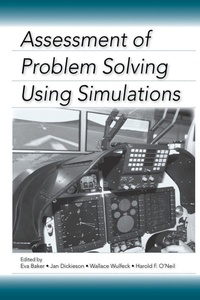
Assessment of Problem Solving Using Simulations
1st Edition
Published on 10. October 2016
Book
Paperback/Softback
356 pages
978-1-138-96404-4 (ISBN)
Description
This volume explores the application of computer simulation technology to measurement issues in education -- especially as it pertains to problem based learning. Whereas most assessments related to problem solving are based on expensive and time consuming measures (i.e., think-aloud protocols or performance assessments that require extensive human rater scoring), this book relies on computerization of the major portion of the administration, scoring, and reporting of problem-solving assessments. It is appropriate for researchers, instructors and graduate students in educational assessment, educational technology, and educational psychology.
More details
Language
English
Place of publication
London
United Kingdom
Publishing group
Taylor & Francis Ltd
Target group
College/higher education
Professional and scholarly
Dimensions
Height: 229 mm
Width: 152 mm
Thickness: 19 mm
Weight
519 gr
ISBN-13
978-1-138-96404-4 (9781138964044)
Copyright in bibliographic data and cover images is held by Nielsen Book Services Limited or by the publishers or by their respective licensors: all rights reserved.
Schweitzer Classification
Other editions
Additional editions
Eva Baker | Jan Dickieson | Wallace Wulfeck
Assessment of Problem Solving Using Simulations
E-Book
09/2017
Routledge
€65.99
Available for download
Eva Baker | Jan Dickieson | Wallace Wulfeck
Assessment of Problem Solving Using Simulations
E-Book
09/2017
Routledge
€65.99
Available for download
Eva Baker | Jan Dickieson | Wallace Wulfeck
Assessment of Problem Solving Using Simulations
Book
09/2007
1st Edition
Routledge
€207.20
Shipment within 10-20 days
Persons
Jan Dickieson, Eva Baker, Wallace Wulfeck, Harold F. O'Neil
Content
Contents: E.L. Baker, J. Dickieson, W.H. Wulfeck, H.F. O'Neil, Preface. Part I:The Context. E.L. Baker, D. Niemi, G.K.W.K. Chung, Simulations and the Transfer of Problem Solving Knowledge and Skills. A. Lesgold, Assessment to Steer the Course of Learning: Dither in Testing. D. Ketelhut, C. Dede, J. Clarke, B. Nelson, C. Bowman, Studying Situated Learning in a Multi-User Virtual Environment. J.T. Behrens, D. Frezzo, R. Mislevy, M. Kroopnick, D. Wise, Structural, Functional, and Semiotic Symmetries in Simulation-Based Games and Assessments. J.V. Cohn, K.M. Stanney, R.P. Darken, J.A. Sullivan, L.M. Milham, D.L. Jones, K.S. Hale, Training Evaluation of Virtual Environments. J.D. Fletcher, J.E. Morrison, Representing Cognition in Games and Simulations. Part II:Low-Stakes Assessment of Problem Solving. R. Mayer, Problem Solving Assessment in Games and Simulation Environments. H.F. O'Neil, H-H. Chen, R. Wainess, C-Y. Shen, Assessing Problem Solving in Simulation Games. H.F. O'Neil, S-h. Chuang, Measuring Collaborative Problem Solving in Low-Stakes Tasks. R. Molkenthin, K. Breuer, R.D. Tennyson, Real-Time Diagnostics of Problem-Solving Behavior for Business Simulations. Part III:High-Stakes Assessment of Problem Solving.W.H. Wulfeck, S.K. Wetzel-Smith, Use of Visualization Techniques to Improve High-Stakes Problem Solving. R.A. Wisher, Assessing Problem-Solving Performance in High-Stakes Tasks. L.L. Meliza, S.L. Goldberg, Impact of After-Action Review on Learning in Simulation-Based U.S. Army Training. D.H. Andrews, R.T. Nullmeyer, J. Good, P. Fitzgerald, Measurement of Learning Processes in Pilot Simulation. Part IV:Authoring Options. G.K.W.K. Chung, G.C. Delacruz, W.L. Bewley, E.L. Baker, J. Elmore, B. Seely, A Computational Approach to Authoring of Problem-Solving Assessments. T.P. Vendlinski, E.L. Baker, Templates and Objects in Authoring Problem-Solving Assessments.