

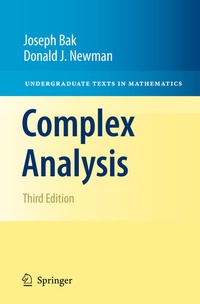
Complex Analysis
3rd Edition
Published on 6. August 2010
Book
Hardback
XII, 328 pages
978-1-4419-7287-3 (ISBN)
Description
Beginning with the ?rst edition of Complex Analysis, we have attempted to present the classical and beautiful theory of complex variables in the clearest and most intuitive form possible. The changes inthisedition, which include additions to ten of the nineteen chapters, are intended to provide the additional insights that can be obtainedby seeing a little more of the "bigpicture".This includesadditional related results and occasional generalizations that place the results inaslightly broader context. The Fundamental Theorem of Algebra is enhanced by three related results. Section 1.3 offers a detailed look at the solution of the cubic equation and its role in the acceptance of complex numbers. While there is no formula for determining the rootsof a generalpolynomial,we added a section on Newton'sMethod,a numerical technique for approximating the zeroes of any polynomial. And the Gauss-Lucas Theorem provides an insight into the location of the zeroes of a polynomial and those of its derivative. Aseries of new results relate to the mapping properties of analytic functions. Arevised proof of Theorem 6.15 leads naturally to a discussion of the connection between critical points and saddle points in the complex plane. The proof of the SchwarzRe?ectionPrinciplehasbeenexpandedtoincludere?ectionacrossanalytic arcs, which plays a key role in a new section (14.3) on the mapping properties of analytic functions on closed domains. And our treatment of special mappings has been enhanced by the inclusion of Schwarz-Christoffel transformations.
Reviews / Votes
From the reviews of the third edition:
"The book of the known mathematicians J. Bak and D. Newman is an excellent introduction into the theory of analytic functions of one complex variable. The book is written on an elementary level and so it supports students in the early stages of their mathematical studies. . The book also contains many illustrations, examples and exercises, which give additional information and explanations." (Konstantin Malyutin, Zentralblatt MATH, Vol. 1205, 2011)More details
Series
Edition
3rd ed. 2010
Language
English
Place of publication
New York
United States
Target group
Lower undergraduate
Edition type
Revised edition
Illustrations
77 s/w Abbildungen
XII, 328 p. 77 illus.
Dimensions
Height: 241 mm
Width: 160 mm
Thickness: 24 mm
Weight
676 gr
ISBN-13
978-1-4419-7287-3 (9781441972873)
DOI
10.1007/978-1-4419-7288-0
Schweitzer Classification
Other editions
Additional editions
Joseph Bak | Donald J. Newman
Complex Analysis
Book
10/2012
3rd Edition
Springer
€69.54
Shipment within 15-20 days
Joseph Bak | Donald J. Newman
Complex Analysis
E-Book
08/2010
3rd Edition
Springer
€69.54
Available for download
Previous edition
Joseph Bak | Donald J. Newman
Complex Analysis
Book
12/1996
2nd Edition
Springer
€64.15
Article exhausted; check for reprint
Persons
Dr. Joseph Bak is the Assistant Chair of the Mathematics department at The City College of New York. Joseph Bak's primary area of research is approximation theory. Dr. Donald J. Newman (July 27, 1930 - March 28, 2007) was a champion problem solver. His mathematical specialties included complex analysis, approximation theory and number theory. His career included posts as a Professor of Mathematics at MIT, Brown University, Yeshiva University, Temple University and a distinguished chair at Bar Ilan University in Israel. His publications include 150 papers and five books.
Content
The Complex Numbers.- Functions of the Complex Variable z.- Analytic Functions.- Line Integrals and Entire Functions.- Properties of Entire Functions.- Properties of Analytic Functions.- Further Properties of Analytic Functions.- Simply Connected Domains.- Isolated Singularities of an Analytic Function.- The Residue Theorem.- Applications of the Residue Theorem to the Evaluation of Integrals and Sums.- Further Contour Integral Techniques.- to Conformal Mapping.- The Riemann Mapping Theorem.- Maximum-Modulus Theorems for Unbounded Domains.- Harmonic Functions.- Different Forms of Analytic Functions.- Analytic Continuation; The Gamma and Zeta Functions.- Applications to Other Areas of Mathematics.