

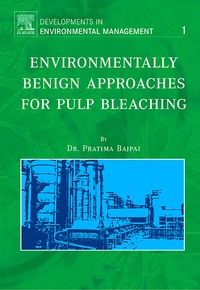
Environmentally Benign Approaches for Pulp Bleaching
Published on 5. August 2005
Book
Hardback
288 pages
978-0-444-51724-1 (ISBN)
Description
Pulp and paper production has increased globally and will continue to increase in the near future. Approximately 155 millions tons of wood pulp is produced worldwide and about 260 millions is projected for 2010. To cope with the increasing demand, an increase in production and improved environmental performance is needed as the industry is under constant pressure to reduce environmental emissions to air and water. This book gives updated information on environmentally benign approaches for pulp bleaching, which can help solve the problems associated with conventional bleaching technologies.
More details
Language
English
Place of publication
Oxford
United Kingdom
Publishing group
Elsevier Science & Technology
Target group
Professional and scholarly
Researchers and management in pulp and paper
Dimensions
Height: 240 mm
Width: 165 mm
Weight
660 gr
ISBN-13
978-0-444-51724-1 (9780444517241)
Copyright in bibliographic data and cover images is held by Nielsen Book Services Limited or by the publishers or by their respective licensors: all rights reserved.
Schweitzer Classification
Other editions
New editions
Pratima Bajpai
Environmentally Benign Approaches for Pulp Bleaching
Book
04/2012
2nd Edition
Elsevier
€152.50
Shipment within 15-20 days
Additional editions
Pratima Bajpai | P. Bajpai
Environmentally Benign Approaches for Pulp Bleaching
E-Book
08/2005
1st Edition
Elsevier
€137.00
Available for download
Persons
Dr. Pratima Bajpai is currently working as a Consultant in the field of Paper and Pulp. She has over 36 years of experience in research at the National Sugar Institute, University of Saskatchewan, the Universitiy of Western Ontario, in Canada, in addition to the Thapar Research and Industrial Development Centre, in India. She also worked as a visiting professor at the University of Waterloo, Canada and as a visiting researcher at Kyushu University, Fukuoka, Japan. She has been named among the World's Top 2% Scientists by Stanford University in the list published in October 2022. This is the third consecutive year that she has made it into the prestigious list. Dr. Bajpai's main areas of expertise are industrial biotechnology, pulp and paper, and environmental biotechnology. She has contributed immensely to the field of industrial biotechnology and is a recognized expert in the field. Dr. Bajpai has written several advanced level technical books on environmental and biotechnological aspects of pulp and paper which have been published by leading publishers in the USA and Europe. She has also contributed chapters to a number of books and encyclopedia, obtained 11 patents, written several technical reports, and has implemented several processes in Indian Paper mills. Dr. Bajpai is an active member of the American Society of Microbiologists and is a reviewer of many international research journals.
Content
1. Introduction.2. General background.3. Options for environmentally benign bleaching.4. ECF and TCF bleaching.5. Chlorine free bleaching of secondary fibers.6. Closed cycle bleach plant.