

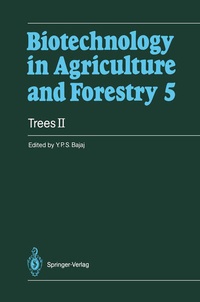
Trees II
Published on 24. January 1989
Book
Hardback
XVIII, 622 pages
978-3-540-19158-2 (ISBN)
Description
'frees contribute a major part of fuel, fodder and fruit, and are an im of bioenergy. They are now needed in large numbers more portant source than ever before for afforestation and social forestry, so that fast-grow ing and multipurpose trees assume great importance. After extensive in discriminate deforestation and rapid depletion of genetic stocks, efforts are now being made to evolve methods for clonal mass propagation of improved and elite trees. Production of short-duration trees with a rapid turnover of biomass, and induction of genetic variability through in vitro manipulation for the production of novel fruit and forest trees, which are high-yielding and resistant to pests and diseases, and trees which display increased photosynthetic efficiency are in demand. These objectives are well within the realm of horticultural and forest biotech nology. Some of the recent advances, such as the regeneration of com plete trees from isolated protoplasts, somatic hybridization, and the Agrobacterium-mediated transformation in various tree species have opened new vistas for the genetic engineering of fruit and forest trees. This book is a continuation of the earlier volume Trees I, and presents 31 chapters on fruit, forest, nut and ornamental trees, such as avocado, pineapple, crabapple, quince, pistachio, walnut, hazelnut, date palm, oil palm, cacao, rubber, maple, sweet-gum, poplars, birches, Chinese tallow, willows, oaks, paper mulberry, rhododendrons, Scots pine, Calabrian pine, Douglas-fir, redwood, ginkgo, cycads and some flowering trees.
More details
Series
Edition
1989
Language
English
Place of publication
Berlin
Germany
Publishing group
Springer Berlin
Target group
College/higher education
Professional and scholarly
Professional/practitioner
Illustrations
XVIII, 622 p.
Dimensions
Height: 241 mm
Width: 160 mm
Thickness: 39 mm
Weight
1121 gr
ISBN-13
978-3-540-19158-2 (9783540191582)
DOI
10.1007/978-3-642-61535-1
Schweitzer Classification
Other editions
Content
Section I Angiosperm Trees.- I.1 Avocado (Persea spp.).- I.2 Pineapple (Ananas comosus L. Merr.).- I.3 Crabapple (Malus spp.).- I.4 Quince (Cydonia oblonga Mill.).- I.5 Carambola (Averrhoa carambola L.).- I.6 Pistachio (Pistacia vera L.).- I.7 Walnut (Juglans spp.).- I.8 Hazelnut (Corylus avellana L.).- I.9 Date Palm (Phoenix dactylifera L.).- I.10 Oil Palm (Elaeis guineensis Jacq.).- I.11 Cacao (Theobroma cacao L.).- I.12 Rubber (Hevea brasiliensis Müll. Arg.).- I.13 Maple (Acer spp.).- I.14 Sweetgum (Liquidambar styraciflua L.).- I.15 Poplar (Populus spp.).- I.16 Birch (Betula spp.).- I.17 Chinese Tallow (Sapium sebiferum Roxb.).- I.18 Empress Tree (Paulownia tomentosa Steud).- I.19 Willows (Salix spp.).- I.20 Oaks (Quercus spp.).- I.21 Paper Mulberry (Broussonetia kazinoki Sieb.).- I.22 Holly (Ilex spp.).- I.23 Rhododendrons.- I.24 Some Australian Ornamental Woody Species.- I.25 Some Indian Ornamental Trees: Cassia fistula Linn., Poinciana regia (Boj.) and Jacaranda acutifolia auct..- Section II Gymnosperm Trees.- II.1 Scots Pine (Pinus sylvestris L.).- II.2 Calabrian Pine (Pinus brutia Tenore).- II.3 Douglas-Fir [Pseudotsuga menziesii (Mirb.) Franco].- II.4 Redwood (Sequoia sempervirens).- II.5 Maidenhair Tree (Ginkgo biloba L.).- II.6 Cycads.