

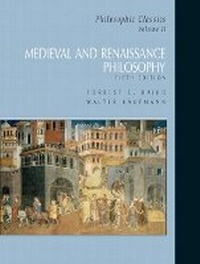
Philosophic Classics, Volume II
Medieval and Renaissance Philosophy
5th Edition
Published on 24. April 2007
Book
Paperback/Softback
552 pages
978-0-13-158595-9 (ISBN)
Description
For courses in History of Medieval Philosophy and as a supplement for Philosophy of Religion.
Esteemed for providing the best available translations, the Philosophic Classics series features complete works or complete sections of the most important works by the major thinkers as well as shorter samples from transitional thinkers.
Forrest E. Baird's revisions of Philosophic Classics, Prentice Hall's long-standing philosophy series, continue the tradition begun in 1961, to provide generations of students with anthologies of high quality in the history of Western philosophy. Using the complete works, or where appropriate, complete sections of works, this series allows philosophers to speak directly to students.
For history of philosophy courses it is difficult to know whether to have students buy a stack of individual books or an anthology. Professor Baird's work includes most of the most important works of the major thinkers-along with shorter samples from transitional or more minor thinkers. By providing complete texts, this volume allows professors to tailor the readings to their particular interests. Those who use this text in a one term course will find more material here than can easily fit a normal semester. This offers teachers some choice and, for those who offer the same course year after year, an opportunity to change the menu without having to assign multiple books.
The full Philosophic Classics series:
Volume I: Ancient Philosophy (0-13-241317-5)
Volume II: Medieval and Renaissance Philosophy (0-13-158595-9)
Volume III: Modern Philosophy (0-13-206058-2)
Volume IV: Nineteenth-Century Philosophy (0-13-048550-0)
Volume V: Twentieth-Century Philosophy (0-13-048563-2)
From Plato to Derrida, Combined Edition (0-13-158591-6)
Esteemed for providing the best available translations, the Philosophic Classics series features complete works or complete sections of the most important works by the major thinkers as well as shorter samples from transitional thinkers.
Forrest E. Baird's revisions of Philosophic Classics, Prentice Hall's long-standing philosophy series, continue the tradition begun in 1961, to provide generations of students with anthologies of high quality in the history of Western philosophy. Using the complete works, or where appropriate, complete sections of works, this series allows philosophers to speak directly to students.
For history of philosophy courses it is difficult to know whether to have students buy a stack of individual books or an anthology. Professor Baird's work includes most of the most important works of the major thinkers-along with shorter samples from transitional or more minor thinkers. By providing complete texts, this volume allows professors to tailor the readings to their particular interests. Those who use this text in a one term course will find more material here than can easily fit a normal semester. This offers teachers some choice and, for those who offer the same course year after year, an opportunity to change the menu without having to assign multiple books.
The full Philosophic Classics series:
Volume I: Ancient Philosophy (0-13-241317-5)
Volume II: Medieval and Renaissance Philosophy (0-13-158595-9)
Volume III: Modern Philosophy (0-13-206058-2)
Volume IV: Nineteenth-Century Philosophy (0-13-048550-0)
Volume V: Twentieth-Century Philosophy (0-13-048563-2)
From Plato to Derrida, Combined Edition (0-13-158591-6)
Reviews / Votes
"Students with little or no background in philosophy would likely find it difficult-if not impossible-to comprehend the works of many of the philosophers addressed in [each] volume on their own. However, this text's informative introductions and careful selection of readings make it possible for students to get a foothold in their primary texts....[S]tudents are afforded the opportunity to engage with the works of these illustrious but often inscrutable thinkers." - Jennifer McMahon, Centre College"This collection is by far the best I have seen in this area....And I certainly prefer having all of my material together in one text rather than having students purchase half a dozen books, which then still require supplementation. I cannot imagine a better format or selection of materials that would tempt me away from this collection for another." - Ted Toadvine, Emporia State University
More details
Edition
5th edition
Language
English
Place of publication
New York
United States
Publishing group
Taylor & Francis Inc
Target group
Professional and scholarly
Edition type
Revised edition
Dimensions
Height: 179 mm
Width: 234 mm
Thickness: 19 mm
Weight
712 gr
ISBN-13
978-0-13-158595-9 (9780131585959)
Copyright in bibliographic data and cover images is held by Nielsen Book Services Limited or by the publishers or by their respective licensors: all rights reserved.
Schweitzer Classification
Other editions
Previous edition
Book
09/2002
4th Edition
Routledge
€34.72
Article exhausted; check for reprint
Content
PROLOGUE I: EARLY CHRISTIANITY
Justin MartyrClement of AlexandriaTertullianOrigen
PROLOGUE II: OTHER FOUNDATIONAL DOCUMENTS
Philo of Alexandria
On the Account of the World's Creation Given by Moses (2-6, 44-46)
Plotinus.
Enneads (Ennead I, Tractate 6)-new translation
Pseudo-Dionysius Areopagite.
The Divine Names (Chapter 4, Sections 18-21, 30; 7,3)
AUGUSTINE
On the Free Choice of the Will (Book II)Confessions (Book VIII, 5, 8-12; and XI, 14-28)City of God (Book VIII, Chapters 1-12; XI, 26; XII, 1-9; XIX, 11-17)
EARLY MEDIEVAL PHILOSOPHY
Boethius.
Commentary on Isagoge of Porphyry (Book I, Chapters 10-11)The Consolation of Philosophy (Book V, Chapter 6)
John Scotus Eriugena
Periphyseon: On the Division of Nature (Book I, Chapters 1-7, 11-12, 13-14)
Anselm (and Guanilo).
Proslogion (Preface, Chapters 1-4)Guanilo and Anselm: Debate
Peter Abelard
On Universals (selections)Ethics (Prologue, Chapters 1-3, 10-12)
Hildegard of Bingen.
Scivias (Book I, Vision 4, Chapters 16-20)
John of Salisbury
Metalogicon (Book II, Chapter 17)Statesman (Policratus) (Chapters 1-3)
ISLAMIC AND JEWISH PHILOSOPHY IN THE MIDDLE AGES
Avicenna
Essay on the Secret of DestinyConcerning the Soul (Chapters 1-2, 4, 6, 12-13)
Al-Ghazali.
The Incoherence of the Philosophers (Introduction and Preface One)
Averroes
The Decisive Treatise
Moses Maimonides
The Guide for the Perplexed (Part I: Chapters 51-53, 58-60; II: Introduction, 13, 17; III: 12)
THIRTEENTH-CENTURY PHILOSOPHY
Robert Grosseteste.
On Light
Roger Bacon.
The Opus Majus (Part IV, 1,3; VI, 1-2)
Bonaventure
The Mind's Road to God (Prologue, Chapters 1-3)On the Eternity of the World (selections)
THOMAS AQUINAS
Summa Theologica (selections)Treatise on Creation: Q. 48, a. 1, 3 (POE)Treatise on Man: Q. 75, a. 1, 3, 6Treatise on Law (I-II) Q. 91, a. 1, 2, 3; Q. 92, a 1The Principles of Nature. On Being and Essence
LATE MEDIEVAL PHILOSOPHY
John Duns Scotus
A Treatise on God as First Principle (Chapter 3)Reportata Parisiensia (in part)Prologue to the Ordination
William of Ockham
On Universals (Summa Logicae, Part I, Chapters 14-16)On Being (Summa Logicae, Part I, Chapter 38)On Knowledge (Quodlibetol Questions, First Quodlibet, Question 13)On God (selections)On Politics (Eight Questions on the Power of the Pope, Question 2, Chapters 1, 7)
Meister Eckhart
Sermon #1
Catherine of Siena
Letter #58. The Dialogues (1-3, 4, 7, 23, 79)
RENAISSANCE PHILOSOPHY
Nicholas Cusanas (1401-1464)
On Learned Ignorance (Chapters 1-4, 26)
Giovanni Pico Della Mirandola
Oration on the Dignity of Man (1-7)
Machiavelli
The Prince, chapter 15-18, 25
MontaigneApology for Raymond Sebond, Chapter 3
Justin MartyrClement of AlexandriaTertullianOrigen
PROLOGUE II: OTHER FOUNDATIONAL DOCUMENTS
Philo of Alexandria
On the Account of the World's Creation Given by Moses (2-6, 44-46)
Plotinus.
Enneads (Ennead I, Tractate 6)-new translation
Pseudo-Dionysius Areopagite.
The Divine Names (Chapter 4, Sections 18-21, 30; 7,3)
AUGUSTINE
On the Free Choice of the Will (Book II)Confessions (Book VIII, 5, 8-12; and XI, 14-28)City of God (Book VIII, Chapters 1-12; XI, 26; XII, 1-9; XIX, 11-17)
EARLY MEDIEVAL PHILOSOPHY
Boethius.
Commentary on Isagoge of Porphyry (Book I, Chapters 10-11)The Consolation of Philosophy (Book V, Chapter 6)
John Scotus Eriugena
Periphyseon: On the Division of Nature (Book I, Chapters 1-7, 11-12, 13-14)
Anselm (and Guanilo).
Proslogion (Preface, Chapters 1-4)Guanilo and Anselm: Debate
Peter Abelard
On Universals (selections)Ethics (Prologue, Chapters 1-3, 10-12)
Hildegard of Bingen.
Scivias (Book I, Vision 4, Chapters 16-20)
John of Salisbury
Metalogicon (Book II, Chapter 17)Statesman (Policratus) (Chapters 1-3)
ISLAMIC AND JEWISH PHILOSOPHY IN THE MIDDLE AGES
Avicenna
Essay on the Secret of DestinyConcerning the Soul (Chapters 1-2, 4, 6, 12-13)
Al-Ghazali.
The Incoherence of the Philosophers (Introduction and Preface One)
Averroes
The Decisive Treatise
Moses Maimonides
The Guide for the Perplexed (Part I: Chapters 51-53, 58-60; II: Introduction, 13, 17; III: 12)
THIRTEENTH-CENTURY PHILOSOPHY
Robert Grosseteste.
On Light
Roger Bacon.
The Opus Majus (Part IV, 1,3; VI, 1-2)
Bonaventure
The Mind's Road to God (Prologue, Chapters 1-3)On the Eternity of the World (selections)
THOMAS AQUINAS
Summa Theologica (selections)Treatise on Creation: Q. 48, a. 1, 3 (POE)Treatise on Man: Q. 75, a. 1, 3, 6Treatise on Law (I-II) Q. 91, a. 1, 2, 3; Q. 92, a 1The Principles of Nature. On Being and Essence
LATE MEDIEVAL PHILOSOPHY
John Duns Scotus
A Treatise on God as First Principle (Chapter 3)Reportata Parisiensia (in part)Prologue to the Ordination
William of Ockham
On Universals (Summa Logicae, Part I, Chapters 14-16)On Being (Summa Logicae, Part I, Chapter 38)On Knowledge (Quodlibetol Questions, First Quodlibet, Question 13)On God (selections)On Politics (Eight Questions on the Power of the Pope, Question 2, Chapters 1, 7)
Meister Eckhart
Sermon #1
Catherine of Siena
Letter #58. The Dialogues (1-3, 4, 7, 23, 79)
RENAISSANCE PHILOSOPHY
Nicholas Cusanas (1401-1464)
On Learned Ignorance (Chapters 1-4, 26)
Giovanni Pico Della Mirandola
Oration on the Dignity of Man (1-7)
Machiavelli
The Prince, chapter 15-18, 25
MontaigneApology for Raymond Sebond, Chapter 3