

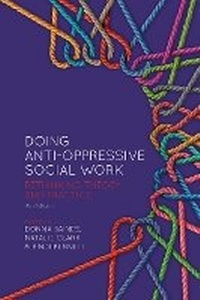
Doing Anti-Oppressive Social Work
Rethinking Theory and Practice
4th Edition
Published on 15. November 2022
Book
Paperback/Softback
352 pages
978-1-77363-555-2 (ISBN)
Description
Doing Anti-Oppressive Social Work brings together critical social work authors to passionately engage with pressing social issues, and to pose new solutions, practices and analysis in the context of growing inequities and the need for reconciliation, decolonization and far-reaching change. The book presents strong intersectional perspectives and practice, engaging closely with decolonization, re-Indigenization, resistance and social justice. Like the first three editions, the 4th edition foregrounds the voices of those less heard in social work academia and to provide cutting-edge critical reflection and skills, including social work's relationship to the state, and social work's responsibility to individuals, communities and its own ethics and standards of practice. Indigenous, Black, racialized, transgender, (dis)Ability and allied scholars offer identity-engaged and intersectional analyses on a wide-range of issues facing those working with intersectional cultural humility, racism and child welfare, poverty and single mothers, critical gerontology and older people, and immigrant and racialized families. This 4th edition of Doing Anti-Oppressive Social Work goes well beyond its predecessors, updating and revising popular chapters, but also problematizing AOP and engaging closely with new and emerging issues.
Reviews / Votes
"Doing Anti-Oppressive Practice - this fourth collection, co-edited by Donna Baines, Natalie Clark and Bindi Bennett, builds on the great foundations of the previous editions. This edition emphasizes the importance of First Nations, Metis and Inuit knowledges and their contributions to anti-oppressive practice and resistance to oppressive and destructive colonialist practices. Its seventeen chapters cover many aspects of identity, celebrating social constructs of reality and intersectionality within identities, especially within the Canadian context. In discussing the many dimensions of this story, the book highlights the role social workers, embedded within state structures, have played in oppressing marginalised and disenfranchised groups. It also provides salutary reminders of having social work's commitment to equality and valuing diversity observed and enhanced not only in Canada/Turtle Island, but more widely throughout the world to live up to its espoused ideals." -- Lena Dominelli, Social Work, University of Stirling "I have loved teaching from this book because it so helpfully explores the most pressing issues for social work in Canada by drawing on the most exciting voices in the discipline. This new edition, once again, demonstrates how a conceptually informed approach to exclusion and marginalization is the unique framework that social work contributes to helping practices and social transformation." -- Sarah Todd, School of Social Work, Carleton University "Important topics, central to social work practitioners in every field and educators who wish to address individual/familial/community issues of diverse vulnerable persons and groups within a social justice framework." -- Mary Valentich, professor emerita, Social Work, University of CalgaryMore details
Edition
fourth edition
Language
English
Place of publication
Black Point, Nova Scotia
Canada
Target group
Professional and scholarly
Edition type
Revised edition
Dimensions
Height: 24 mm
Width: 17 mm
Thickness: 1 mm
Weight
595 gr
ISBN-13
978-1-77363-555-2 (9781773635552)
Copyright in bibliographic data and cover images is held by Nielsen Book Services Limited or by the publishers or by their respective licensors: all rights reserved.
Schweitzer Classification
Persons
Donna Baines is the director and a professor in the School of Social Work at the University of British Columbia. She is editor of Doing Anti-Oppressive Practice, co-editor (with Stephen McBride) of Orchestrating Austerity and co-author of Case Critical. Her research and teaching interests include anti-oppressive theory and practice, paid and unpaid care work and social justice change.
Natalie Clark's practice, research and activism is informed and mobilized through her interconnected identities including her Settler ancestry and her Secwepemc and Metis kinship - as grandmother, mother, auntie and community member. Natalie is a Full Professor in the School of Social Work and Human Service at Thompson Rivers University, Co-Chair of the Gender Equity committee, and continues to practice as a violence counsellor and girls group facilitator with children, youth and families.
Bindi Bennett is a Gamilaraay cisgender mother, researcher and social worker. She is an associate professor in the Faculty of Health Sciences at Bond University. She has over twenty years' practice experience in the fields of Aboriginal social work, child and adolescent mental health, schools and health.
Raven Sinclair (Otiskewapiwskew) is Cree/Assinniboine/Saulteaux from Gordon's First Nation. She is a professor of social work at the University of Regina.
Dr. Thomas Bernard is a Canadian senator. She was formerly a social worker and educator from East Preston, Nova Scotia. Dr. Thomas Bernard is the first Black Canadian to have an academic tenure position and become a full professor at Dalhousie University, where her research focuses on anti-oppression and diversity. She Bernard was one of the founding members of the Association of Black Social Workers. In 2005, she was appointed to the Order of Canada for her work addressing racism and diversity in the field of social work, and in 2014, she was awarded the Order of Nova Scotia. On October 27, 2016, Dr. Thomas Bernard was named to the Senate of Canada by Prime Minister Justin Trudeau to sit as an independent. At the time of her appointment, she was the chair of the Nova Scotia Advisory Council on the Status of Women. She is the first African Nova Scotian woman to serve in the Senate Chamber
Natalie Clark's practice, research and activism is informed and mobilized through her interconnected identities including her Settler ancestry and her Secwepemc and Metis kinship - as grandmother, mother, auntie and community member. Natalie is a Full Professor in the School of Social Work and Human Service at Thompson Rivers University, Co-Chair of the Gender Equity committee, and continues to practice as a violence counsellor and girls group facilitator with children, youth and families.
Bindi Bennett is a Gamilaraay cisgender mother, researcher and social worker. She is an associate professor in the Faculty of Health Sciences at Bond University. She has over twenty years' practice experience in the fields of Aboriginal social work, child and adolescent mental health, schools and health.
Raven Sinclair (Otiskewapiwskew) is Cree/Assinniboine/Saulteaux from Gordon's First Nation. She is a professor of social work at the University of Regina.
Dr. Thomas Bernard is a Canadian senator. She was formerly a social worker and educator from East Preston, Nova Scotia. Dr. Thomas Bernard is the first Black Canadian to have an academic tenure position and become a full professor at Dalhousie University, where her research focuses on anti-oppression and diversity. She Bernard was one of the founding members of the Association of Black Social Workers. In 2005, she was appointed to the Order of Canada for her work addressing racism and diversity in the field of social work, and in 2014, she was awarded the Order of Nova Scotia. On October 27, 2016, Dr. Thomas Bernard was named to the Senate of Canada by Prime Minister Justin Trudeau to sit as an independent. At the time of her appointment, she was the chair of the Nova Scotia Advisory Council on the Status of Women. She is the first African Nova Scotian woman to serve in the Senate Chamber
Content
Foreword: Raven Sinclair
: Introduction to Anti-oppressive Practice: Roots, Theory and Tensions (Donna Baines and Natalie Clark)
Intersectional Practice:
: Perseverance, Determination and Resistance: An Indigenous Intersectional Analysis of Social Work Colonial Violence in the Lives of Indigenous girls (Natalie Clark)
: Understanding the State: A Central Anti-Oppressive Social Work Skill (Donna Baines and Dylan Lambi Raine)
: Cultural Humility and Work with Aboriginal LGBTQI+ (Trevor Gates and Bindi Bennett)
: Seeing Low Income Single Moms: Intersectionality Meets Struggles for an Anti-Oppressive Practice (Lea Caragata)
Theory and Praxis:
: Critical Clinical Social Work: Working in the Context of Trauma and (dis)Ability (Catrina Brown and Judy MacDonald)
: Occupied Spaces: Unmapping Standardized Assessments (Kristin Smith)
: Bridging the Activist-Practice Divide: Advocacy, Organizing, and Social Movements (Donna Baines and Jaclyn Sauer)
: Re-Imagining Social Work Resistance Through the Resistance of the Below: Knowledge, Bodies, and Solidarities (Fritz Pino)
Specific Lived-Experience and AOP with Specific Groups of People:
: Soup Days and Decolonization: Indigenous Pathways to Anti-Oppressive Practice (Bonnie Freeman)
: Anti-Black Racism, Bio-Power, and Governmentality: Deconstructing the Suffering of Black Families Involved with Child Welfare (Doret Phillips and Gordon Pon)
: Getting to the Heart of the Matter: Connecting Anti-Oppressive Social Work Practice to a Social Oppression Model of Disability (Irene Carter, Roy Hanes and Judy MacDonald)
: Gender-Affirming Care in Canada: Aspirations of Anti-Oppressive Care For and With Trans People (Kinnon MacKinnon, Daniel Grace, Stella L. Ng, Suzanne R. Sicchia, Lori E. Ross)
: Anti-oppressive social work with older adults: Counter-Storytelling and Other Strategies (Wendy Hulko, Shari Brotman, Louise Stern, Illyan Ferrer)
: "No One Cares More About Your Community Than You": Approaches to Healing With Secwepemc Children and Youth (Natalie Clark)
Afterword:
Black Canadians and Anti-Oppressive Social Work: Wanda Thomas Bernard
Closing Words : Banakonda Kennedy Kish and Ben Carniol
: Introduction to Anti-oppressive Practice: Roots, Theory and Tensions (Donna Baines and Natalie Clark)
Intersectional Practice:
: Perseverance, Determination and Resistance: An Indigenous Intersectional Analysis of Social Work Colonial Violence in the Lives of Indigenous girls (Natalie Clark)
: Understanding the State: A Central Anti-Oppressive Social Work Skill (Donna Baines and Dylan Lambi Raine)
: Cultural Humility and Work with Aboriginal LGBTQI+ (Trevor Gates and Bindi Bennett)
: Seeing Low Income Single Moms: Intersectionality Meets Struggles for an Anti-Oppressive Practice (Lea Caragata)
Theory and Praxis:
: Critical Clinical Social Work: Working in the Context of Trauma and (dis)Ability (Catrina Brown and Judy MacDonald)
: Occupied Spaces: Unmapping Standardized Assessments (Kristin Smith)
: Bridging the Activist-Practice Divide: Advocacy, Organizing, and Social Movements (Donna Baines and Jaclyn Sauer)
: Re-Imagining Social Work Resistance Through the Resistance of the Below: Knowledge, Bodies, and Solidarities (Fritz Pino)
Specific Lived-Experience and AOP with Specific Groups of People:
: Soup Days and Decolonization: Indigenous Pathways to Anti-Oppressive Practice (Bonnie Freeman)
: Anti-Black Racism, Bio-Power, and Governmentality: Deconstructing the Suffering of Black Families Involved with Child Welfare (Doret Phillips and Gordon Pon)
: Getting to the Heart of the Matter: Connecting Anti-Oppressive Social Work Practice to a Social Oppression Model of Disability (Irene Carter, Roy Hanes and Judy MacDonald)
: Gender-Affirming Care in Canada: Aspirations of Anti-Oppressive Care For and With Trans People (Kinnon MacKinnon, Daniel Grace, Stella L. Ng, Suzanne R. Sicchia, Lori E. Ross)
: Anti-oppressive social work with older adults: Counter-Storytelling and Other Strategies (Wendy Hulko, Shari Brotman, Louise Stern, Illyan Ferrer)
: "No One Cares More About Your Community Than You": Approaches to Healing With Secwepemc Children and Youth (Natalie Clark)
Afterword:
Black Canadians and Anti-Oppressive Social Work: Wanda Thomas Bernard
Closing Words : Banakonda Kennedy Kish and Ben Carniol