

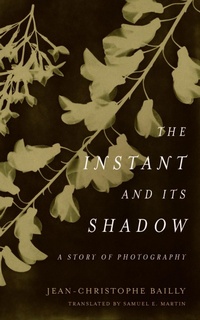
The Instant and Its Shadow
A Story of Photography
Published on 7. April 2020
Book
Hardback
128 pages
978-0-8232-8745-1 (ISBN)
Description
A compelling and innovative reflection on the way photography captures and condenses time
Two photographs, connected by a ladder, separated by a century. First, William Henry Fox Talbot photographed a faithfully realistic image of a ladder against a haystack in the English countryside.One hundred years later, an anonymous photographer captured another ladder, "photographed" alongside an incinerated man by the blinding light of the atomic bomb. These two images underpin a poetic and theoretical reflection on the origins of photographic technique, the imaginative power of montage, and the relation of photography to time itself in Jean-Christophe Bailly's The Instant and Its Shadow, translated into English for the very first time.
A rare find of intellectual caliber and theoretical rigor, The Instant and Its Shadow pursues a unique and powerful reflection on the first hundred years of photography's history and on the essence of the photographic art in general. Inspired by the unexpected coming together of these two iconic images, the book begins by retracing Talbot's invention of the photographic calotype in the early nineteenthcentury, highlighting the paradox that saw Talbot wishing to imitate the representative arts of painting and drawing while simultaneously liberating the image from any imitative paradigm. This analysis leads Bailly to elucidate photography's relation to material and visual reality. A meditation on photography's seeming ability to stop time follows, concluding with the photographs of Hiroshima and the photographic nature of the atomic bomb.
Building on an inspired juxtaposition of The Haystack with the Hiroshima photographs, the book becomes a testament to the potency of photomontage, arguing that "the more singular an image, the greater its connective power." Bailly's book is at once a lyrical homage to some of the founding texts of photographic theory and a startling reminder of the uncanny power of photography itself. Part theoretical reflection, part lyrical reverie, The Instant and Its Shadow is packed with profound and stellar insights about the medium.
Two photographs, connected by a ladder, separated by a century. First, William Henry Fox Talbot photographed a faithfully realistic image of a ladder against a haystack in the English countryside.One hundred years later, an anonymous photographer captured another ladder, "photographed" alongside an incinerated man by the blinding light of the atomic bomb. These two images underpin a poetic and theoretical reflection on the origins of photographic technique, the imaginative power of montage, and the relation of photography to time itself in Jean-Christophe Bailly's The Instant and Its Shadow, translated into English for the very first time.
A rare find of intellectual caliber and theoretical rigor, The Instant and Its Shadow pursues a unique and powerful reflection on the first hundred years of photography's history and on the essence of the photographic art in general. Inspired by the unexpected coming together of these two iconic images, the book begins by retracing Talbot's invention of the photographic calotype in the early nineteenthcentury, highlighting the paradox that saw Talbot wishing to imitate the representative arts of painting and drawing while simultaneously liberating the image from any imitative paradigm. This analysis leads Bailly to elucidate photography's relation to material and visual reality. A meditation on photography's seeming ability to stop time follows, concluding with the photographs of Hiroshima and the photographic nature of the atomic bomb.
Building on an inspired juxtaposition of The Haystack with the Hiroshima photographs, the book becomes a testament to the potency of photomontage, arguing that "the more singular an image, the greater its connective power." Bailly's book is at once a lyrical homage to some of the founding texts of photographic theory and a startling reminder of the uncanny power of photography itself. Part theoretical reflection, part lyrical reverie, The Instant and Its Shadow is packed with profound and stellar insights about the medium.
More details
Edition
New edition
Language
English
Place of publication
New York
United States
Target group
Professional and scholarly
Edition type
New edition
Product notice
Cloth over boards
Illustrations
13
Dimensions
Height: 209 mm
Width: 132 mm
Thickness: 10 mm
Weight
229 gr
ISBN-13
978-0-8232-8745-1 (9780823287451)
Copyright in bibliographic data and cover images is held by Nielsen Book Services Limited or by the publishers or by their respective licensors: all rights reserved.
Schweitzer Classification
Persons
Jean-Christophe Bailly teaches at the Ecole Nationale Superieure de la Nature et du Paysage, in Blois, France. His books include The Animal Side and The Instant and Its Shadow, as well as many other books and artists' catalogs in French.
Samuel E. Martin is Lecturer in French and Francophone Studies at the University of Pennsylvania. His translation of Georges Didi-Huberman's Bark, won the French-American Foundation Translation Prize.
Samuel E. Martin is Lecturer in French and Francophone Studies at the University of Pennsylvania. His translation of Georges Didi-Huberman's Bark, won the French-American Foundation Translation Prize.
Content
Preface vii
Part I: A Haystack in the Sun 1
Part II: The Shadow of a Ladder 57
Notes 95
Part I: A Haystack in the Sun 1
Part II: The Shadow of a Ladder 57
Notes 95