

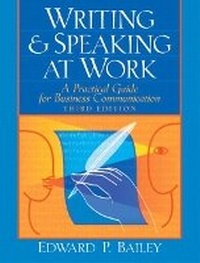
Writing and Speaking at Work
A Practical Guide for Business Communication
3rd Edition
Published on 10. June 2004
Book
Paperback/Softback
288 pages
978-0-13-143403-5 (ISBN)
Description
For undergraduate and graduate courses in Business Communication.
Designed to help students improve their ability to write and speak with confidence in the world of work, this text focuses on the practicalities of contemporary business communication-giving useful, concrete advice that students can apply immediately. Shorter than most other business communication texts, it eliminates unnecessary theoretical matters and gets right to the core of real, on-the-job communication.
Designed to help students improve their ability to write and speak with confidence in the world of work, this text focuses on the practicalities of contemporary business communication-giving useful, concrete advice that students can apply immediately. Shorter than most other business communication texts, it eliminates unnecessary theoretical matters and gets right to the core of real, on-the-job communication.
More details
Edition
3rd edition
Language
English
Place of publication
United States
Publishing group
Pearson Education (US)
Target group
Professional and scholarly
Dimensions
Height: 234 mm
Width: 176 mm
Thickness: 8 mm
Weight
410 gr
ISBN-13
978-0-13-143403-5 (9780131434035)
Copyright in bibliographic data and cover images is held by Nielsen Book Services Limited or by the publishers or by their respective licensors: all rights reserved.
Schweitzer Classification
Other editions
New editions
Book
04/2007
4th Edition
Pearson
€64.36
Article exhausted; check for reprint
Previous edition
Edward P. Bailey
Writing and Speaking at Work
Book
06/2001
2nd Edition
Pearson
€44.56
Article exhausted; check for reprint
Content
I. WRITING.
1. What Is Good Writing?
2. Developing a Good Style.
3. Using Examples and Comparisons.
4. Making Your Page Look Inviting.
5. Making Your Main Point Easy to Find.
6. Illustrating Your Ideas.
7. Getting Beyond the Period and Comma.
8. Learning Common-Sense Rules.
9. Making the Most of E-mail.
10. Writing for the Web.
11. Preparing a Resume and Cover Letter.
12. Documenting Your Sources.
II. SPEAKING.
12. What Is Business Speaking?
13. Using Good Techniques of Delivery.
14. Developing a Clear Structure.
15. Designing Visual Aids.
16. Giving a Presentation Using a Computer.
17. Giving a Presentation Using Transparencies.
18. Rehearsing, Setting Up, and Overcoming Nervousness.
19. Preparing an Annotated Presentation.
Appendix A. Final Project: Applying Computer Techniques.
Appendix B. Final Project: Creating Reports.
Appendix C. Formats for Letters and Memos.
Appendix D. Sample Papers.
Index.
1. What Is Good Writing?
2. Developing a Good Style.
3. Using Examples and Comparisons.
4. Making Your Page Look Inviting.
5. Making Your Main Point Easy to Find.
6. Illustrating Your Ideas.
7. Getting Beyond the Period and Comma.
8. Learning Common-Sense Rules.
9. Making the Most of E-mail.
10. Writing for the Web.
11. Preparing a Resume and Cover Letter.
12. Documenting Your Sources.
II. SPEAKING.
12. What Is Business Speaking?
13. Using Good Techniques of Delivery.
14. Developing a Clear Structure.
15. Designing Visual Aids.
16. Giving a Presentation Using a Computer.
17. Giving a Presentation Using Transparencies.
18. Rehearsing, Setting Up, and Overcoming Nervousness.
19. Preparing an Annotated Presentation.
Appendix A. Final Project: Applying Computer Techniques.
Appendix B. Final Project: Creating Reports.
Appendix C. Formats for Letters and Memos.
Appendix D. Sample Papers.
Index.