

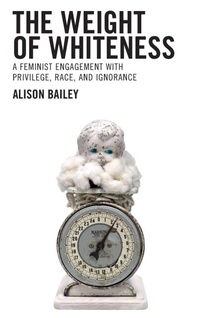
The Weight of Whiteness
A Feminist Engagement with Privilege, Race, and Ignorance
Published on 23. February 2021
Book
Hardback
202 pages
978-1-7936-0449-1 (ISBN)
Description
"Check your privilege" is not a request for a simple favor. It asks white people to consider the painful dimensions of what they have been socialized to ignore. Alison Bailey's The Weight of Whiteness: A Feminist Engagement with Privilege, Race, and Ignorance examines how whiteness misshapes our humanity, measuring the weight of whiteness in terms of its costs and losses to collective humanity. People of color feel the weight of whiteness daily. The resistant habits of whiteness and its attendant privileges, however, make it difficult for white people to feel the damage. White people are more comfortable thinking about white supremacy in terms of what privilege does for them, rather than feeling what it does to them. The first half of the book focuses on the overexposed side of white privilege, the side that works to make the invisible and intangible structures of power more visible and tangible. Bailey discusses the importance of understanding privileges intersectionally, the ignorance-preserving habits of "white talk," and how privilege and ignorance circulate in educational settings. The second part invites white readers to explore the underexposed side of white dominance, the weightless side that they would rather not feel. The final chapters are powerfully autobiographical. Bailey engages readers with a deeply personal account of what it means to hold space with the painful weight of whiteness in her own life. She also offers a moving account of medicinal genealogies, which helps to engage the weight she inherits from her settler colonial ancestors. The book illustrates how the gravitational pull of white ignorance and comfort are stronger than the clean pain required for collective liberation. The stakes are high: Failure to hold the weight of whiteness ensures that white people will continue to blow the weight of historical trauma through communities of color.
Reviews / Votes
Bailey has found a way to engage with and weave together feminist theory, philosophy of race, historical events, and personal stories to form a tapestry for the present. The Weight of Whiteness illustrates a way of employing critical whiteness studies that invites the reader to invest their whole self in personal reflection about racial identity, racial privilege, and white supremacy.... A major advantage of this book is the extent to which Bailey theorizes not only about the personal or the political, but about how these mutually reinforce one another according to the logic of white supremacy. Furthermore, she gracefully attempts to express the multifarious ways in which whiteness attempts to insulate itself from criticism. This book will cause many to pause. It may raise some eyebrows. A few readers will shake their heads; more will applaud. Although sometimes challenging, it is accessible to a wide audience and well worth the read. Recommended. * Choice Reviews * Alison Bailey's book could not have come at a more opportune time, a time when, on the one hand, white supremacy in its narrow and structural sense is being normalized by the highest levels of authority in our country and, on the other hand, where resistance and activism for racial justice is broadly and increasingly gaining recognition. Bailey's work, courageous in its deeply personal humility and epistemic honesty, and compelling in its philosophical acuity, boldly exposes the ways in which the weight of whiteness is discounted by white people and demonstrates how this weight must not be ignored. This book offers important tools to help white people to cultivate opportunities for the weighty conversations of race that are so desperately needed today. -- Barbara Applebaum, Syracuse University Alison Bailey's The Weight of Whiteness provides a timely engagement with the embodied comportments and habits of emotion that compose whiteness as a citadel of white privilege and supremacy in the United States. The weight of whiteness, Bailey argues, has pressed upon Black, Indigenous, and people of color for far too long, but dismantling it requires white people to inhabit the world differently. It's not enough to make whiteness visible. White people must learn to feel its costs and losses. Her book provides indispensable resources for doing the affective work necessary for grappling with what white people are taught to ignore. -- Gaile Pohlhaus Jr., Miami University, Ohio The achievement of racial justice in the United States will require both social and individual transformation. In this rich and insightful exploration of the multi-dimensionality of 'whiteness,' Alison Bailey gives us an expert philosophical guided tour of the patterns and structures of white privilege, white discursive evasion, white pedagogical resistance, and self-inflicted white moral damage, climaxing in a moving and heartfelt account of her discovery of her own ancestors' deep involvement in American slavery, and the 'weight' she inherits. -- Charles W. Mills, CUNY Graduate CenterMore details
Series
Language
English
Place of publication
United States
Publishing group
Bloomsbury Publishing Plc
Target group
Professional and scholarly
Illustrations
4 b/w illustrations;1 tables;
Dimensions
Height: 235 mm
Width: 157 mm
Thickness: 16 mm
Weight
451 gr
ISBN-13
978-1-7936-0449-1 (9781793604491)
Copyright in bibliographic data and cover images is held by Nielsen Book Services Limited or by the publishers or by their respective licensors: all rights reserved.
Schweitzer Classification
Other editions
Additional editions
E-Book
02/2021
1st Edition
Lexington Books
€33.49
Available for download
Person
Alison Bailey is professor of philosophy at Illinois State University, where she directs the Women's, Gender, and Sexuality Studies Program.
Content
Acknowledgments
Introduction: Has The Weight Finally Come Up to Claim Us?
1. Understanding Privilege as Unearned Power Conferred Systemically
2. The Problem with White Talk: Ignorance and Epistemic Closure
3. Tracking Privilege-Preserving Epistemic Pushback in Feminist Philosophy and Critical Race Theory Classes
4. The Weighty Conversation: How White Supremacy Damages White People
5. Inheriting the Weight of Whiteness
Bibliography
Introduction: Has The Weight Finally Come Up to Claim Us?
1. Understanding Privilege as Unearned Power Conferred Systemically
2. The Problem with White Talk: Ignorance and Epistemic Closure
3. Tracking Privilege-Preserving Epistemic Pushback in Feminist Philosophy and Critical Race Theory Classes
4. The Weighty Conversation: How White Supremacy Damages White People
5. Inheriting the Weight of Whiteness
Bibliography