

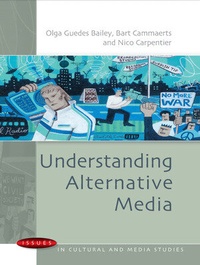
Understanding Alternative Media
Published on 16. December 2007
Book
Hardback
216 pages
978-0-335-22210-0 (ISBN)
Description
What are alternative media? What roles do alternative media play in pluralistic, democratic societies? What are the similarities and differences between alternative media, community media, civil society media and rhizomatic media? How do alternative media work in practice?
This clear and concise text offers a one-stop guide through the complex political, social and economic debates that surround alternative media and provides a fresh and insightful look at the renewed importance of this form of communication.Combing diverse case studies from countries including the UK, North America and Brazil, the authors propose an original theoretical framework to help understand the subject. Looking at both 'old' and 'new' media, the book argues for the importance of an alternative media and suggests a political agenda as a way of broadening its scope.Understanding Alternative Media is valuable reading for students in media, journalism and communications studies, researchers, academics, and journalists.
This clear and concise text offers a one-stop guide through the complex political, social and economic debates that surround alternative media and provides a fresh and insightful look at the renewed importance of this form of communication.Combing diverse case studies from countries including the UK, North America and Brazil, the authors propose an original theoretical framework to help understand the subject. Looking at both 'old' and 'new' media, the book argues for the importance of an alternative media and suggests a political agenda as a way of broadening its scope.Understanding Alternative Media is valuable reading for students in media, journalism and communications studies, researchers, academics, and journalists.
More details
Persons
Olga Guedes Bailey is a journalist and Senior Lecturer in the Institute of Cultural Analysis at Nottingham Trent University, UK.
Bart Cammaerts is a political scientist and Media Researcher lecturing on media, citizenship, and democracy at the Media and Communication Department of the London School of Economics and Political Science, University of London, UK.
Nico Carpentier is a media sociologist working at the Communication Studies Departments of the Vrije Universiteit Brussel and the Katholieke Universiteit Brussel, Belgium.
Bart Cammaerts is a political scientist and Media Researcher lecturing on media, citizenship, and democracy at the Media and Communication Department of the London School of Economics and Political Science, University of London, UK.
Nico Carpentier is a media sociologist working at the Communication Studies Departments of the Vrije Universiteit Brussel and the Katholieke Universiteit Brussel, Belgium.
Content
IntroductionPart I - Theorizing alternative media
Four approaches to alternative media
An introductory case study - Radio Favela: Representing alternative media
Part II - The case studies
Community approaches in Western radio policies
Diasporas and alternative media practices
Blogs in the second Iraqi war: Alternative media challenging the mainstream?
Ethnic-religious groups and alternative journalism
Online participation and the Public Sphere: Civil society mailinglists and forums
The Brazilian Landless Rural Workers Movement : Identity, action, and communication
Translocalization, glocalization and the internet: The RadioSwap-project
Jamming the political: reverse-engineering, hacking the dominant codes
Conclusion
Four approaches to alternative media
An introductory case study - Radio Favela: Representing alternative media
Part II - The case studies
Community approaches in Western radio policies
Diasporas and alternative media practices
Blogs in the second Iraqi war: Alternative media challenging the mainstream?
Ethnic-religious groups and alternative journalism
Online participation and the Public Sphere: Civil society mailinglists and forums
The Brazilian Landless Rural Workers Movement : Identity, action, and communication
Translocalization, glocalization and the internet: The RadioSwap-project
Jamming the political: reverse-engineering, hacking the dominant codes
Conclusion