

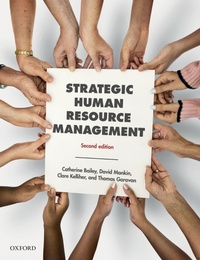
Strategic Human Resource Management
2nd Edition
Published on 29. March 2018
Book
Paperback/Softback
416 pages
978-0-19-870540-6 (ISBN)
Description
What is strategic HRM, and how do you apply it in business? What makes good HR strategy and how do you develop it? What are the key issues that need to be considered when creating, developing, and embedding a strategic approach to managing people? These are the fundamental questions asked by HR professionals and tackled in this innovative and comprehensive textbook.
Drawing on the latest academic research, the well-respected author team take a reliably thematic approach to SHRM. Broken into four distinct parts, the book addresses the context, theories, themes, and future of managing people strategically. Tata Motors, Samsung, Pizza Express, and Deliveroo make up some of the case studies and examples that feature across the book, ensuring that theoretical discussion is always linked to practical application. New 'Strategic HRM in Action' boxes take this one step further by presenting students with a scenario in which they themselves can make strategic decisions and reflect on their own evaluation of real-life business practices.
Critical thinking is essential in SHRM, so frequent Critical Reflection boxes, Review Questions, and questions or activities to accompany every case study ensure students are challenged to engage with the subject critically and reflectively, and consider their own evaluations of the essential theories and the strategic practices adopted by different organizations. Global case studies and an opening chapter dedicated to the global context of SHRM challenge the dominant Western perspective and provide a rounded and adaptable view of SHRM.
A user-friendly structure and wide range of learning features, including learning objectives, key concept boxes, and summaries, ensure the text remains accessible, even for those completely new to SHRM, allowing all students to benefit from the book's ideal balance between the latest academic theory and contemporary, real-world practice.
The book is accompanied by a selection of online resources:
For students:
Glossary
Web links
For registered lecturers:
Additional case studies
PowerPoint slides
Seminar activities
Suggested case study answers
Figures from the book
Drawing on the latest academic research, the well-respected author team take a reliably thematic approach to SHRM. Broken into four distinct parts, the book addresses the context, theories, themes, and future of managing people strategically. Tata Motors, Samsung, Pizza Express, and Deliveroo make up some of the case studies and examples that feature across the book, ensuring that theoretical discussion is always linked to practical application. New 'Strategic HRM in Action' boxes take this one step further by presenting students with a scenario in which they themselves can make strategic decisions and reflect on their own evaluation of real-life business practices.
Critical thinking is essential in SHRM, so frequent Critical Reflection boxes, Review Questions, and questions or activities to accompany every case study ensure students are challenged to engage with the subject critically and reflectively, and consider their own evaluations of the essential theories and the strategic practices adopted by different organizations. Global case studies and an opening chapter dedicated to the global context of SHRM challenge the dominant Western perspective and provide a rounded and adaptable view of SHRM.
A user-friendly structure and wide range of learning features, including learning objectives, key concept boxes, and summaries, ensure the text remains accessible, even for those completely new to SHRM, allowing all students to benefit from the book's ideal balance between the latest academic theory and contemporary, real-world practice.
The book is accompanied by a selection of online resources:
For students:
Glossary
Web links
For registered lecturers:
Additional case studies
PowerPoint slides
Seminar activities
Suggested case study answers
Figures from the book
Reviews / Votes
By far the most versatile book on SHRM. It strikes a very good balance between comprehensiveness, academic rigour, and accessibility. * Dr Michael Koch, University of Kent * Well-researched and well-written, addresses key issues within the SHRM field, and makes excellent use of organizational and international examples to illustrate information points. * Margaret Masson, Glasgow Caledonian University *More details
Edition
2nd Revised edition
Language
English
Place of publication
Oxford
United Kingdom
Target group
Adult education
Edition type
Revised edition
Dimensions
Height: 246 mm
Width: 189 mm
Thickness: 22 mm
Weight
804 gr
ISBN-13
978-0-19-870540-6 (9780198705406)
Copyright in bibliographic data and cover images is held by Nielsen Book Services Limited or by the publishers or by their respective licensors: all rights reserved.
Schweitzer Classification
Persons
Catherine Bailey is Professor in Work and Employment at King's College London. David Mankin is an academic consultant specializing in online learning for Kaplan Open Learning and the University of Essex Online. Clare Kelliher is Professor of Work and Organization at Cranfield School of Management, Cranfield University. Thomas Garavan is Research Professor AT Edinburgh Napier University.
Author
Professor in Work and Employment, King's College London.
Academic consultant specializing in online learning for Kaplan Open Learning and the University of Essex Online.
Professor of Work and Organization, Cranfield School of Management, Cranfield University
Research Professor, Edinburgh Napier University
Content
Part 1: The context of SHRM 1: The global context of SHRM 2: The changing context for SHRM 3: Strategic management and HRM
Part 2: Strategic HRM 4: The strategic role of the HR function 5: HR strategy 6: The foundations of SHRM 7: Resource-based and institutional perspectives on SHRM 8: SHRM and performance
Part 3: Strategic imperatives 9: SHRM and human resource development 10: SHRM and talent management 11: SHRM and employment relations 12: SHRM and employee engagement 13: Knowledge management and SHRM 14: SHRM, business ethics, CSR, and sustainability 15: SHRM and the management of change
Part 3: New forms of SHRM 16: New forms of SHRM
Part 2: Strategic HRM 4: The strategic role of the HR function 5: HR strategy 6: The foundations of SHRM 7: Resource-based and institutional perspectives on SHRM 8: SHRM and performance
Part 3: Strategic imperatives 9: SHRM and human resource development 10: SHRM and talent management 11: SHRM and employment relations 12: SHRM and employee engagement 13: Knowledge management and SHRM 14: SHRM, business ethics, CSR, and sustainability 15: SHRM and the management of change
Part 3: New forms of SHRM 16: New forms of SHRM