

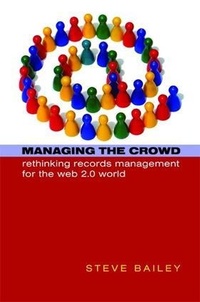
Managing the Crowd
Rethinking Records Management for the Web 2.0 World
1st Edition
Published on 20. June 2008
Book
Hardback
224 pages
978-1-85604-641-1 (ISBN)
Description
Imagine a records management (RM) future where the user community collectively describes the value and properties of a record using the wisdom of the crowd; where records retention, description and purpose are determined by their users, within general boundaries defined by the records manager. It may sound far-fetched, but could represent a way forward for managing records.
It has never been more apparent that RM as traditionally practised will soon no longer be fit for purpose. With the increasing plurality of information sources and systems within an organization, as the deluge of content increases, so the percentage of the organization's holdings that can be formally classed as records declines.
In the Web 2.0 world new technology is continually changing the way users create and use information. RM must change its approach fundamentally if it is to have a role to play in this new world. This provocative new book challenges records managers to find time amidst the daily operational pressures to debate the larger issues thrown up by the new technological paradigm we are now entering, and the threat it poses to established theory and practice.
A range of stimulating ideas are put up for discussion: why not, for instance, embrace folksonomies rather than classification schemes and metadata schemas as the main means of resource discovery for unstructured data? Adopt a ranking system that encourages users to rate how useful they found content as part of the appraisal process? Let the content creator decide whether there should be any access restrictions on the content they have created?
Readership: This is a thought-provoking book which questions received wisdom and suggests radical new solutions to the very real issues RM faces. Every records manager needs to read this challenging book, and those that do may never think about their profession in quite the same way again.
It has never been more apparent that RM as traditionally practised will soon no longer be fit for purpose. With the increasing plurality of information sources and systems within an organization, as the deluge of content increases, so the percentage of the organization's holdings that can be formally classed as records declines.
In the Web 2.0 world new technology is continually changing the way users create and use information. RM must change its approach fundamentally if it is to have a role to play in this new world. This provocative new book challenges records managers to find time amidst the daily operational pressures to debate the larger issues thrown up by the new technological paradigm we are now entering, and the threat it poses to established theory and practice.
A range of stimulating ideas are put up for discussion: why not, for instance, embrace folksonomies rather than classification schemes and metadata schemas as the main means of resource discovery for unstructured data? Adopt a ranking system that encourages users to rate how useful they found content as part of the appraisal process? Let the content creator decide whether there should be any access restrictions on the content they have created?
Readership: This is a thought-provoking book which questions received wisdom and suggests radical new solutions to the very real issues RM faces. Every records manager needs to read this challenging book, and those that do may never think about their profession in quite the same way again.
Reviews / Votes
"This is a timely text and Steve Bailey has done the records management community a great service in putting together this publication. It is recommended reading for records managers and the wider information sector. Now records management research and practitioner communities must continue to work together to address the challenges posed and to present answers." - Business Archives "This book is essential reading for any records manager who is willing is to question the validity of conventional methods and approaches." - HEA-ICS "This is an important book about an important question. The more people that read it the better. I have no hesitation in recommending it." - Records Management Society Bulletin "This is a timely text and Steve Bailey has done the records management community a great service in putting together this publication. It is recommended reading for records managers and the wider information sector. Now records management research and practitioner communities must continue to work together to address the challenges posed and to present answers." -- Business Archives "This book is essential reading for any records manager who is willing is to question the validity of conventional methods and approaches." "This is an important book about an important question. The more people that read it the better. I have no hesitation in recommending it." -- Records Management Society BulletinMore details
Language
English
Place of publication
London
United Kingdom
Target group
Professional and scholarly
Professional Practice & Development
Product notice
Laminated cover
Dimensions
Height: 250 mm
Width: 164 mm
Thickness: 18 mm
Weight
425 gr
ISBN-13
978-1-85604-641-1 (9781856046411)
Copyright in bibliographic data and cover images is held by Nielsen Book Services Limited or by the publishers or by their respective licensors: all rights reserved.
Schweitzer Classification
Other editions
Additional editions
E-Book
06/2008
1st Edition
Facet Publishing
from
€81.79
Available for download
Persons
Steve Bailey BA (Hons) MA currently acts as senior advisor on records management issues for JISC infoNet, an advisory service for managers within the HE and FE sectors. He is responsible for preparing and disseminating a range of guidance material and tools to help support the development of records management within the sector and is a well known speaker and writer on records management issues with over 60 papers and presentations to his credit. He is a former Director of the Records Management Society and is currently a member of the Education & Skills FOI Sector Group, the Ministry of Justice's Information Rights User Group and The National Archive's s.46 Code of Practice working group.
Content
PART 1: THE NATURE OF THE CHANGING WORLD1. The big picture: Web 2.0 and current trends in IT
Questions addressed in this chapter
What is Web 2.0?
Similarities and differences compared to Web 1.0
IT trends: blurring the boundaries
IT trends: the exponential age
2. The reality check: surely change is endemic in IT?
Questions addressed in this chapter
Change as the only constant in IT
The familiarity of the office of 1997
The first IT paradigm
The second IT paradigm
3. Web 2.0 and Office 2.0: enter the third paradigm
Questions addressed in this chapter
Blogs
Wikis
Collaborative editing tools
Social bookmarking and tagging
4. Welcome to the world of Office 2.0
Questions addressed in this chapter
The scenario
Outsourcing e-mail
Perceived limitations of the client-server based document management system
A successful wiki pilot
Online applications: the next logical step
Keeping up with insatiable user demand
Boundless potential
PART 2: IS RECORDS MANAGEMENT NO LONGER FIT FOR PURPOSE?5. The need for critical professional self-examination
Questions addressed in this chapter
The importance of continued professional reinvention
The gulf between theory and practice
6. 'Not all information sources are records ...'
Questions addressed in this chapter
The inherent value of records
The consequences of our focus on records
The dangers of being cocooned from change
The power and value of information
7. The centralized command and control ethos
Questions addressed in this chapter
Records management as a bottleneck
The records manager as jack of all trades, master of none
Folksonomy vs taxonomy
The death of the classification scheme?
The difficulties of applying a classification scheme within the Web 2.0 enabled office
Problems of scalability
8. 'Regardless of format...'
Questions addressed in this chapter
Did the concept of management 'regardless of format' ever really make sense?
A world of silos
The decline of the common underlying storage facility
Integrated Office 2.0 suites
9. Appraisal, retention and destruction
Questions addressed in this chapter
Definitions
The origins and traditional rationale for retention management
The pros and cons of random selection
Why not keep everything?
What about the smoking gun?
But keeping everything is not a panacea either
10. The problems with applying existing approaches to appraisal in the Web 2.0 world
Questions addressed in this chapter
Appraisal theory and reality
Scalability
Scope and detail
Failure to adequately assess information value alongside evidential value
The role of the user and demands placed on them
Conclusion: one size does not fit all
Questions addressed in this chapter
What is Web 2.0?
Similarities and differences compared to Web 1.0
IT trends: blurring the boundaries
IT trends: the exponential age
2. The reality check: surely change is endemic in IT?
Questions addressed in this chapter
Change as the only constant in IT
The familiarity of the office of 1997
The first IT paradigm
The second IT paradigm
3. Web 2.0 and Office 2.0: enter the third paradigm
Questions addressed in this chapter
Blogs
Wikis
Collaborative editing tools
Social bookmarking and tagging
4. Welcome to the world of Office 2.0
Questions addressed in this chapter
The scenario
Outsourcing e-mail
Perceived limitations of the client-server based document management system
A successful wiki pilot
Online applications: the next logical step
Keeping up with insatiable user demand
Boundless potential
PART 2: IS RECORDS MANAGEMENT NO LONGER FIT FOR PURPOSE?5. The need for critical professional self-examination
Questions addressed in this chapter
The importance of continued professional reinvention
The gulf between theory and practice
6. 'Not all information sources are records ...'
Questions addressed in this chapter
The inherent value of records
The consequences of our focus on records
The dangers of being cocooned from change
The power and value of information
7. The centralized command and control ethos
Questions addressed in this chapter
Records management as a bottleneck
The records manager as jack of all trades, master of none
Folksonomy vs taxonomy
The death of the classification scheme?
The difficulties of applying a classification scheme within the Web 2.0 enabled office
Problems of scalability
8. 'Regardless of format...'
Questions addressed in this chapter
Did the concept of management 'regardless of format' ever really make sense?
A world of silos
The decline of the common underlying storage facility
Integrated Office 2.0 suites
9. Appraisal, retention and destruction
Questions addressed in this chapter
Definitions
The origins and traditional rationale for retention management
The pros and cons of random selection
Why not keep everything?
What about the smoking gun?
But keeping everything is not a panacea either
10. The problems with applying existing approaches to appraisal in the Web 2.0 world
Questions addressed in this chapter
Appraisal theory and reality
Scalability
Scope and detail
Failure to adequately assess information value alongside evidential value
The role of the user and demands placed on them
Conclusion: one size does not fit all