

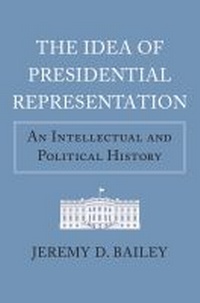
The Idea of Presidential Representation
An Intellectual and Political History
Will be published approx. on 30. July 2019
Book
Hardback
264 pages
978-0-7006-2815-5 (ISBN)
Description
Does the president represent the entire nation? Or does he speak for core partisans and narrow constituencies? The Federalist Papers, the electoral college, history and circumstance from the founders' time to our own: all factor in theories of presidential representation, again and again lending themselves to different interpretations. This back-and-forth, Jeremy D. Bailey contends, is a critical feature, not a flaw, in American politics. Arriving at a moment of great debate over the nature and exercise of executive power, Bailey's history offers an invaluable, remarkably relevant analysis of the intellectual underpinnings, political usefulness, and practical merits of contending ideas of presidential representation over time.
Among scholars, a common reading of political history holds that the founders, aware of the dangers of demagogy, created a singularly powerful presidency that would serve as a check on the people's representatives in Congress; then, this theory goes, the Progressives, impatient with such a counter-majoritarian approach, reformed the presidency to better reflect the people's will-and, they reasoned, advance the public good. The Idea of Presidential Representation challenges this consensus, offering a more nuanced view of the shifting relationship between the president and the American people. Implicit in this pattern, Bailey tells us, is another equivocal relationship-that between law and public opinion as the basis for executive power in republican constitutionalism. Tracing these contending ideas from the framers time to our own, his book provides both a history and a much-needed context for our understanding of presidential representation in light of the modern presidency. In The Idea of Presidential Representation Bailey gives us a new and useful sense of an enduring and necessary feature of our politics.
Among scholars, a common reading of political history holds that the founders, aware of the dangers of demagogy, created a singularly powerful presidency that would serve as a check on the people's representatives in Congress; then, this theory goes, the Progressives, impatient with such a counter-majoritarian approach, reformed the presidency to better reflect the people's will-and, they reasoned, advance the public good. The Idea of Presidential Representation challenges this consensus, offering a more nuanced view of the shifting relationship between the president and the American people. Implicit in this pattern, Bailey tells us, is another equivocal relationship-that between law and public opinion as the basis for executive power in republican constitutionalism. Tracing these contending ideas from the framers time to our own, his book provides both a history and a much-needed context for our understanding of presidential representation in light of the modern presidency. In The Idea of Presidential Representation Bailey gives us a new and useful sense of an enduring and necessary feature of our politics.
Reviews / Votes
This is an outstanding and important book. Professor Bailey challenges many of our conceptions of presidential representation. Taking his bearings from an intense engagement with history on its own terms, Bailey uncovers conceptions of presidential representation that are lost to us when we begin from our current account of it. Bailey combines political science with history to produce a truly magnificent book that will be of significant interest to historians, political scientists, and legal scholars." - Benjamin A. Kleinerman, author of The Discretionary President: The Promise and Peril of Executive Power"The Idea of Presidential Representation is a major scholarly achievement. Jeremy Bailey's analysis illuminates the tensions that inhere in the republican idea of the executive: the president is understood to be both a defender of the law and a representative of popular will. Covering the whole of American political development, this book reveals that these dueling conceptions of the presidency date to the founding itself. Bailey's careful scholarly eye and diligent research will overturn the prevailing consensus that the idea of the president as a popular representative of the people is the twentieth-century invention of progressives like Woodrow Wilson." - George Thomas, Burnet C. Wohlford Professor of American Political Institutions, Claremont McKenna College
"Presidents claim to be the only nationally elected constitutional officer. Jeremy Bailey shows that while the president's place in the constitutional order has been Set since the founding, the understanding of the president as a representative has not been static. Original, probing, and provocative, Bailey's history of the idea of presidential representation offers a new window on the entire history of presidential politics." - Jeffrey K. Tulis, associate professor of government, University of Texas at Austin
"Jeremy Bailey has written a learned book that offers new insights into the fraught relationship between the Constitution and the presidency. The idea of presidential representation, he shows, has been contested from the earliest days of the republic-a debate that resonates through our own disruptive political time. This enduring struggle between those who view the president as wielder of executive power and those who champion the executive office as the vanguard of popular opinion has animated a vital debate about the meaning of self-government and, at least to this point in our history, defied a dangerous joining of executive prerogative and populism." - Sidney M. Milkis, author of Theodore Roosevelt, the Progressive Party, and the Transformation of American Democracy
More details
Language
English
Place of publication
Kansas
United States
Target group
Professional and scholarly
Dimensions
Height: 229 mm
Width: 152 mm
Thickness: 25 mm
Weight
569 gr
ISBN-13
978-0-7006-2815-5 (9780700628155)
Copyright in bibliographic data and cover images is held by Nielsen Book Services Limited or by the publishers or by their respective licensors: all rights reserved.
Schweitzer Classification
Other editions
Additional editions
E-Book
10/2019
1st Edition
University Press of Kansas
from
€92.99
Available for download
Person
Jeremy D. Bailey is professor of political science and honors at the University of Houston. His books include Thomas Jefferson and Executive Power, James Madison and Constitutional Imperfection, and The Contested Removal Power, also from Kansas.
Content
Acknowledgments Introduction
1. The Presidential Representation in the 1780s
2. Jefferson's Federalists, Jackson's Whigs, and Lincoln's Democrats
3. The Progressives and Presidential Representation
4. The National Security Constitution and Presidential Representation at Midcentury
5. Reformed Democrats and Unitarian Republicans
Conclusion: Law and Opinion
Notes
Index
1. The Presidential Representation in the 1780s
2. Jefferson's Federalists, Jackson's Whigs, and Lincoln's Democrats
3. The Progressives and Presidential Representation
4. The National Security Constitution and Presidential Representation at Midcentury
5. Reformed Democrats and Unitarian Republicans
Conclusion: Law and Opinion
Notes
Index