

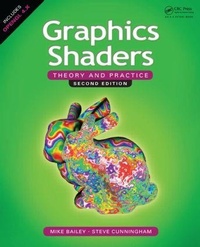
Graphics Shaders
Theory and Practice, Second Edition
2nd Edition
Published on 8. November 2011
Book
Hardback
492 pages
978-1-56881-434-6 (ISBN)
Description
Graphics Shaders: Theory and Practice is intended for a second course in computer graphics at the undergraduate or graduate level, introducing shader programming in general, but focusing on the GLSL shading language. While teaching how to write programmable shaders, the authors also teach and reinforce the fundamentals of computer graphics. The second edition has been updated to incorporate changes in the OpenGL API (OpenGL 4.x and GLSL 4.x0) and also has a chapter on the new tessellation shaders, including many practical examples.
The book starts with a quick review of the graphics pipeline, emphasizing features that are rarely taught in introductory courses, but are immediately exposed in shader work. It then covers shader-specific theory for vertex, tessellation, geometry, and fragment shaders using the GLSL 4.x0 shading language. The text also introduces the freely available glman tool that enables you to develop, test, and tune shaders separately from the applications that will use them. The authors explore how shaders can be used to support a wide variety of applications and present examples of shaders in 3D geometry, scientific visualization, geometry morphing, algorithmic art, and more.
Features of the Second Edition:
Written using the most recent specification releases (OpenGL 4.x and GLSL 4.x0) including code examples brought up-to-date with the current standard of the GLSL language.
More examples and more exercises
A chapter on tessellation shaders
An expanded Serious Fun chapter with examples that illustrate using shaders to produce fun effects
A discussion of how to handle the major changes occurring in the OpenGL standard, and some C++ classes to help you manage that transition
The authors thoroughly explain the concepts, use sample code to describe details of the concepts, and then challenge you to extend the examples. They provide sample source code for many of the book's examples at www.cgeducation.org
The book starts with a quick review of the graphics pipeline, emphasizing features that are rarely taught in introductory courses, but are immediately exposed in shader work. It then covers shader-specific theory for vertex, tessellation, geometry, and fragment shaders using the GLSL 4.x0 shading language. The text also introduces the freely available glman tool that enables you to develop, test, and tune shaders separately from the applications that will use them. The authors explore how shaders can be used to support a wide variety of applications and present examples of shaders in 3D geometry, scientific visualization, geometry morphing, algorithmic art, and more.
Features of the Second Edition:
Written using the most recent specification releases (OpenGL 4.x and GLSL 4.x0) including code examples brought up-to-date with the current standard of the GLSL language.
More examples and more exercises
A chapter on tessellation shaders
An expanded Serious Fun chapter with examples that illustrate using shaders to produce fun effects
A discussion of how to handle the major changes occurring in the OpenGL standard, and some C++ classes to help you manage that transition
The authors thoroughly explain the concepts, use sample code to describe details of the concepts, and then challenge you to extend the examples. They provide sample source code for many of the book's examples at www.cgeducation.org
Reviews / Votes
"If you are one of the multitudes of OpenGL programmers wondering about how to get started with programmable shaders or what they are good for, this is the book for you. Mike and Steve have filled their new edition with such a variety of interesting examples that you'll be running to your computer to begin writing your own shaders."-Ed Angel, Chair, Board of Directors, Santa Fe Complex, Founding Director, Art, Research, Technology and Science Laboratory (ARTS Lab), Professor Emeritus of Computer Science, University of New Mexico
"Shaders are an essential tool in today's computer graphics, from films and games to science and industry. In this excellent book, Bailey and Cunningham not only clearly explain the how and why of shaders, but they provide a wealth of cutting-edge shaders and development tools. If you want to learn about shaders, this is the place to start!"
-Andrew Glassner
Praise for the First Edition:"Bailey and Cunningham provide a comprehensive, well-written overview of graphics shaders. ... Although the book uses the OpenGL Shading Language (GLSL) for its examples, it gives enough theoretical background for readers to learn the fundamentals for any graphics language. ... The book also addresses scientific visualization and the GLSL API to call GLSL functions from an OpenGL program. A final chapter offers ideas for using shaders in very entertaining ways. ... Highly recommended."
-C. Tappert, CHOICE, December 2009
"... a pick for any college-level, advanced computer library catering to programming professionals. ... discusses different types of shaders, how to use the glman program for free, and how to blend shaders into an interactive game environment. Libraries will find it a powerful, appealing lend for intermediate programmers seeking extra spice for their projects."
-Midwest Book Review, August 2009 "If you are one of the multitudes of OpenGL programmers wondering about how to get started with programmable shaders or what they are good for, this is the book for you. Mike and Steve have filled their new edition with such a variety of interesting examples that you'll be running to your computer to begin writing your own shaders."
-Ed Angel, Chair, Board of Directors, Santa Fe Complex, Founding Director, Art, Research, Technology and Science Laboratory (ARTS Lab), Professor Emeritus of Computer Science, University of New Mexico
"Shaders are an essential tool in today's computer graphics, from films and games to science and industry. In this excellent book, Bailey and Cunningham not only clearly explain the how and why of shaders, but they provide a wealth of cutting-edge shaders and development tools. If you want to learn about shaders, this is the place to start!"
-Andrew Glassner
Praise for the First Edition:"Bailey and Cunningham provide a comprehensive, well-written overview of graphics shaders. ... Although the book uses the OpenGL Shading Language (GLSL) for its examples, it gives enough theoretical background for readers to learn the fundamentals for any graphics language. ... The book also addresses scientific visualization and the GLSL API to call GLSL functions from an OpenGL program. A final chapter offers ideas for using shaders in very entertaining ways. ... Highly recommended."
-C. Tappert, CHOICE, December 2009
"... a pick for any college-level, advanced computer library catering to programming professionals. ... discusses different types of shaders, how to use the glman program for free, and how to blend shaders into an interactive game environment. Libraries will find it a powerful, appealing lend for intermediate programmers seeking extra spice for their projects."
-Midwest Book Review, August 2009
More details
Edition
2nd edition
Language
English
Place of publication
Natick
United States
Publishing group
Taylor & Francis Inc
Target group
Professional and scholarly
Academic and Professional Practice & Development
Edition type
New edition
Product notice
sewn/stitched
Cloth over boards
Dimensions
Height: 249 mm
Width: 205 mm
Thickness: 28 mm
Weight
1226 gr
ISBN-13
978-1-56881-434-6 (9781568814346)
Copyright in bibliographic data and cover images is held by Nielsen Book Services Limited or by the publishers or by their respective licensors: all rights reserved.
Schweitzer Classification
Other editions
Additional editions
E-Book
04/2016
2nd Edition
CRC Press
€98.99
Available for download
E-Book
04/2016
2nd Edition
CRC Press
€98.99
Available for download
Persons
Mike Bailey is a professor of computer science at Oregon State University. Dr. Bailey is a member of ACM, SIGGRAPH, IEEE, ASME. He earned a Ph.D. in computer graphics and computer aided design from Purdue University. His areas of interest include scientific visualization, high performance computer graphics, GPU programming, solid freeform fabrication, geometric modeling, and computer aided design and analysis.
Steve Cunningham is a professor emeritus of computer science at California State University Stanislaus. A member of ACM SIGGRAPH, ACM SIGCSE, and Eurographics, he has been actively engaged in computer graphics education for many years.
Steve Cunningham is a professor emeritus of computer science at California State University Stanislaus. A member of ACM SIGGRAPH, ACM SIGCSE, and Eurographics, he has been actively engaged in computer graphics education for many years.
Content
The Fixed-Function Graphics Pipeline. OpenGL Shader Evolution. Fundamental Shader Concepts. Using glman. The GLSL Shader Language. Lighting. Vertex Shaders. Fragment Shaders and Surface Appearance. Surface Textures in the Fragment Shader. Noise. Image Manipulation with Shaders. Geometry Shader Concepts and Examples. Tessellation Shaders. The GLSL API. Using Shaders for Scientific Visualization. Serious Fun. Appendices. References. Index.