

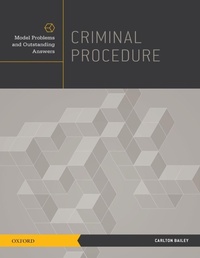
Criminal Procedure
Model Problems and Outstanding Answers
Published on 21. May 2015
Book
Paperback/Softback
152 pages
978-0-19-979519-2 (ISBN)
Description
In a criminal procedure class, students are asked to determine whether a citizen's constitutional rights were violated, and this question is consistently posed under a myriad of factual circumstances. In order to answer the query, students would need to examine and discuss the United States Supreme Court's interpretations of the Fourth, Fifth, Sixth, and Fourteenth Amendments of the US Constitution, identifying many tests and standards from those examinations and spirited discussions. Criminal Procedure: Model Problems and Outstanding Answers documents a few of the United States Supreme Court's tests and standards from these amendments to provide a more accurate assessment of whether a "right" under the Constitution has retained its full vitality, or whether it has been modified or made less vital than originally intended.
Oxford University Press equips students with an accessible guide to acing challenging criminal procedure law exams. In Criminal Procedure: Model Problems and Outstanding Answers, Carlton Bailey helps students demonstrate their knowledge of criminal procedure in the structured and sophisticated manner that professors expect on law school exams. This book provides clear introductions on the fundamental topics in criminal procedure, provides hypotheticals similar to those that students can expect to see on an exam (including multi-issue questions), and offers model answers to those hypotheticals. Professor Bailey then coaches students in how to evaluate their own work with a comprehensive self-analysis section. This book prepares students by challenging them to use the law they learn in class while also explaining the best way to express sophisticated answers on law school exams.
Oxford University Press equips students with an accessible guide to acing challenging criminal procedure law exams. In Criminal Procedure: Model Problems and Outstanding Answers, Carlton Bailey helps students demonstrate their knowledge of criminal procedure in the structured and sophisticated manner that professors expect on law school exams. This book provides clear introductions on the fundamental topics in criminal procedure, provides hypotheticals similar to those that students can expect to see on an exam (including multi-issue questions), and offers model answers to those hypotheticals. Professor Bailey then coaches students in how to evaluate their own work with a comprehensive self-analysis section. This book prepares students by challenging them to use the law they learn in class while also explaining the best way to express sophisticated answers on law school exams.
More details
Series
Language
English
Place of publication
New York
United States
Target group
College/higher education
Dimensions
Height: 280 mm
Width: 216 mm
Thickness: 8 mm
Weight
402 gr
ISBN-13
978-0-19-979519-2 (9780199795192)
Copyright in bibliographic data and cover images is held by Nielsen Book Services Limited or by the publishers or by their respective licensors: all rights reserved.
Schweitzer Classification
Other editions
Additional editions
E-Book
03/2015
1st Edition
OUP eBook
€31.49
Available for download
E-Book
03/2015
1st Edition
OUP eBook
€31.49
Available for download
Person
Carlton Bailey is the Robert A. Leflar Distinguished Professor of Law, University of Arkansas School of Law. Professor Bailey has served as the director of Arkansas' Legal Clinic, and he has taught criminal procedure, trial advocacy, pre-trial skills, and basic evidence.
Content
About the Author ; Preface ; 1. Is the Fourth Amendment Implicated? ; 2. The Fourth Amendment - Sense-Enhancing Devices/Probable Cause and the Good Faith Exception ; 3. The Warrant Process / Knock and Announce / Plainview ; 4. Consent Searches ; 5. Exceptions to the Warrant Requirement ; 6. Arrest in a Public Place or One's Private Home ; 7. Search Incident to an Arrest or a Stop ; 8. Special Needs and Reasonableness under the Fourth Amendment ; 9. The Fifth Amendment Privilege ; 10. Confessions and Interrogations ; Table of Cases ; Table of Constitutions, Statutes, Rules, and Treaties ; Other Materials