

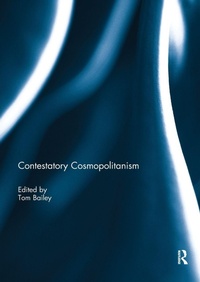
Contestatory Cosmopolitanism
1st Edition
Published on 3. January 2019
Book
Paperback/Softback
152 pages
978-0-367-14222-3 (ISBN)
Description
Contemporary global politics poses urgent challenges - from humanitarian, migratory and environmental problems to economic, religious and military conflicts - that strain not only existing political systems and resources, but also the frameworks and concepts of political thinking. The standard cosmopolitan response is to invoke a sense of global community, governed by such principles as human rights or humanitarianism, free or fair trade, global equality, multiculturalism, or extra-national democracy. Yet, the contours, grounds and implications of such a global community remain notoriously controversial, and it risks abstracting precisely from the particular and conflictual character of the challenges which global politics poses.
The contributions to this collection undertake to develop a more fruitful cosmopolitan response to global political challenges, one that roots cosmopolitanism in the particularity and conflict of global politics itself. They argue that this 'contestatory' cosmopolitanism must be dialectical, agonistic and democratic: that is, its concepts and principles must be developed immanently and critically out of prevailing normative resources; they must reflect and acknowledge their antagonistic roots; and they must be the result of participatory and self-determining publics. In elaborating this alternative, the contributions also return to neglected cosmopolitan theorists like Hegel, Adorno, Arendt, Camus, Derrida, and Mouffe, and reconsider mainstream figures such as Kant and Habermas.
This collection was originally published as a special edition of Critical Horizons.
The contributions to this collection undertake to develop a more fruitful cosmopolitan response to global political challenges, one that roots cosmopolitanism in the particularity and conflict of global politics itself. They argue that this 'contestatory' cosmopolitanism must be dialectical, agonistic and democratic: that is, its concepts and principles must be developed immanently and critically out of prevailing normative resources; they must reflect and acknowledge their antagonistic roots; and they must be the result of participatory and self-determining publics. In elaborating this alternative, the contributions also return to neglected cosmopolitan theorists like Hegel, Adorno, Arendt, Camus, Derrida, and Mouffe, and reconsider mainstream figures such as Kant and Habermas.
This collection was originally published as a special edition of Critical Horizons.
More details
Language
English
Place of publication
London
United Kingdom
Publishing group
Taylor & Francis Ltd
Target group
College/higher education
Dimensions
Height: 246 mm
Width: 174 mm
Thickness: 9 mm
Weight
305 gr
ISBN-13
978-0-367-14222-3 (9780367142223)
Copyright in bibliographic data and cover images is held by Nielsen Book Services Limited or by the publishers or by their respective licensors: all rights reserved.
Schweitzer Classification
Other editions
Additional editions
Tom Bailey
Contestatory Cosmopolitanism
E-Book
10/2018
1st Edition
Routledge
€64.49
Available for download
Tom Bailey
Contestatory Cosmopolitanism
Book
04/2017
1st Edition
Routledge
€231.10
Shipment within 10-20 days
Person
Tom Bailey is Associate Professor of Philosophy at John Cabot University in Rome, Italy. He works on modern and contemporary ethics and political philosophy. He has published essays on Kant and Nietzsche, and edited Nietzsche and Kantian Ethics (with J Constancio, London: Bloomsbury, 2017), Rawls and Religion (with V. Gentile, New York: Columbia University Press, 2015) and Deprovincializing Habermas: Global Perspectives (London: Routledge, 2013).
Content
Introduction 1. Cosmopolitanism and the Modern Revolutionary Tradition: Reflections on Arendt's Politics 2. National Sovereigntism and Global Constitutionalism: An Adornian Cosmopolitan Critique 3. A Brief Sketch of the Possibility of a Hegelian Cosmopolitanism 4. Overcoming Statism from Within: The International Criminal Court and the Westphalian System 5. Cosmopolitanism From Below: Universalism as Contestation 6. Farewell to Teleology: Reflections on Camus and a Rebellious Cosmopolitanism without Hope 7. Towards an Agonistic Cosmopolitanism: Exploring the Cosmopolitan Potential of Chantal Mouffe's Agonism 8. Citizens and Strangers: Cosmopolitanism as an Empty Universal 9. From Self-Legislation to Self-Determination: Democracy and the New Circumstances of Global Politics 10. Law and (Global) Order: Towards a Theory of Cosmopolitan Policing