

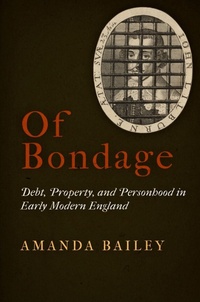
Of Bondage
Debt, Property, and Personhood in Early Modern England
Published on 14. June 2013
Book
Hardback
224 pages
978-0-8122-4516-5 (ISBN)
Description
The late sixteenth-century penal debt bond, which allowed an unsatisfied creditor to seize the body of his debtor, set in motion a series of precedents that would shape the legal, philosophical, and moral issue of property-in-person in England and America for centuries. Focusing on this historical juncture at which debt litigation was not merely an aspect of society but seemed to engulf it completely, Of Bondage examines a culture that understood money and the body of the borrower as comparable forms of property that impinged on one another at the moment of default.
Amanda Bailey shows that the early modern theater, itself dependent on debt bonds, was well positioned to stage the complex ethical issues raised by a system of forfeiture that registered as a bodily event. While plays about debt like The Merchant of Venice and The Custom of the Country did not use the language of political philosophy, they were artistically and financially invested in exploring freedom as a function of possession. By revealing dramatic literature's heretofore unacknowledged contribution to the developing narrative of possessed persons, Amanda Bailey not only deepens our understanding of creditor-debtor relations in the period but also sheds new light on the conceptual conditions for the institutions of indentured servitude and African slavery. Of Bondage is vital not only for students and scholars of English literature but also for those interested in British and colonial legal history, the history of human rights, and the sociology of economics.
Amanda Bailey shows that the early modern theater, itself dependent on debt bonds, was well positioned to stage the complex ethical issues raised by a system of forfeiture that registered as a bodily event. While plays about debt like The Merchant of Venice and The Custom of the Country did not use the language of political philosophy, they were artistically and financially invested in exploring freedom as a function of possession. By revealing dramatic literature's heretofore unacknowledged contribution to the developing narrative of possessed persons, Amanda Bailey not only deepens our understanding of creditor-debtor relations in the period but also sheds new light on the conceptual conditions for the institutions of indentured servitude and African slavery. Of Bondage is vital not only for students and scholars of English literature but also for those interested in British and colonial legal history, the history of human rights, and the sociology of economics.
Reviews / Votes
"[Bailey] offers a compelling account of the role of debt in the early modern imaginary. . . . [Her] literary exegesis . . . raises important historical questions." (Sixteenth Century Journal) "Absorbing and beautifully written. Amanda Bailey thinks about debt as a bodily event at the center of political and moral issues raised by contract law, including the question of self-ownership." (Jonathan Gil Harris, George Washington University)More details
Language
English
Place of publication
Pennsylvania
United States
Target group
College/higher education
Product notice
Paper over boards
Illustrations
1 illus.
Dimensions
Height: 231 mm
Width: 160 mm
Thickness: 25 mm
Weight
499 gr
ISBN-13
978-0-8122-4516-5 (9780812245165)
Copyright in bibliographic data and cover images is held by Nielsen Book Services Limited or by the publishers or by their respective licensors: all rights reserved.
Schweitzer Classification
Other editions
Additional editions
E-Book
04/2013
1st Edition
University of Pennsylvania Press
€63.49
Available for download
Person
Amanda Bailey is Associate Professor of English at the University of Maryland and author of Flaunting: Style and the Subversive Male Body in Renaissance England.
Content
Preface
Introduction: Bound Bodies and the Theater of Debt
Chapter 1. Timon of Athens, Forms of Payback, and the Genre of Debt
Chapter 2. Shylock and the Slaves: Owing and Owning in The Merchant of Venice
Chapter 3. Michaelmas Term and the Problem of Satisfaction
Chapter 4. Freedom, Bondage, and Redemption in The Custom of the Country
Chapter 5. Prison Prose, the Pit, and the End of Tricks
Epilogue: The Debtor and the Slave
Notes
Works Cited
Index
Acknowledgments
Introduction: Bound Bodies and the Theater of Debt
Chapter 1. Timon of Athens, Forms of Payback, and the Genre of Debt
Chapter 2. Shylock and the Slaves: Owing and Owning in The Merchant of Venice
Chapter 3. Michaelmas Term and the Problem of Satisfaction
Chapter 4. Freedom, Bondage, and Redemption in The Custom of the Country
Chapter 5. Prison Prose, the Pit, and the End of Tricks
Epilogue: The Debtor and the Slave
Notes
Works Cited
Index
Acknowledgments