

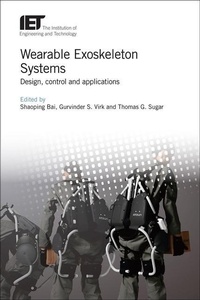
Wearable Exoskeleton Systems
Design, control and applications
Published on 11. May 2018
Book
Hardback
408 pages
978-1-78561-302-9 (ISBN)
Description
Wearable exoskeletons are electro-mechanical systems designed to assist, augment, or enhance motion and mobility in a variety of human motion applications and scenarios. The applications, ranging from providing power supplementation to assist the wearers to situations where human motion is resisted for exercising applications, cover a wide range of domains such as medical devices for patient rehabilitation training recovering from trauma, movement aids for disabled persons, personal care robots for providing daily living assistance, and reduction of physical burden in industrial and military applications. The development of effective and affordable wearable exoskeletons poses several design, control and modelling challenges to researchers and manufacturers. Novel technologies are therefore being developed in adaptive motion controllers, human-robot interaction control, biological sensors and actuators, materials and structures, etc.
In this book, the editors and authors report recent advances and technology breakthroughs in exoskeleton developments. It will be of interest to engineers and researchers in academia and industry as well as manufacturing companies interested in developing new markets in wearable exoskeleton robotics.
In this book, the editors and authors report recent advances and technology breakthroughs in exoskeleton developments. It will be of interest to engineers and researchers in academia and industry as well as manufacturing companies interested in developing new markets in wearable exoskeleton robotics.
More details
Series
Language
English
Place of publication
Stevenage
United Kingdom
Target group
Professional and scholarly
College/higher education
Product notice
sewn/stitched
Cloth over boards
Dimensions
Height: 239 mm
Width: 163 mm
Thickness: 25 mm
Weight
726 gr
ISBN-13
978-1-78561-302-9 (9781785613029)
Copyright in bibliographic data and cover images is held by Nielsen Book Services Limited or by the publishers or by their respective licensors: all rights reserved.
Schweitzer Classification
Other editions
New editions
Shaoping Bai | Gurvinder Singh Virk | Thomas Sugar
Wearable Exoskeleton Systems
Design, control and applications
Book
approx. 03/2026
2nd Edition
Institution of Engineering and Technology
€147.50
Not yet published
Persons
Shaoping Bai is an Associate Professor at the Department of Mechanical and Manufacturing Engineering, Aalborg University, Denmark. His research interests include dynamics and design, assistive exoskeletons, parallel manipulators, and walking robots. He holds a Ph.D. degree in Robotics from Nanyang Technological University, Singapore.
Gurvinder Singh Virk is Technical Director at InnotecUK involved in designing and commercialising specialised robotic systems for hazardous environments and service robots for healthcare. His current interests are in wearable exoskeletons; climbing and walking robots, and robot safety standardisation. He has been awarded the Freedom of the City of London for his work and holds a PhD in Control theory from Imperial College, University of London, UK. He has held Professorship positions at several universities in UK, New Zealand, Germany, China, India and Sweden.
Thomas Sugar is Professor in the Department of Engineering, The Polytechnic School, Ira A. Fulton Schools of Engineering, Arizona State University, USA. He works in the areas of wearable robotics for rehabilitation, gait assistance and enhanced mobility. He holds a PhD in Mechanical Engineering and Applied Mechanics from the University of Pennsylvania, USA.
Gurvinder Singh Virk is Technical Director at InnotecUK involved in designing and commercialising specialised robotic systems for hazardous environments and service robots for healthcare. His current interests are in wearable exoskeletons; climbing and walking robots, and robot safety standardisation. He has been awarded the Freedom of the City of London for his work and holds a PhD in Control theory from Imperial College, University of London, UK. He has held Professorship positions at several universities in UK, New Zealand, Germany, China, India and Sweden.
Thomas Sugar is Professor in the Department of Engineering, The Polytechnic School, Ira A. Fulton Schools of Engineering, Arizona State University, USA. He works in the areas of wearable robotics for rehabilitation, gait assistance and enhanced mobility. He holds a PhD in Mechanical Engineering and Applied Mechanics from the University of Pennsylvania, USA.
Content
Section 1: Review and overall requirements
Chapter 1: Lower-limb wearable robotics
Chapter 2: Review of exoskeletons for medical and service applications: ongoing research in Europe on wearable robots, with focus on lower extremity exoskeletons
Chapter 3: Soft wearable robots
Chapter 4: Exploring user requirements for a lower body soft exoskeleton to assist mobility
Section 2: Design and control of exoskeletons
Chapter 5: Design and control of spherical shoulder exoskeletons for assistive applications
Chapter 6: Calibration platform for wearable 3D motion sensors
Chapter 7: Control and performance of upper- and lower extremity SEA-based exoskeletons
Chapter 8: Gait-event-based synchronization and control of a compact portable knee-ankle-foot exoskeleton robot for gait rehabilitation
Section 3: Devices
Chapter 9: Real-time gait planning for a lower limb exoskeleton robot
Chapter 10: Soft wearable assistive robotics: exosuits and supernumerary limbs
Chapter 11: Walking assistive apparatus for gait training patients and promotion exercise of the elderly
Section 4: Commercialization issues
Chapter 12: Regulatory issues for exoskeletons
Chapter 13: Test methods for exoskeletons - lessons learned from industrial and response robotics
Chapter 14: Ekso Bionics
Chapter 1: Lower-limb wearable robotics
Chapter 2: Review of exoskeletons for medical and service applications: ongoing research in Europe on wearable robots, with focus on lower extremity exoskeletons
Chapter 3: Soft wearable robots
Chapter 4: Exploring user requirements for a lower body soft exoskeleton to assist mobility
Section 2: Design and control of exoskeletons
Chapter 5: Design and control of spherical shoulder exoskeletons for assistive applications
Chapter 6: Calibration platform for wearable 3D motion sensors
Chapter 7: Control and performance of upper- and lower extremity SEA-based exoskeletons
Chapter 8: Gait-event-based synchronization and control of a compact portable knee-ankle-foot exoskeleton robot for gait rehabilitation
Section 3: Devices
Chapter 9: Real-time gait planning for a lower limb exoskeleton robot
Chapter 10: Soft wearable assistive robotics: exosuits and supernumerary limbs
Chapter 11: Walking assistive apparatus for gait training patients and promotion exercise of the elderly
Section 4: Commercialization issues
Chapter 12: Regulatory issues for exoskeletons
Chapter 13: Test methods for exoskeletons - lessons learned from industrial and response robotics
Chapter 14: Ekso Bionics